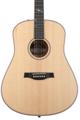
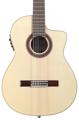
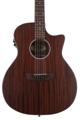
There is so much that contributes to the unique structure and sound of your acoustic guitar other than just its tonewoods. An often-underappreciated feature is the type of interior bracing it utilizes. Bracing contributes to not only how strongly reinforced your guitar’s top and sides are, but also affects the tone, sustain, and projection of the instrument, all of which are seriously important factors to consider when searching for the right guitar. From the basics to big brand visions, there’s a lot to unpack — brace yourself!
Purpose: Structure and Sound
The guitar is an instrument that begs to be played passionately, and without proper reinforcement, it’s easy to imagine how quickly a thin spruce top might bend, crack, and splinter apart from the regular pressures of palm weight and strum force. So, first and foremost, the main purpose of acoustic bracing is to ensure that the top wood of your instrument is structurally sound enough to withstand the rigors of constant play. Typically, this is broken down into a myriad of wooden braces and bars that intersect into something of a three-dimensional piece of abstract art. And with most of a bracing design’s intricacies being hidden inside the guitar, it can be easy to miss out on its aesthetic complexity!
Usually, bracing designs are broken down into two categories: main braces and lateral/other braces. The main pieces are most imperative to the strength of the guitar’s top. In the case of an X-braced guitar, for example, the large “X” that spans most of the guitar’s top area represents one of the main structural features of the braced design. Other main pieces include soundhole bracing, which encompasses the guitar’s opening where the top is most structurally vulnerable, as well as side bracing consisting of shorter vertical pieces that stretch from the back to the top of the guitar and are dispersed around the edges. The bracing on the inside of the back of the guitar is usually gridded and uncomplicated, providing more strength than song.
Smaller braces and bars that fall under the lateral/other category contribute to the enhancement of tonal elements as the guitar’s engineers see fit. These most frequently include tone bars and treble braces. Tone bars are much longer and located at the rear of the guitar, differing heavily depending on the bracing type. In the case of fan-braced guitars, these bars are quite plentiful and prominent, often extending to the rear of the instrument in a sunbeam (or fan) formation. This not only aids in bringing out the lower tonal resonance of the instrument, but also unearths and strengthens the sonic impact of the guitar’s top tonewood. Treble bars, on the other hand, are shorter and protrude from outside of the main bracing to the edge of the guitar, strengthening the points where the top meets the sides and enhancing higher frequencies.
It’s also important to remember that too much bracing can lead to tone muffling and a reduction of your instrument’s beautiful voice. However, not enough bracing increases the chance of potential reliability issues. So, depending on how hard you play, and what you play, knowing the benefits and components of each bracing type is essential!
The 3 Big Bracing Designs
While there are countless variations of bracing types on the market, there are three extremely relevant designs we will discuss. Whether specific to a few manufacturers and genres or the skeleton of a tried-and-true technique that numerous engineers continue to utilize and refine, these are the big bracing methods worth having a look at. Be sure to check out some of our favorite picks listed just below each category that are available right now at Sweetwater!
X-bracing
Originally developed by Martin in the mid-19th century, the X-bracing design has since become an easy go-to solution for many guitar manufacturers. But why have so many companies followed suit? Well, its pattern forms a fine structural support across a large portion of the guitar, intersecting just below the soundhole. The remaining triangular spaces allow enough room for customized tone and treble bar configurations, enabling sound-craft that excavates as much or as little desired tone needed for each model. An overwhelming majority of acoustic body styles sport this design, and it can be found in the lineups of manufacturers like Martin, Gibson, Fender, D’Angelico, and Seagull. For guitars that possess a greater intensity across the instrument, such as 12-string models, a “double-X” pattern is often employed to reduce the likelihood of top damage from bellying, or over-flexing.
Sonically speaking, X-braced guitars are certainly the most “genre-fluid,” for lack of a better term. While they aren’t an exact fit to account for all corners of the musical world, their common construction is ideal for folk, pop, country, jazz, and alternative guitarists of all calibers. X-bracing is a design that easily breaks price barriers as well, and you’ll find plenty of available options for smaller budgets. But because of its popularity, it’s difficult to nail down the exact sound of an X-braced guitar. Tonewoods will typically have a greater influence in that department. However, a general rule of thumb is that its tonal distribution is quite even, offering universally great sustain that has helped keep it the preferred bracing process of many luthiers for decades.
V-class Bracing
This patented concept was introduced in 2018 by Taylor and has since remained a main staple of the company’s unique sound. This method implements a thin V-patterned main brace design that essentially rests directly below the strings, clamping the soundhole and coming to a point at the rear of the guitar. It’s then flanked by uniquely medium-length tone bars on either side — the cherry on top for this revolutionary divergence from the traditional X-bracing process. The result of a design that allows the bracing to rest right below the strings is drastically improved sustain with exceptional high-register clarity and wonderful projection. This design prioritizes the flexibility of the top, providing better movement and thus more volume. These careful sonic improvements make Taylor guitars a recording and performing artist’s dream! If you want to know more of the nitty-gritty specifics, check out this exclusive interview we did with Andy Powers, the mastermind behind the V-class magic!
Fan Bracing
You’ll find that a lot of classical and nylon string guitars are and have been constructed using the design (or variation on the design) of Antonio Torres’s original fan bracing process for quite some time. As touched on earlier, the term “fan bracing” pertains to the series of long tone bars that extend from beneath the soundhole to the rear of the guitar in a fan-like display. Since nylon string guitars do not command as much tension as their steel string counterparts, the long tone bars are able to essentially double as structural supports, with only the additional aid of a few support struts. As you can imagine, this more expansive tonal technique warms up the sound of the instrument and enhances the low end, beautifully complementing a few specific playing styles. Because of this process’s genre exclusivity, classical and flamenco guitarists will appreciate our great selection of available fan-braced instruments from brands like Cordoba and Takamine!
Honorable Mentions
The list of additional bracing variants could go on a long time, with wide-eyed luthiers continuously developing new designs. Other bracing types such as ladder — an outdated and more straightforwardly structure-focused method common among archtops — and lattice — a checkerboard variant of fan-bracing — were more popular on historic guitar models and are slowly making a comeback thanks to a few boutique guitar manufacturers. Even so, these designs remain few and far between, keeping general construction limited to the three main processes mentioned above.
Custom Adjustments
With better understanding the bracing processes comes the need for familiarity with some frequently used terminology. These are terms you may have heard associated with bracing methods without knowing exactly what they are and what their purpose is. Let’s change that!
Scalloping
Scalloped bracing, as opposed to more traditional tapered bracing, integrates a series of concave parabolic cuts into the bracing wood. With less weight on each bracing piece, this technique allows for greater vibration of the guitar’s top to, in turn, improve the projection of the instrument, as well as add a bit of bass boost. The process of scalloping has been abandoned and picked up again many times over the years, as its technique tends to weaken the braces’ support of the top wood. However, when compared to tapered bracing, there is no denying its full-bodied sonic impact.
Forward- and Rear-shifting
As we get further into the fine-tuning stages of bracing design, it’s important to know the role that main brace placement has on any given guitar’s sound. These two varied placement types, forward-shifted and rear-shifted, are fairly straightforward but offer very unique sonic enhancements — both are commonly found in Martin guitars. Forward-shifting takes the placement of an intersecting main brace, like an X-brace, and moves it closer to the soundhole, resulting in a larger open area at the rear of the top that heightens the guitar’s bass tone. In the case of rear-shifting, the rear area of the top is reduced, creating more focus and better projection — a small change that can make a world of difference for gigging musicians!
Quartersawn
Structural integrity is imperative in every aspect of guitar making, and that includes the structural pieces themselves! Quartersawn bracing refers to the use of wood pieces for bracing that have been cut with their grain perpendicular, or nearly perpendicular, to their faces. This type of cut is the strongest and ensures maximum reliability and time-tested durability of your guitar’s bracing. Riftsawn and flatsawn pieces of that size are just asking to splinter and damage with consistent play and temperature change. If you’re torn between an instrument that mentions quartersawn bracing and one that doesn’t, it’s always better to be structurally safe than sorry!
How’s It Sinking In?
We hope you’ve gotten a better grasp on some of the larger ideas relating to acoustic guitar bracing — we know, it’s a lot of specifics! But knowing more about the internals of your instrument, and the effect that has on its sound, keeps you all the more in tune with how and what you play and also how your guitar will respond. Let one of our expert Sales Engineers help you nail down the guitar and bracing type that will work best for you by giving us a ring at (800) 222-4700. Keep on strummin’!