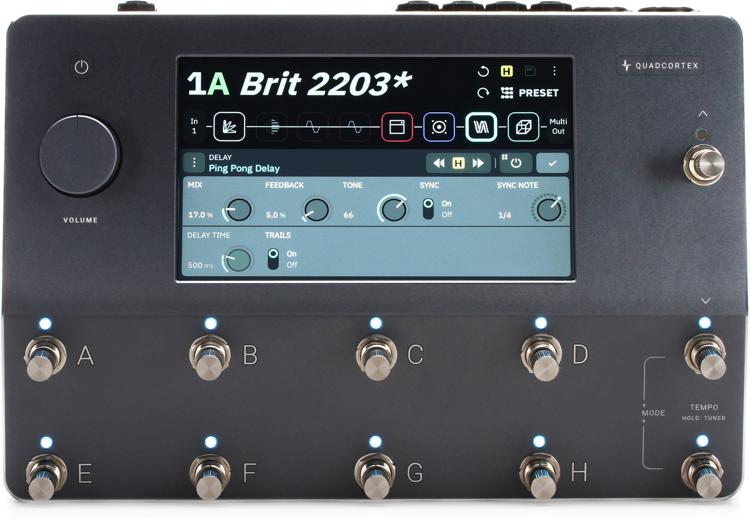
Guitar and bass players at Sweetwater got a sneak peek at the Neural DSP Quad Cortex — what some are calling the future of guitar modeling — when Neural DSP brought their new floor processor for us to demo. This unit has been on many players’ radar, including our own, since Winter NAMM 2020. Why? For starters, it was designed from the ground up by Neural DSP’s Doug Castro of Darkglass’s little plug-in company that could. Neural’s flagship software models have attracted diverse players from Cory Wong to Tosin Abasi. Factor in its powerful SHARC-based DSP, intuitive gig-centric layout, and machine learning–based capture technology for modeling real-world hardware amps, stomps, and cabs, and it’s no wonder why Neural is calling its Quad Cortex “the most powerful floor modeler on the planet.”
Is the hype deserved? Sweetwater takes a look at some key features of the Neural DSP Quad Cortex and why we think it could be paving the way for a new generation of modeling units.
Powered by Neural
The guitar players at Sweetwater will be the first to admit that tons of horsepower is meaningless if a unit isn’t fun to play. Fortunately, we can report that the Quad Cortex sounds and feels really, really good — and this coming from lots of Kemper and Helix lovers. Truly though, when you look at Neural’s track record, there’s little reason for skepticism. Their plug-in suites have been winning over high-profile producers like Adam “Nolly” Getgood to players like Plini and Rabea Massaad for the past three years. The Quad Cortex ships with all your bases covered for clean rhythms to verge-of-breakup blues to high-gain modern grind. The usual suspects from both sides of the pond are all here: Tweeds, Rectos, Plexis, JCMs, ACs, Ubers, and more. And a promise of more amps to come just makes the Quad all the more enticing.
Bass players, don’t worry: the Quad Cortex hasn’t left you out of the equation. In addition to some fabled tube heads and bourgie bass preamps, you get a selection of Darkglass preamp/distortion pedals to amp up the gain for modern styles of music.
Quad-Core SHARC DSP
The Quad Cortex is the first modeling unit of its kind to include 2GHz Quad-Core SHARC architecture. This much dedicated DSP unleashes some pretty astounding feats, including the ability to run four amp chains at once and serve two guitarists’ worth of tones simultaneously. This amount of processing power also comes into play for the Quad Cortex’s Neural Capture feature, touched on below.
Interactive 7″ touchscreen & rotary switches
Whether you’re the type of player who prefers to spin amp knobs or draw in EQ curves, the Quad Cortex accommodates. Its snappy full-color 7″ multi-touch screen responds to common smartphone gestures (swipe, touch, trace, etc.), which comes in handy for re-arranging Blocks in an amp path or cycling between operation modes. For other players, the Quad Cortex’s dual-function rotary switches, which both spin and stomp to save space, offer tactile control over all tone-shaping functions.
Road-tested durability
If you, like us, were concerned about the road worthiness of a unit this sophisticated, put your fears to rest. The Quad Cortex’s laser-engraved anodized aluminum chassis is rated to take the abuse of the road. Stomped on onstage or tossed in a gear bag, Neural assures us that this thing is up to the test. The display is shielded by 1.8mm of protective glass. And with its combined rotary knob-switches, you’re even less likely to damage this thing in the heat of a performance.
Neural Capture: biomimetic machine learning
One of the Quad Cortex’s most exciting features has to be its ability to digitize real-world hardware. Tube amps, speaker cabs, and stomp FX — every part of your very own stage and studio rig can be modeled down to the component level to be used in any other virtual signal path. This Neural Capture process is driven by a neural network algorithm that is trained to hear and reproduce sounds, similar to the way the human ear can. According to designer Castro, this makes it one of the most natural-sounding capture technologies ever created.
To confirm that it works as promised, Sweetwater’s Don Carr tried out Neural Capture for himself in the studio. Here’s his take:
One of the first things I did when I got the Quad was test the capture feature. I set up my Fender Princeton, which I know very well, and did a quick capture with the Quad. A/B-ing between the two was revealing. The character of the two was the same — the Quad capture sounded and felt like my Princeton!
I/O to go!
The Neural DSP Quad Cortex gives new meaning to routing versatility. In addition to its generous hardware ins and outs, you can actually configure and route ins/outs on a patch-by-patch basis. So let’s say you say run a four-cable amp setup on Friday nights and play acoustic music on Saturday evenings. The Quad Cortex keeps all your routing preferences locked into your presets, which means one less thing to worry about when it’s time to set up and play.
Wireless backups and tone imports
Most modeling units are tethered to computers in some way, whether it’s backing up presets or exploring new sounds. But not the Quad Cortex. Onboard Wi-Fi and mobile app connectivity connects you to a cloud of fresh new tones, user backups, and firmware updates, all without having to reach for a laptop.
Conclusion
Is the Neural DSP Quad Cortex the most powerful floor modeler on the planet? By all accounts, it very well could be. Whether or not it’s right for your needs is a conversation you can have with your Sweetwater Sales Engineer. Give us a call at (800) 222-4700 to learn more about this “one small step” for guitar and bass processors.