

The next generation of Taylor tone has arrived. Sporting revamped Claria System electronics, scalloped V-Class bracing, and the revolutionary Action Control Neck joint, Taylor’s Next Generation guitars mark the biggest milestone in the company’s history since Andy Powers unveiled V-Class bracing back in 2018. Naturally, the first thing I did when a Taylor Next Generation 314ce arrived at my desk was to take a short trip over to the Sweetwater Music Store, pull a standard Taylor V-Class 314ce off the wall, and compare the two to answer a simple question: what distinguishes the Next Generation series from a player’s perspective?
Shop All Taylor Next Generation GuitarsScalloped V-Class Bracing: Taylor Innovation Meets Tonal Tradition
As a musician who generally favors traditional guitar designs, the Next Generation 314ce won me over from the first open E chord. Compared to the standard 314ce, this fresh, new model delivered everything my admittedly more rustic tonal taste requires. Deep bass? Check. A warm voice? Check. Rich overtones? Check.
I was also pleased to discover that scalloped V-Class bracing retains my favorite qualities of standard V-Class bracing. As a longtime fingerpicker and an amateur chord-melody enthusiast, I’ve always enjoyed how V-Class bracing keeps complex chords and intricate fingerpicking patterns clearly defined all the way up the neck. Despite the deeper bass of scalloped V-Class bracing, it goes toe to toe with its forebear in this regard.
Later, I was fortunate to speak with Andy Powers directly about the development of scalloped V-Class bracing, and he made it clear that scalloped V-Class is not meant to supplant standard V-Class bracing — it’s simply another tonal flavor in the Taylor repertoire. As such, I wouldn’t be surprised if players who live in the world of melodic fingerstyle or other modern musical environments still favor the focus and clarity of standard V-Class bracing. Conversely, V-Class-curious players like me who require just a bit more bass when strumming open chords will embrace scalloped V-Class bracing.

Road-proven Claria System Electronics
To my ears, electronics in an acoustic guitar are always a compromise of sorts. The closer you get to a microphone-like performance, the more issues you’ll encounter. Even systems such as Taylor’s time-proven ES2 that clock in closer to the microphone side of the spectrum require more finessing than a simple under-saddle system. However, the trade-off is that microphone and multi-sensor setups better capture your guitar’s inherent acoustic character.

All that to say that I wasn’t quite sure what to expect when I plugged in the Next Generation 314ce. I went in blind, knowing little more about the Claria System than its name, the fact that it’s an under-saddle transducer (UST), and that Taylor received rave reviews when testing it with artists on the road. My first impression after switching between the ES2-equipped Taylor and the Next Generation 314ce was that the latter sounded ready to go right out of the gate — the signal was significantly stronger and more direct with minimal knob twiddling required.
I also appreciated the relocated soundhole controls, comprising a simplified arrangement of Volume, Tone, and Mid-Contour. I’m very much a “plug in and play” type of guitarist, and the Claria System was clearly optimized with that philosophy in mind. And for those who prefer to explore multiple sounds onstage, the new Mid-Contour control is perfect for quickly switching between clean, scooped rhythm tones and midrange-heavy leads.
It’s also key to mention that Taylor’s Claria System represents an alternative, not a replacement. ES2 will still stand ready for guitarists who prefer its more microphone-like performance. On the other hand, Claria is perfect for the musician seeking a reliable, efficient, and superb-sounding UST that performs without a fuss.

The Revolutionary Action Control Neck Joint
I’ve always admired Taylor’s dedication to furthering the art of guitar design. True innovation is a rare sight, indeed, in the often history-facing world of guitars, and it’s clear that both Bob Taylor and Andy Powers view the acoustic guitar in terms of what it can be rather than what it has been in the past.
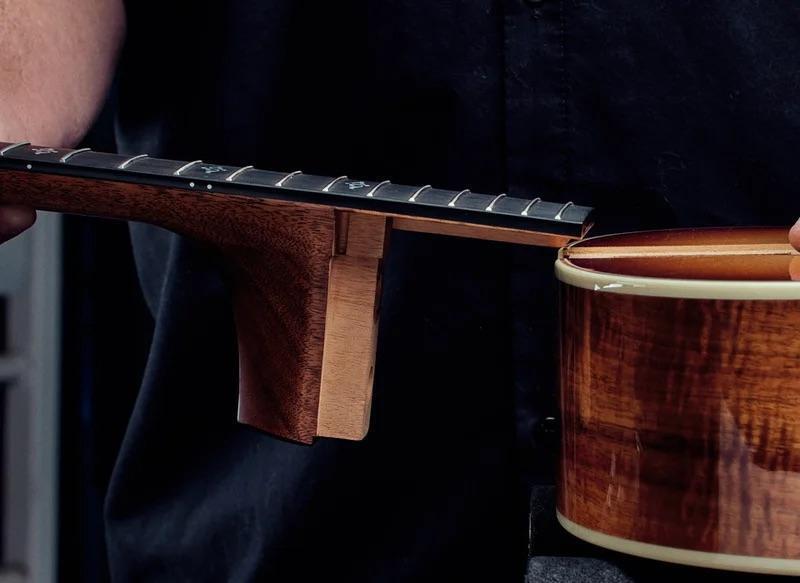
Nowhere is that philosophy more evident than in the Next Generation series’ Action Control Neck joint — a marvel of six-string engineering that allows you to adjust the angle of the guitar’s neck with simple hand tools. Taylor’s previous bolt-on neck joint required precisely crafted custom shims from Taylor to accomplish this task; and you’re not going to change the neck angle on any old-school, glued-in dovetail without forking over a hefty sum to your local luthier.
Why would you want to change the angle of a guitar’s neck, anyway? Simply put, adjusting the neck angle allows you to precisely set the action of the strings without sanding or shimming the saddle. Furthermore, if your guitar needs its neck angle adjusted for structural reasons, then the Action Control Neck transforms what was once a complex procedure into a routine adjustment.
Finally, while I was unable to directly compare an NT-neck Taylor to an identical model (bracing and all) with the Action Control Neck to test tonal differences, I was able to speak with someone who had: Andy Powers. As a tech and tinkerer, my adoration of the Action Control Neck joint was originally inspired purely by its utility. However, Andy was quick to lay down the law on how the Action Control Neck’s long-tenon construction and superior wood-to-wood contact (comparable to a traditional dovetail) supply a deeper low-end resonance and a fuller body to notes across the fingerboard.
Which Taylor Will You Choose?
For a player who favors straightforward electronics and a bit of rumble in the low register, the Next Generation series is the clear winner. For those who champion balance and clarity above all else, standard V-Class still reigns supreme. Neither option is better, and the Next Generation series is by no means replacing the standard Taylor lineup — it’s just another tonal option for you to explore. Need help choosing the perfect Taylor for your musical needs? Reach out to your Sweetwater Sales Engineer at (800) 222-4700 for personalized gear advice on everything six-string!