

Most world-domination stories involve evil James Bond villains or aliens who want to destroy humanity. But then there’s MIDI.
Spawned in a spirit of global cooperation by otherwise fiercely competitive companies, MIDI (Musical Instrument Digital Interface) has become a dominant, positive force in every aspect of music. It’s been around so long that most people making music today have never known a world without MIDI. It’s easy to take MIDI for granted . . . but that’s about to change.
The Power of MIDI
By creating a language that translated musical characteristics and gestures into computer code, MIDI became the connective tissue between computers and music. That DAW you use for making music? MIDI makes it possible. Concerts where sounds and lighting change seamlessly? MIDI. The fountains at Las Vegas’s Bellagio Hotel & Casino that dance to the music? MIDI. DJs using grooveboxes and virtual turntable controllers? MIDI. Broadway shows where cues happen with split-second precision? MIDI. The pyrotechnics display at a heavy-metal band’s concert? MIDI. It’s in keyboards, smartphones, electric drums, computers, and more. From art installations to stadiums packed with adoring fans, MIDI plays a pivotal role.
Think about it — virtually none of the standards used by computers in 1983 are still around. Even FireWire and USB didn’t appear until more than a decade later. Yet MIDI has persisted for several reasons:
- MIDI is free for all to use and inexpensive to implement. The Windows, Apple, and Android operating systems inherently support MIDI, so it’s easy for software developers to implement applications. And macOS became MIDI 2.0–ready with macOS 11 so that developers could get a head start on developing Mac applications. MIDI’s efficiency even accommodates DIY-oriented systems like Pico and Raspberry Pi. Smaller hardware developers can easily and inexpensively begin innovating with MIDI.
- MIDI has always been a universal initiative. There was never a format war like with VHS versus Beta. The music industry knew a protocol to link music and computers had to be universal, or it would fail.
- From its inception, MIDI made music more affordable. Before MIDI, keyboard players needed banks of expensive keyboard synthesizers onstage. MIDI allowed using a single keyboard to control multiple smaller, keyboardless tone generators and sound modules. Today, you can stuff a keyboard rig of the gods into a laptop using virtual instruments and still drive them with a MIDI keyboard from 1983. MIDI also accelerated computer-based recording, so musicians could enjoy the workflow of multitrack tape-based studios at a fraction of the cost.
- The standard evolved with technology. The MIDI Association, a global nonprofit organization, has helped keep the spec current. MIDI’s underlying computer language is so elegant that it has been adapted to video games, lighting, tape machines, soft synths, and more.
- Backward compatibility. Buying cutting-edge consumer electronics is a gamble. Differing connectors, protocols, and companies that create self-serving proprietary “standards” mean that today’s cool toy could be tomorrow’s doorstop. Yet MIDI gear bought today can talk to MIDI gear from 40 years ago.
Well, What’s Next?
Modern computers are light years ahead of 1983’s machines. So, the MIDI Association had the daunting task of creating a MIDI 2.0 standard that could take advantage of today’s and tomorrow’s technology yet remain backward compatible. We’ve all learned that claims of “This product will never become obsolete!” are often wishes, not promises. But once again, a cooperative music industry devised an elegant solution: turn MIDI communications from a monolog into a dialogue so that MIDI devices could exchange information. This provided multiple advantages, and one is true backward compatibility.
Remember, MIDI is primarily a computer language that expresses musical concepts like notes, dynamics, timbre, and the like as code. MIDI 2.0 adds to the language’s vocabulary. A MIDI 2.0 device can start a dialogue with another MIDI device and ask if it speaks MIDI 2.0. If it can, then they communicate with their expanded vocabulary. If not, then the MIDI 2.0 device communicates using MIDI 1.0’s vocabulary. Devices can even exchange information over the original MIDI 1.0 5-pin DIN connectors if both the MIDI in and out are connected.

MPE
The MPE (MIDI Polyphonic Expression) spec, ratified in 2018, gave the first taste of MIDI 2.0’s power by adding expressive capabilities beyond polyphonic aftertouch for individual notes. Improved sensor technology lets you press on keys or pads to open a filter on some notes but not on others, wiggle your finger on the surface to create vibrato, move from side to side to initiate other controllers, slide to bend pitch, and more. MIDI 2.0 takes MPE further with per-note controllers, which provide independent parameter control for individual notes. What’s more, MIDI 2.0 delivers higher resolution, so controls have a smooth, “analog” feel.
The Expressive E Osmose 49-key polyphonic synthesizer and MIDI controller is one of the new generations of MPE-enabled keyboards that dramatically enhance musical expressiveness.
One of MIDI 1.0’s challenges was the potentially steep learning curve involved in configuring a system. So, much effort has gone into making MIDI 2.0 devices more self-configuring. For example, Profiles can dynamically configure a device for a particular application. If a control surface queries a device with a “mixer” Profile, then the controls will map to faders, pan pots, and other mixer parameters. But with a “drawbar organ” Profile, that same control surface can map its controls automatically to virtual drawbars. MIDI 2.0 devices can even ask detailed questions, like “What’s the cutoff frequency of Oscillator Number 2 on Channel 10?”
To accommodate future devices — such as 3D controllers and virtual or augmented reality — the new spec dramatically expands the number of available channels and controllers. As to MIDI 2.0’s current status, after the painstaking collaborative work of defining the spec, the MIDI Association has ratified MIDI 2.0’s core elements. With the path cleared for development, manufacturers are currently designing MIDI 2.0 devices that conform to the spec.
MIDI appeared the same year as Star Wars: Episode VI — Return of the Jedi, so let’s end with words of wisdom from Lando Calrissian: “We had each other. That’s how we won.” MIDI remaining relevant for 40 years is an astonishing achievement. Still, it shows what happens when an industry unites in a shared vision that puts competition on hold, prioritizes the needs of musicians and artists, and brilliantly manages the balancing act of anticipating the future while retaining compatibility with the past.
MIDI 1.0 has served us well and will continue to do so. But with MIDI 2.0’s expanded capabilities, MIDI’s best days lie ahead.
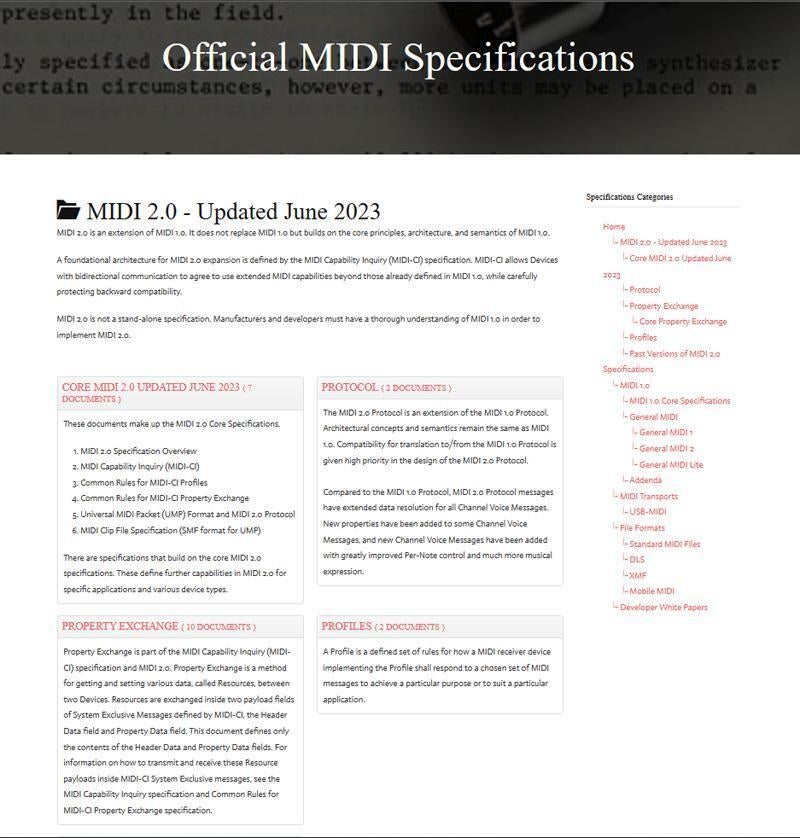
To learn more about MIDI, read articles about novel applications, or download the latest MIDI 2.0 documents, please visit https://midi.org and sign up for free as an individual MIDI Association member.