
This video lesson is all about the art of performing trills on guitar — an extremely important and oft-used technique in not only soloing but sometimes riff writing, too. Want proof of the latter statement? Look no further than the classic intro riff to “Black Sabbath” by — wait for it — Black Sabbath or the delightful darkness that opens Slayer’s ominous opus “South of Heaven.” In fact, said Slayer riff opens this video lesson.
DISCLAIMER: This lesson is not intended for advanced or intermediate players. It is aimed at future guitar heroes of all ages who’ve just started out on their playing journeys.
As the opening riff on the accompanying video illustrates, a trill is basically a rapid-fire burst of hammer-ons and pull-offs between two notes on the same string. When used wisely, a trill or two can definitely add excitement and momentum to a solo or riff. Plus, as a further bonus, they’re pretty easy to do!
According to the various dictionaries found on “the Googles” (© Henry Rollins), a trill in music is the following:
“A musical ornament consisting of a rapid alternation between two adjacent notes, usually a semitone* or tone* apart.”
*Note: The easiest way to think of a semitone on the guitar is as two notes on the same string that are a mere fret apart. Likewise, a tone is two frets apart on the same string. Make sense?
Some trill definitions get even more specific and will sometimes mention at least one of the following points:
- The two notes in the trill are usually next-door neighbors in the scale being used.
- Trills start on the lowest of the two notes being used in the trill.
To be honest though (as opposed to lying!), many of my favorite rock trills debunk the above “rules.” As you’ll learn in the video:
- Some great rock-guitar trills start on the highest note being used in the trill.
- The two notes used in some truly classic rock trills are carried out between two notes that are further apart than a mere semitone or two — a lot further!
As was the case in the pull-off lesson, your fretboard digits should try to adhere to the following rules when trilling:
- Keep your trilling finger (the one doing the hammer-ons and pull-offs) curved so you’re using its tip.
- Try to mute as many of the higher strings as you can with the underside of the finger you’re pulling-off to.
- Make sure you’re not inadvertently pulling down the string you’re trilling on, thus making it sound sharp and out of tune . . . unless, of course, that’s the effect you’re going for!
Finally, before we learn the first seven licks in the video, let’s take a quick look at how trills are notated in tab.
Trill Notation in Tab
Not surprisingly, the presence of a trill is indicated above the relevant section of tab with a “tr” followed by a wavy line that runs for the length of said trill. An example of this is below in figure 1.
Figure 1
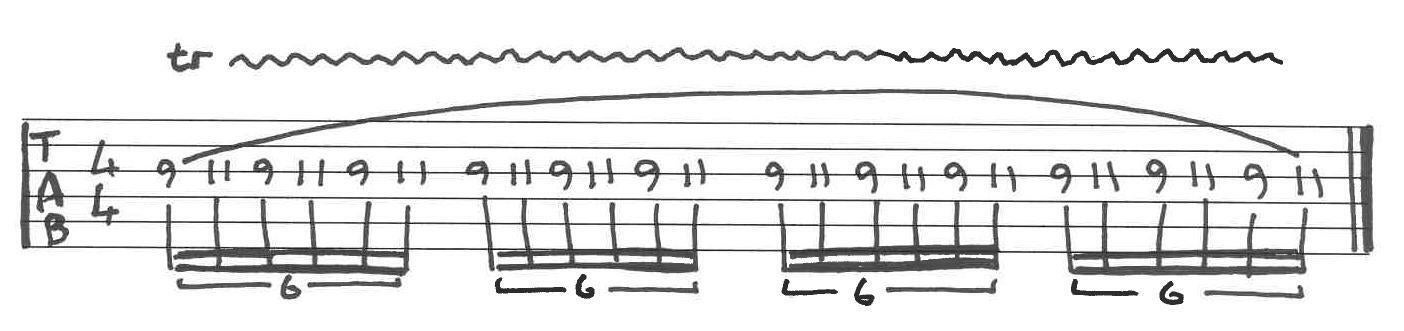
We can think of figure 1 as the longhand form of a trill, where each and every note in the trill appears in the tab. Oftentimes though, a trill is abbreviated as shown in figure 2.
Figure 2
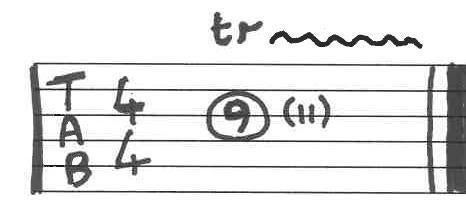
As you can see in figure 2, the “shorthand” version of a trill is merely indicated by the first note of the trill (in this case, the E note at the 9th fret on the G string), and then the trilled note (the F# at the 11th fret on the same string) is next to it in parentheses and in a slightly smaller font size. Simple to read plus nice and neat . . .
This explained, on with the show. Here’s tab for the first batch of trill licks in the video:
Lick 1
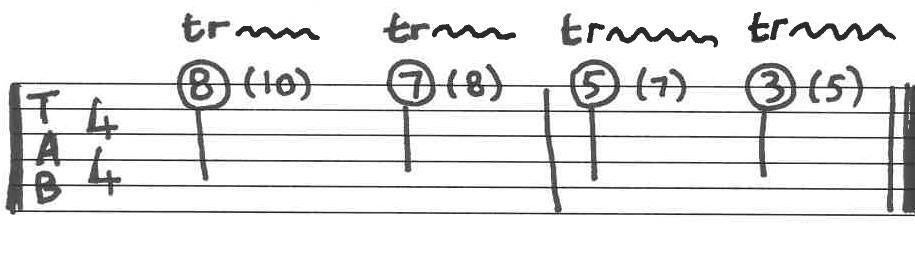
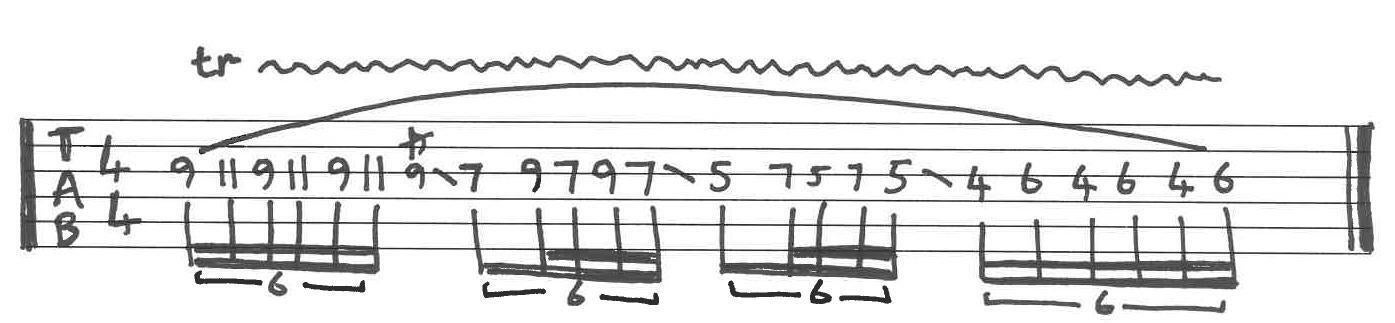
This A-minor descent of consecutive trills on the high E string is a great way of seamlessly moving down the neck. Dave Murray of Iron Maiden is a master of rapid-fire ascending and descending trill passages. Lick 2 is similar to the short but incredibly effective descending trill run the late Edward Van Halen does down the G string just before his game-changing two-handed-tapping finale in “Eruption.”
Lick 2
Lick 3

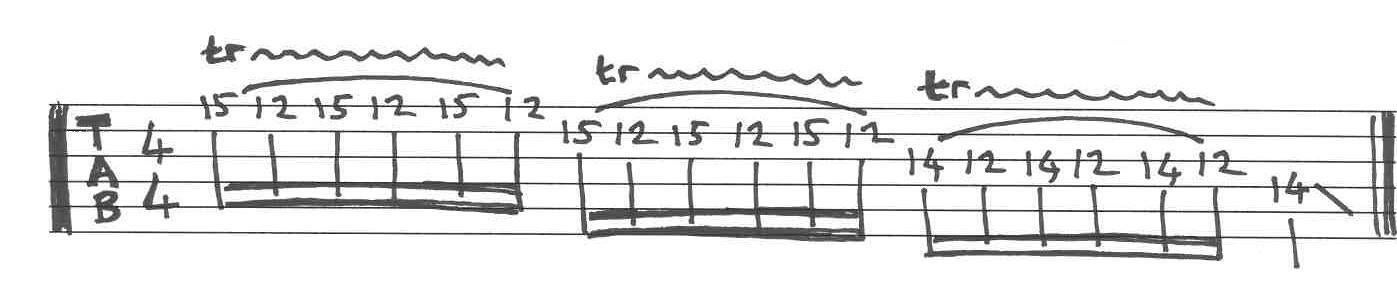
The dramatic E-minor salvo in Lick 3 was inspired by a brilliant burst of classical-tinged trilling Gary Moore did in his breathtaking “End of the World” opus.
Lick 4

Lick 5
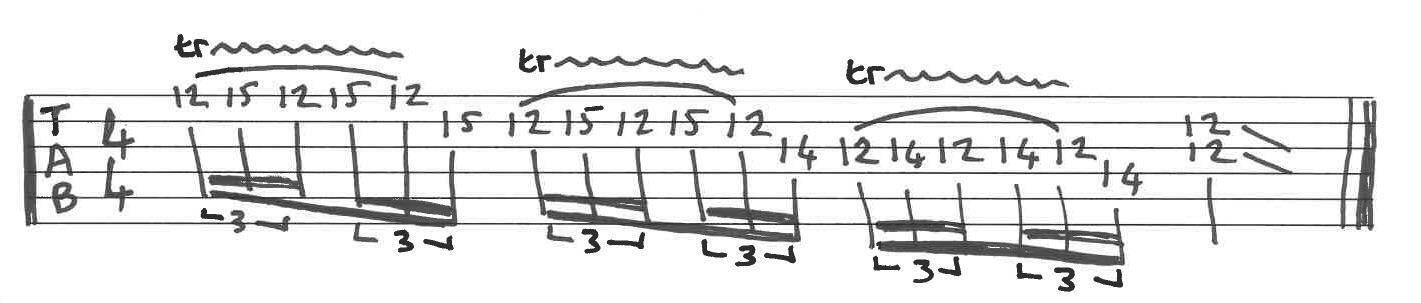
Lick 6 is one the “Godfather of Heavy Metal” Tony Iommi showed me when I had the honor of working with him on his popular monthly column in Guitar World magazine. This E-minor pentatonic burst is a great example of trills that start on the highest note — not the lowest.
Lick 6
Lick 7
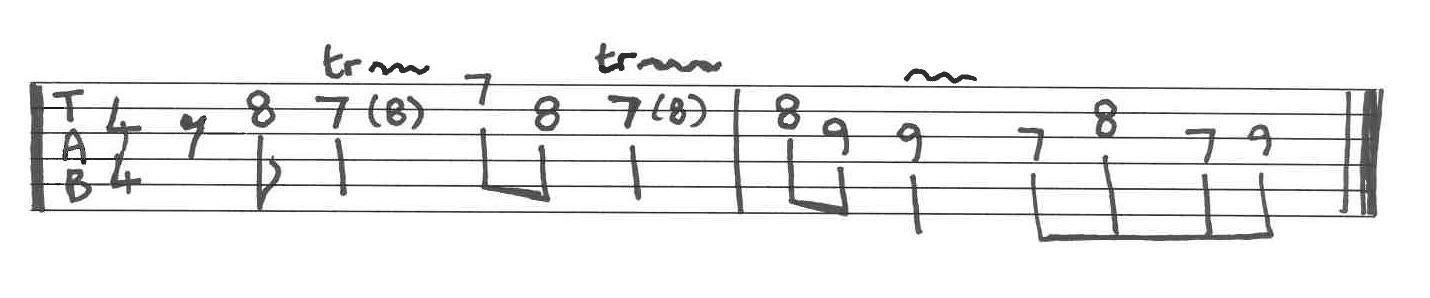
While some trills can be pretty long, sometimes lasting for a bar or more, an effective trill can also be short, too — really short. The two trills in Lick 8 are good examples of short yet sweet ones. This C-minor ditty was inspired by a descending section in Brian May’s incredible “Bohemian Rhapsody” solo.
Lick 8
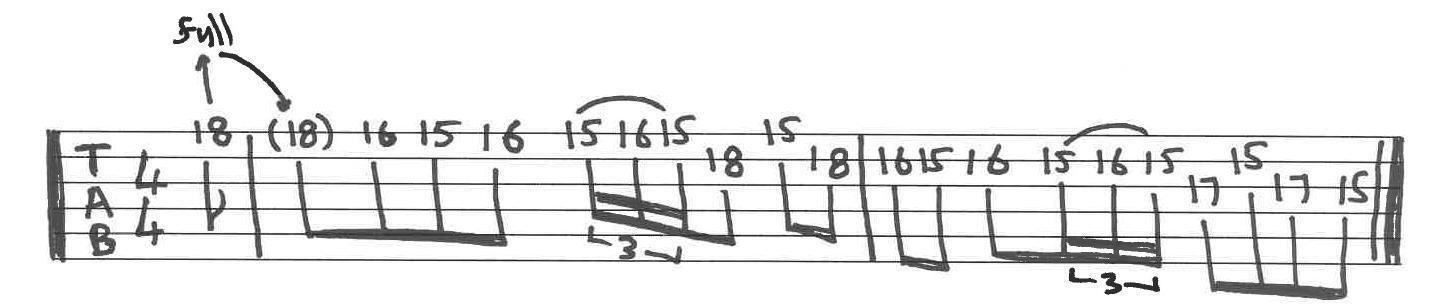
Lick 8 is another example of “little trills” put to great use. This E-minor pentatonic flurry was another one Tony Iommi showed me when we were working on his Guitar World column. He
described it as having “a stuttering, stop/start sound to it” and stated that it’s something he “does quite often.”
As mentioned in the video, if you delve into the wonderful rabbit hole that is music theory, then you might well find people referring to little trills like these as “mordents” and “inverted mordents” or as “upper mordents” and “lower mordents.” Just so you know! As “mordent” sounds like the name of a Scandinavian death metal band, I’m gonna stick with calling them “little trills.”
Trilling Trivia: Brian May once referred to the “little trills” (mordents) he does in his “Bohemian Rhapsody” solo as “twiddles”! Works for me . . .
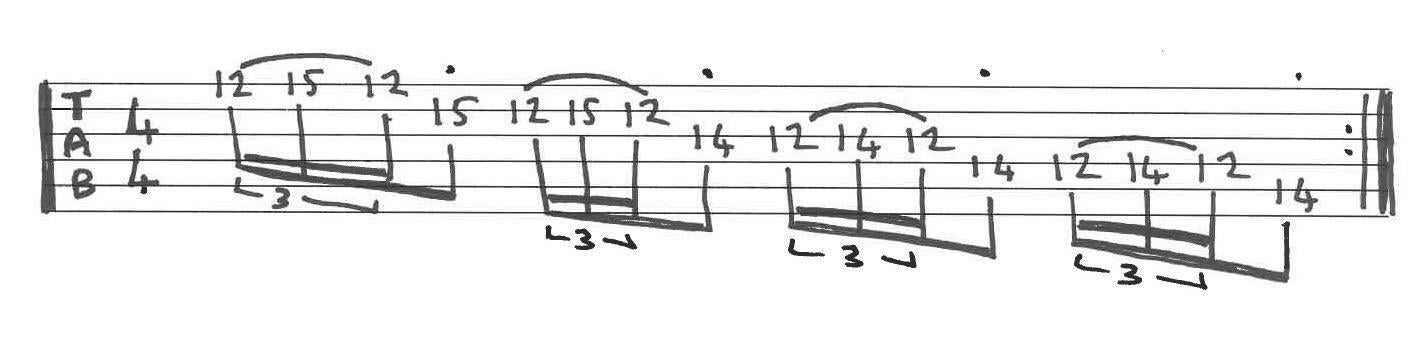
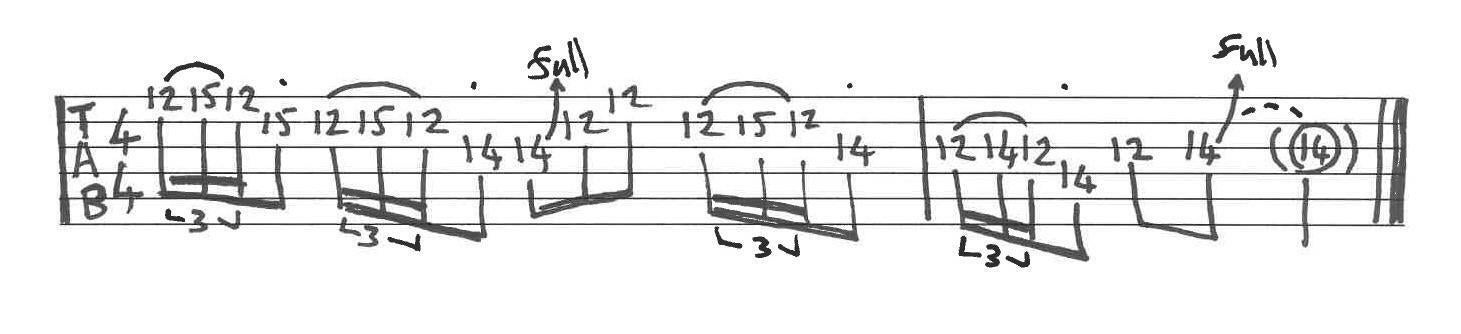
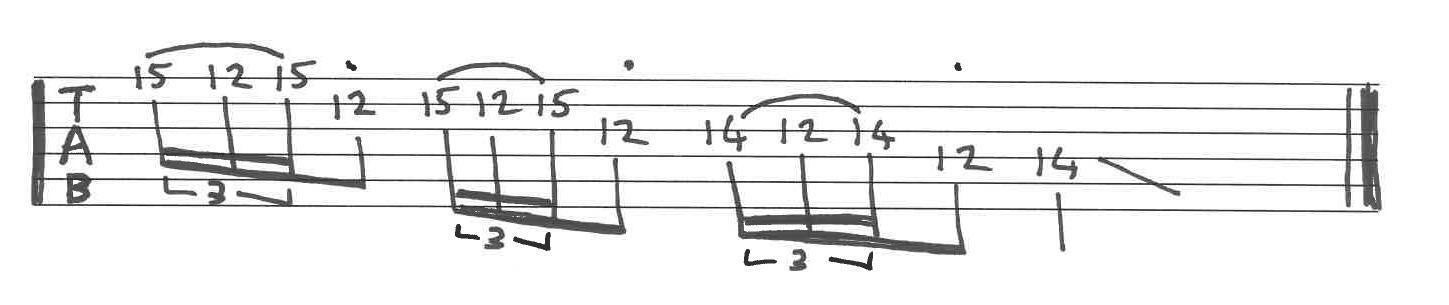
To close, here are tabs for the final three licks in the video.
Lick 9
Lick 10
Lick 11
I hope this lesson has served as a useful introduction to the wonderful world of trills — be they long, short, fast, or slow. Enjoy!