¡Obtenga asesoría en español!  Llámenos hoy a (800) 222-4701
(800) 222-4700 Talk to an expert!
Loading Cart
Your Cart Is Empty

See what's new at Sweetwater.

My Cart this.cartQty
Recording Guitar Bass Keyboard Drums Live Sound DJ Band & Orchestra Content Creators Worship

Everything You Need to Know About Bass Guitar Strings

Everything You Need to Know About Bass Guitar Strings

There are a number of reasons you might buy a specific bass: you may fall in love with the shape of the instrument, your favorite bassist may play that model, or you may simply think that the color matches your favorite stage wear. But there are really only a couple of reasons you would want to keep — and play — a bass: the way it feels and the way it sounds. A large part of the feel and the sound of an instrument comes from the strings you choose to put on it.

Almost all electric bass strings have an inner core made of steel wire covered by one or more outer wraps. (There are exceptions, such as the rubbery strings used on Kala U-Basses.) While we sell all sorts of bass strings at Sweetwater, they generally fall into one of four major categories: roundwound, flatwound, half round, and tapewound.

Roundwound Strings

Roundwound bass strings are the strings that most of us know and use. Almost every new bass comes from the factory with roundwound strings, and, with a few exceptions, they’re the least-expensive bass strings. The outer wraps of roundwound strings are, as the name implies, made of round wire. You can feel the ridges of the individual wraps under your fingers as you slide your hand up and down the neck. Roundwounds tend to have a brighter sound with more harmonic overtones and longer sustain than flatwound strings.

DAddario-NYXL45130SL-Regular-Light-5-string-Super-Long-Scale-Nickel-Wound-Bass-Strings-.045-.130
D’Addario NYXL45130SL Regular Light 5-string Super Long Scale Nickel Wound Bass Strings – .045-.130
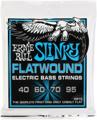
Ernie-Ball-2815-Extra-Slinky-Flatwound-Electric-Bass-Strings-.040-.095Ernie-Ball-2815-Extra-Slinky-Flatwound-Electric-Bass-Strings-.040-.095
Ernie Ball 2815 Extra Slinky Flatwound Electric Bass Strings – .040-.095

Flatwound Strings

Flatwound strings are made using a flat ribbon of steel wrapped around the inner core of each string rather than round wire. This makes the strings smoother, stiffer, and darker sounding than roundwound strings. They’ll typically also have less sustain, which is largely a result of the stiffness of the strings.

Half Round Strings

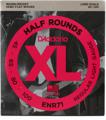
Half rounds are an interesting hybrid; they’re made as roundwound strings and then precision ground, so, while not quite a smooth surface (like flatwound strings), they’re smoother than roundwounds. Half rounds have most of the tone and tension characteristics of roundwound strings, including longer sustain and more harmonic information than flatwound strings, while having a smoother feel that’s closer to a flatwound set.

DAddario-ENR71-Regular-Light-Semi-Flat-Wound-Long-Scale-Bass-Strings-.045-.100
D’Addario ENR71 Regular Light Semi-Flat Wound Long Scale Bass Strings – .045-.100
Rotosound-RS88LD-Tru-Bass-88-Black-Nylon-Tapewound-Long-Scale-Bass-Strings
Rotosound RS88LD Tru Bass 88 Black Nylon Tapewound Long Scale Bass Strings

Tapewound Strings

Tapewound strings are made in much the same way as flatwound strings, but they are made with a length of nylon tape wrapped around the outer wrap rather than a ribbon of steel wrapped around the inner core. Folks who prefer tapewound strings often say that they’re the closest electric bass strings to the sound and feel of an upright bass.

Gauges

Beyond the construction of the outer core, the thickness of the strings will make a great difference in the feel. Once you’ve found a string with a texture that feels right to you, it’s worth spending time experimenting with the different string gauges available in the style you prefer. Depending on the brand, G strings can range in size from about 0.040 inch (on a light-gauge set) to 0.065 inch (for a tapewound G), and E strings can run from about 0.095 inch all the way up to 0.115 inch.

Materials

The material used to make the strings will make a difference, as well. Strings can be made of steel, stainless steel, nickel-plated steel, an iron/cobalt blend, or any number of proprietary super alloys. For that matter, even the inner core can be a round wire or a hexagonal wire — everything matters.

Personal Preference

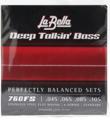
In the final analysis, none of the details matter. The important thing is that you like the way the strings on your bass sound and the way they feel under your fingers. I play a number of different basses regularly, and I tend to experiment with one bass at a time. For example, for the last few years, I’ve been using D’Addario EXL160 strings on my Fender Precision Bass. When I purchased a Fender Jazz Bass some months ago, I put the same EXL160 strings on it. But I found that I play the Jazz differently than I do the Precision, and, after trying a few different brands (including Rotosound, Ernie Ball, and DR), what works best for me on the Jazz is a slightly lighter-gauge set of D’Addarios — the EXL170. I keep a second Precision Bass strung with flatwound strings, and the La Bella Deep Talkin’ Bass set sounds great on that bass.

La-Bella-760FS-Deep-Talkin-Bass-Flatwound-Bass-Strings-Standard
La Bella 760FS Deep Talkin’ Bass Flatwound Bass Strings – Standard
Roundwound_StringArtwork_ver.01_light
Fodera 45125 Nickel Roundwound 5-string Bass Strings – .045-.125 Medium

For my Ernie Ball Music Man StingRay 5-string, D’Addario’s NYXL45130 set works great. And there’s another 5-string bass back here in the studio — a Fodera Emperor— strung with Fodera’s own light-gauge strings, the 45125 Nickel.

I’ve gone through the experimentation process with all of my instruments, and I expect to continue doing so in the future. Why? Because while I’m pretty happy with the sound of all of these instruments, I’m sure that I could be even happier.

In this article

Shop Sweetwater

About Dave Martin

A veteran of the recording world and an experienced touring musician, Dave is a producer, engineer, and session bassist. He has recorded symphony orchestras and country-music legends and has performed with rock and roll icons and western swing bands. As a producer/engineer, Dave worked with artists ranging from the Old Crow Medicine Show, the Downing Family and the Fisk Jubilee Singers to Porter Wagoner, Nokie Edwards, and Lulu Roman during the 20 years he owned Nashville’s Java Jive Studio and has played bass (either live or in the studio) with artists as diverse as Addison Agen, Robben Ford, Lynn Anderson, Russ Taff, Jack Greene, Adrian Belew, Cheap Trick’s Rick Nielsen, Felix Cavaliere’s Rascals, and Eric Johnson.
Read more articles by Dave »

Offer applies only to single-receipt qualifying purchases. Select manufacturers may require that only the manufacturer’s products qualify towards the minimum purchase amount needed to be eligible for promotional financing. Otherwise, an invoice that meets the minimum purchase amount and contains at least one qualifying manufacturer product is eligible for promotional financing. No interest will be charged on promo purchase balance, and equal monthly payments are required on promo purchase until it is paid in full. The payments equal the amount financed divided by the number of months in the promo period, rounded up to the next whole dollar. These payments may be higher than the payments that would be required if this purchase was a non-promo purchase. During the last month(s) of the promo period the required monthly payment may be reduced due to the prior months’ rounding. Regular account terms apply to non-promo purchases. New Accounts as of 07/31/2025: Purchase APR is 34.99%. Penalty APR is 39.99%. Min Interest Charge is $2. Existing cardholders: See your credit card agreement terms. Subject to credit approval.

Offer applies only to single-receipt qualifying purchases. No interest will be charged on the promo balance if you pay it off, in full, within the promo period. If you do not, interest will be charged on the promo balance from the purchase date. The required minimum monthly payments may or may not pay off the promo balance before the end of the promo period, depending on purchase amount, promo length and payment allocation. Regular account terms apply to non-promo purchases and, after promo period ends, to the promo balance. New Accounts as of 07/31/2025: Purchase APR is 34.99%. Penalty APR is 39.99%. Min Interest Charge is $2. Existing cardholders: See your credit card agreement terms. Subject to credit approval.

The estimated required monthly payment shown which excludes taxes and delivery equals the amount financed divided by the number of months in the promo period, rounded up to the next cent. During the last month(s) of the promo period the required monthly payment may be reduced due to this rounding. These payments apply only with the financing offer shown. If you make these payments by the due date each month, you should pay off this amount financed within the promo period, if it is the only balance you are paying off. If you have other balances on your account, this payment will be added to any other minimum monthly payments.

Applies only to select items from this manufacturer. Ask your Sweetwater Sales Engineer for more details.