

You’re about to hit the stage, and suddenly you start to feel yourself shaking. There’s a knot in your stomach and a lump in your throat. Even with the applause, your self-doubt is more deafening than the crowd.
As you reach for the mic, plug in your guitar, or take your seat behind the drums, the sweat starts to bead on your forehead and an inner voice whispers, “You’re not good enough. You’re going to fail. You’re going to blow the guitar solo. You’ll never hit that high note…”
Sound familiar?
Welcome to the world of stage fright; everybody has it to some degree, and those who say otherwise are lying to themselves.
Stage fright is bad, right? Nobody wants to perform when their nerves are shot, right? Truth is, the nervous energy created from stage fright can be the best thing to happen to a performer once they understand it.
Stage fright is nothing more than a reflection of your passion. When you’re passionate about music, you’ll overanalyze every nuance of your performance. You’ll worry that you won’t be “in the zone” when the time comes.
That’s okay; we’re human. We want to be accepted by the fans for the hard work we’ve put into our craft. Music comes from our soul, and we want others to hear and feel our same passion.
Wanting to perform your best and to be acknowledged by fans ultimately leads to stage fright. It’s similar to the fight-or-flight response; it’s a jolt to the system before we hit the stage. More importantly, it’s our source of “performance fuel!”
There are two choices you can make when stage fright kicks in. You can allow it to overwhelm you, leaving you nauseous, tight-throated, forgetting words and chords of the song — even missing the high notes.
OR
You can turn that nervous energy into performance fuel to energize your performance for the best show of your life!
So, you see, nervous energy and performance fuel are one and the same. It is how we perceive the effects of stage fright that determines the outcome. Good or bad, it’s up to you to decide how stage fright will affect your performance!
Many artists say that they’ve never experienced stage fright. Yet, you might catch them beside the stage bouncing up and down or staring out into the crowd, their eyes in a hypnotic trance. These are signs of nervous energy, but the artist is instinctively choosing to use their nervous energy to charge their performance.
So, how do self-proclaimed “non-nervous” performers overcome stage fright?
I just told you — perception.
When stage fright kicks in and you notice your energy spiking, will you choose to perceive those butterflies in your stomach as ill feelings of self-doubt or to shake off those negative thoughts and use that energy to boost your confidence?
It truly is a choice that can be controlled like flipping a switch. You either (a) worry about your performance or (b) believe in yourself!
There’s a little more to it than changing your perception. I know it can be tough to think positively when your stomach is turning flips. I’ve been there; I get nervous every time I perform on television or give a vocal workshop. To turn my nervous energy into performance fuel, I use a three-step process from my book, Raise Your Voice, to flip my stage-fright switch to a positive performance. The three steps are Breathe, Visualize, and Vocalize.
Step One: Breathe
Generally, when you start to feel nervous, your breathing will speed up. You have to slow your breathing to control stage fright. If you notice you’re breathing fast, then begin inhaling for a count of four, holding for a count of four, and exhaling on a hiss for a count of eight. Repeat a minimum of four times, or until your breathing has slowed.
Step Two: Visualize
Next, visualize the performance from beginning to end as if you are watching yourself at hyperspeed. Take in an entire hour set in seconds, playing it out perfectly. Visualize the crowd going crazy; hear yourself performing and nailing every note; see yourself ending the night walking off the stage as the crowd begs for more, your fans coming up to you afterward telling you how amazing you sounded.
When I visualize my crowd, I always repeat to myself, “I’m a rock star; I’m a rock star,” as I see the beginning and end of the performance… and I’ve yet to fully botch a performance.
Step Three: Vocalize
This third step is mainly for singers. Even if you’re warmed up, it helps to keep the blood flowing to your vocal cords. You can do this with a random vocal slide on lip bubbles, while humming, or with a Vox trainer from doctorvox.us. You don’t need to go crazy with volume and range; that is not the goal. The goal is to keep the vocal cords vibrating a few minutes before showtime so that your voice doesn’t feel shaky as you start to sing.
Some of you may doubt this three-step process because it is stupidly simple. But I assure you that it works. I’ve walked singers from bands like Starset, Skyharbor, and I Prevail through these same steps when they were sick or tired from touring — and all of them owned the stage in perfect voice simply by breathing, visualizing, and vocalizing.
You will, too. All you need to do is change your perception about stage fright and learn to breathe, visualize, and vocalize to get in the zone! Now, go share your passion with confidence!
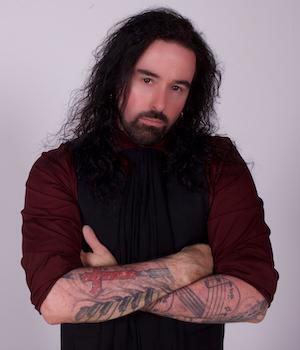
About Jaime Vendera
Vocal coach Jaime Vendera is known for his glass-shattering voice, as seen on MythBusters and The Dr. Oz Show. He is the co-creator of the online school Vendera Vocal Academy; author of Raise Your Voice, Mind Over Music, The Ultimate Breathing Workout, Unleash Your Creative Mindset,and Rebalance Your Voice;and co-creator of the Extreme Scream series. Some of his clients include James LaBrie (Dream Theater), Brian Burkheiser (I Prevail), Dustin Bates (Starset), Eric Emery (Skyharbor), Mixi Demner (Stitched Up Heart), Kevin Rudolf, and Clayton Stroope.
To learn more about Jaime’s products, to hear him sing, or to book a lesson, go to JaimeVendera.com and SingersNation.com.