
When conjured up by the likes of Billy F. Gibbons, John Sykes, Edward Van Halen, Dimebag Darrell, or Zakk Wylde, these cool-sounding 6-string sonic screamers can add extra aural excitement to a riff, lick, or run. Sometimes referred to as pick harmonics, pick squeals, or simply squeals, pinch harmonics are created by using a specific picking technique in exactly the “right places” on a string — and these right places depend on the note you’re fretting* that you want to add a squeal to, and also exactly how** you want that sucker to squeal.
*Note: Pinch harmonics are created on fretted notes, not open-string notes — if this stipulation causes confusion, fret not (awful pun intended), read on, and it will become clear, I promise.
**Note: By “how,” I mean the pitch you want to hit with the resulting squeal. Granted, you don’t have to be that specific, but the aforementioned masters of the technique often are specific — they’re not just going for “a squeal” but a specifically pitched one to ensure maximum musical impact. And on every fretted note, certain specific pitches are achievable.
The Pinch Harmonic Picking Technique
A specific picking technique is used to create a pinch harmonic. What you do is essentially a 2-step process:
- You literally “choke” your pick so a mere fraction of it is sticking out
- Many players, including myself, also rotate their picking hand ever so slightly so that the tip of the pick is pointing more toward the bridge than straight down. In the words of ZZ Top’s Reverend Bill Gibbons: “Roll the picking fingers slightly off edge of the plectrum and move around a bit.”

Provided you do this correctly, the result is this: when you pick a note, the lower edge of your picking-hand thumb will hit the string right after it is struck by the pick. The pick hits the string first, and then the edge of your thumb hits it as well, mere milliseconds later.
The always amusing Billy F. Gibbons aptly describes the resulting one-two punch as “meat on metal on wood.”
This “double-hit” picking technique will produce the desired pinch harmonic — provided you perform it at the right place on the string. The ever-eloquent Mr. Gibbons refers to said right places as “sweet spots.” Here’s what the pinch harmonic wizard wisely told Guitar World magazine about the technique:
“The sound changes drastically and requires some experimentation until you get comfortable finding your sweet spots. It’s a tricky thing to do, until muscle memory becomes second nature. Striking exactly where you want requires some guesswork, especially while you’re learning the technique. Again, experiment until you’re playing exactly what you want to hear.”
In addition to sounding great, this technique is not too difficult to master — it can’t be if I can do it, as I have trouble walking and chewing gum at the same time!
To better understand how and why pinch harmonics exist and also where those elusive “sweet spots” live, let’s take a look at natural harmonics.
Natural Harmonics
Natural harmonics are created on the open (unfretted) strings. Here’s a very simple, guitarist-friendly explanation of these wonderful-sounding things.
Fundamental Frequency & Harmonic Overtones
In a nutshell, each and every note played on a guitar is actually made up of more than just the one note we “hear” — there’s more (notes!) to it than that. The note we hear is called the fundamentalfrequency, but it is also reinforced and colored by a bunch of harmonic overtones of various frequencies. The fundamental note has the lowest frequency; all the reinforcing harmonic overtones are higher in frequency.
The reason we hear the fundamental as being “the note” is because not only is it the lowest frequency, but it is also the loudest. There are other higher harmonic overtones in there too, but our ears blend them together, and the result is the “single” note we hear — the fundamental. This changes when we induce natural harmonics on an open string. This technique enables us to isolate and hear these “hidden” harmonic overtones.
Playing a Natural Harmonic
To do this, we lightly touch an open string with a finger (but don’t actually fret the note) at a specific place on the fretboard and pick the string; a harmonic will ring out — providing we place our finger at exactly the right spot. There are a bunch of “right spots” on each string, and these right spots are called nodes.
Nodes
The scientific definition of a node is this: a point along a standing wave where the wave has minimum amplitude. For example, in a vibrating guitar string, the ends of the string are nodes.
When an open string vibrates, it is actually made up of a bunch of different waves of varying (wave) lengths. The longest one (from nut to bridge) is the fundamental. The other shorter (and therefore higher-frequency) waves are the harmonic overtones. Figure 1 illustrates the fundamental and the first six (there are more!) overtones.
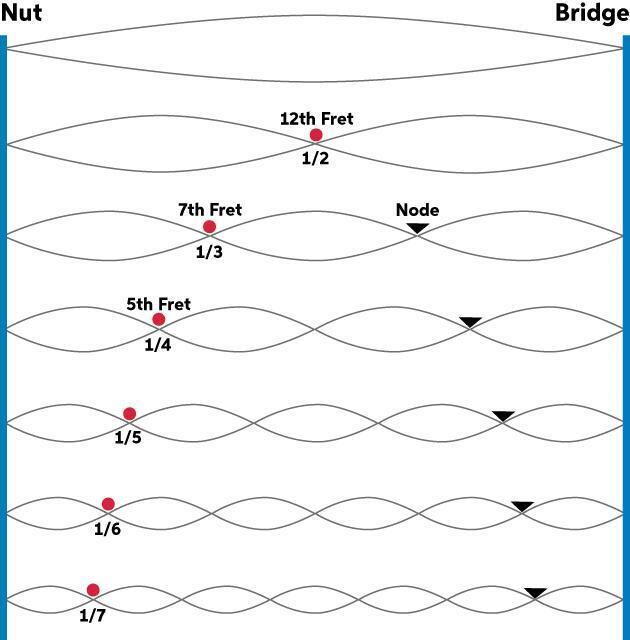
Figure 1: Here you can see where different nodes exist on a string. You can see the fret positions of the first three nodes that just so happen to live directly over frets.
So to hear the first overtone, we lightly touch a string directly above a node (at the 12th fret) and then pick the string.

As illustrated on the video, unfortunately not all the natural harmonics live conveniently over a fret! There are some really cool ones that lurk between frets, but they can be found and used to wonderful and often dramatic effect, as in Dimebag Darrell’s brilliant opening, 100% natural harmonic riff to Pantera’s “Heresy.” At 4:09 in the video above, I demonstrate how he outlines an E7 arpeggio (E, G#, B, D) via a combination of easy-to-find, and not-so-easy-to-find, natural harmonics. The photo below shows the place in between the second and third frets to sound a high D note on the low E string.

Guitar Geek Note 1: There’s actually a scientific/mathematical formula to find the position of a node for a specific frequency. You can find out more about it via “the Googles” (©Henry Rollins).
Geek Note 2/Warning: There are certain nodes for higher-frequency harmonics that coincide with the node for a lower harmonic too. In such cases, the lower one will be way stronger and drown out the higher one.
So if natural harmonics occur only on open strings, what do we call harmonics produced on fretted notes? And the answer is….
Artificial Harmonics & Pick Squeals
Artificial harmonics can be found and sounded at the nodes of the harmonic overtones of a fretted note. And that’s exactly what the pinch harmonic picking technique does: the plectrum hit causes the string to vibrate, and then the side of your thumb induces the creation of the desired harmonic squeal — providing this is done at a node, of course.
Finding Pinch Harmonic “Sweet Spots” (a.k.a. Nodes)
You can either use the aforementioned complex formula to find these picking sweet spots, or by deft trial and error, use your guitar’s pickups as reference points for future squeals!
If you want to be a little more scientific, you can also employ a technique called finger touch harmonics to find a good spot. Here’s what you do:
- Switch your guitar to the bridge (a.k.a. lead) pickup, as its brightness will help any harmonic to pop.
- Crank up the gain to “eleven”! Add gobs of healthy overdrive/distortion to bring artificial harmonics out of hiding.
- Fret a note — let’s say the 7th fret on the G string — then pick the string and let the note ring.
- While that string is ringing, lightly touch it with the tip of one of your picking-hand fingers somewhere over the neck (rhythm) pickup and listen.
- If a harmonic occurs, then you’ve found a node. Congrats!
- If a harmonic doesn’t happen — no worries, merely repeat the process and move the position of your finger. And keep doing so until a harmonic occurs.
- Once you’ve successfully found a node via this method, make a careful mental note of its position on the string, and then —
- Employ the pinch harmonic picking technique at the exact same spot, as shown below.

Pinch Harmonic Playing Tips
Hopefully this will help you find those pinch harmonics. To further your quest for Zakk Wylde– level mastery of the pick squeal, here are a few tips:
- Use the bridge pickup
- Crank the gain
- Pick like you mean it
- Add a healthy serving of fretboard-hand vibrato
- Remember where those sweet spots are for the note in question, and pay attention to your picking-hand’s position!
Good luck and have fun. I’m gonna sign off by requoting BFG’s earlier advice, as it’s excellent:
The sound changes drastically and requires some experimentation until you get comfortable finding your sweet spots. It’s a tricky thing to do, until muscle memory becomes second nature. Striking exactly where you want requires some guesswork, especially while you’re learning the technique. Again, experiment until you’re playing exactly what you want to hear. — Billy F. Gibbons, ZZ Top

The legendary pinch harmonic pioneer Billy F. Gibbons of ZZ Top with Nick Bowcott