

Every recording session is different, just as every musician, instrument, and acoustic space is different. Instead of asking, “What’s the best microphone for vocals/guitar/whatever,” you might ask, “How can I best equip myself for any recording scenario?” After all, the “best” mic for one singer may be the worst mic for the next. If you record regularly and take the time to position your mics well, having a smart selection of microphones for a wide range of applications trumps having one great mic for a specific purpose. Let’s take a look at a versatile combination of microphones that will equip you for almost any recording task.
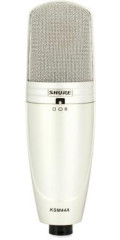
Shure KSM44A Large-diaphragm Condenser Mic
There are other large-diaphragm microphones that get much more hype, but savvy recording engineers know the Shure KSM44A is a true gem. Known for its incredible accuracy and extremely low self-noise, you could record an entire ensemble with just one KSM44A and achieve stellar results (many bluegrass acts do exactly that). More likely, you’ll be using it on female and male vocalists, acoustic guitar, piano, and other acoustic instruments in general. Once you hear the detailed, true-to-life sound of the KSM44A, you’ll likely want a second for stereo applications.
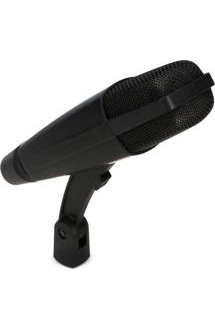
Sennheiser MD 421 II Dynamic Mic
Recording engineers know it’s best to get your sounds right at the source, and the Sennheiser MD 421 II is a renowned tool for getting the best out of loud sound sources like drums, guitar amps, and vocals. A big part of this is the 421’s 5-position bass roll-off switch, which is perfect for controlling the proximity effect when close-miking. It’s a tried-and-true mic for guitar amps and drums, capturing transients and midrange character exceptionally well. And you’ll often find that it sounds great on vocalists who, for whatever reason, don’t sound great on large-diaphragm condenser mics.
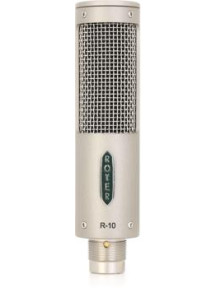
Royer R-10 Ribbon Microphone
Ribbon microphones are loved in the studio for their rich sound and smooth response, and the R-10 is no exception. Similar to the acclaimed R-121, the R-10 handles high sound pressure levels extremely well, making it a first choice for loud electric guitar amplifiers, horns, vocals, and so on. Its midrange is amazingly detailed, with smooth highs and solid lows to complete the spectrum. The R-10 also takes EQ extremely well.
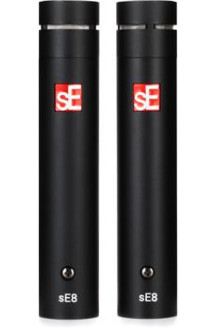
sE Electronics sE8 Small-diaphragm Condenser Mic Stereo Pair
When you need a mic that responds to transients quickly and delivers a detailed, wide-ranging sound, you’ll do well with a small-diaphragm condenser mic like the sE8. And for stereo recording applications, it’s hard to beat the value of the sE8 stereo pair. They’re great for acoustic guitar, drum overheads, group vocals, and piano, and their built-in highpass filters and pads give you the flexibility to use them in many different applications. The included stereo bar makes it easy to position them properly for stereo miking, using a single mic stand.
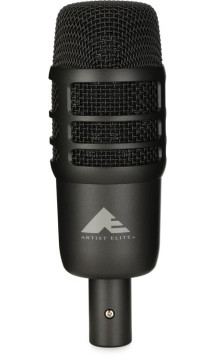
Audio-Technica AE2500 Dual-element Microphone
This is a favorite of mine simply for its pure versatility. If you’ve ever used a combination of dynamic and condenser mics to capture one sound source, you can imagine how useful this dual-element mic is. Equipped with two mic elements in perfect phase alignment, one is a dynamic element and the other is a condenser. Output is via a special Y-cable with separate XLR connectors for each mic element. The AE2500 makes it simple to record bass drums and guitar amps, giving you the benefits of both types of microphone while simplifying your setup (try fitting two mics inside a kick drum and you’ll immediately understand the benefit of this mic). And the best part is that the AE2500 performs well as a dynamic-only or condenser-only mic — you don’t have to record both outputs if you don’t want to.
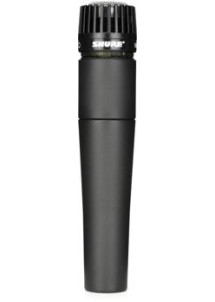
Shure SM57 Dynamic Microphone
You didn’t think we’d leave this one out, did you? Even if you’re new to recording, the Shure SM57 needs no introduction. You’ve heard it on countless albums, on snare drums, guitar amps, and even vocals at times. It’s a dependable microphone that delivers great results in a huge range of applications. With a few SM57s in your mic locker, you’ll be well equipped to record anything you’ll come across in traditional band setups. Said another way, the SM57 may not be your go-to mic for every application, but it’s absolutely worth trying out in every application.
The Beginning of a Well-equipped Mic Locker
So let’s take stock — we’ve got a large-diaphragm condenser mic, two dynamic mics with different strengths, a ribbon mic, a stereo pair of small-diaphragm condenser mics, and a versatile dual-element mic. We have access to various polar patterns, including omni, cardioid, and figure-8, and the ability to handle sound pressure levels from a whisper to a scream. And we have solutions to make stereo miking and combined dynamic/condenser miking as simple as possible. No matter how you look at it, this is a great start to building your mic locker. Want to know more about these mics, or about adding other mics to your existing mic locker? Give your Sweetwater Sales Engineer a call anytime at (800) 222-4700.