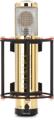
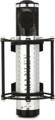
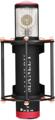
In 1990, Manley came roaring out of the gate with two tube microphones that were destined to become industry standards. The Reference Gold mic and Reference Cardioid were instant hits and have become modern classics used by top artists, engineers, and producers across all genres. Now, 27 years later, Manley is adding another stellar mic to their lineup. The Reference Silver marks a departure from the bright, up-front sound of the company’s Reference Gold and the robust warmth of its Reference Cardioid mic. Like all Manley gear, the Reference Silver is handcrafted in the company’s Chino, California, labs with painstaking attention to detail.
Manley Reference Gold

The Manley Reference Gold microphone is in a class by itself: not only has it become an industry standard found in top studios worldwide, but it’s also a holy grail mic for audiophile recordings that delivers a truthful, transparent rendition of every source you aim it at. The Reference Gold’s three polar patterns – continuously variable between omnidirectional, cardioid, and figure-8 positions – give you amazing flexibility when it comes to exploring different recording techniques. Often, you need a microphone that doesn’t add color, and that’s where the Manley Reference Gold comes in. Precise, revealing, and open sounding, the Reference Gold is ideal for singers with great voices that should ideally be captured without the infusion of midrange colorations. One of the most transparent-sounding mics we’ve heard, the Reference Gold boasts a neutral midrange with a touch of vintage-flavored warmth, along with the high-frequency extension and resolution to capture the nuance and air that makes a recorded vocal performance come to life. These same qualities make it ideal for just about any acoustic instrument. It’s stunning on grand piano, acoustic guitar, strings, brass, drum overheads and percussion, and as a room mic.
Manley Reference Cardioid
When a track needs to make an impact, the Manley Reference Cardioid obliges, with a sound that’s bold and authoritative, yet stunningly transparent. Since its introduction, the Reference Cardioid has become an industry standard, thanks to the deity-like presence and weight it imparts to pop, rock, rap, and R&B vocalists as well as voice-over artists. It’s also great for capturing massive drums when deployed on toms or overheads. Saxophones rule when recorded with this mic. In fact, the Reference Cardioid enhances any source, delivering punchy, larger-than-life tracks with that elusive professional polish, right out of the box. At Sweetwater, we consider the Reference Cardioid a “just add talent” mic – a serious tool for making audacious statements with your music.
Manley Reference Silver

Based on the legendary 1950s Sony C-37A, the Reference Silver has an alluringly rich, nuanced, and open sonic character that renders instruments and vocals in stunning, almost three-dimensional high fidelity. It features cardioid and omnidirectional polar patterns, switchable from a novel mechanical selector on the rear of the head basket. As with all Manley gear, the Reference Silver’s parts list is strictly top-shelf and includes a 5670 vacuum tube, hand-wound Manley IRON transformers, a low-noise custom switch-mode power supply, and esteemed capsule maker David Josephson’s masterful re-creation of the C-37’s C-3 capsule, which is the heart of this mic’s rich, warm sound. The rear of the capsule features an adjustable acoustic chamber used to switch between cardioid and omni polar patterns. Perfect for just about any vocal or instrument, the Manley Reference Silver mic is a studio workhorse, and an invaluable addition to any mic locker.
Let’s Listen
When we heard that Manley was coming out with a new mic, the first question that came to mind was, “How does it compare to the other Manley mics?” So to that end, Sweetwater recording engineers Nathan Hieronimous and Mark Hornsby miked up several sources with the three Manley mics: acoustic and electric guitar, as well as male and female vocals. The recordings were made in Sweetwater’s Studio B through the Manley Force preamp, all flat with no processing. These mics each have unique sonic personalities. Take a listen and see what you think.

- For the vocal recordings, all three mics were set up in a triangle with the heads as close as possible to each other and the singer sang into the middle of the triangle so that they were equidistant (7-8″ away) from all three.
- For the Martin D-28 Authentic 1931 acoustic guitar, the mics were positioned three away focused at the guitar where the neck meets the body.
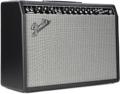
- For electric guitar, an LSL CVS (Carl Verheyen Special) Strat was reamped through a Fender ’65 Deluxe 1×12 amp with each mic carefully positioned at precisely the same spot in front of the amp.

These recordings feature several of our talented Sweetwater staffers performing original compositions.
Electric Guitar: Don Carr
Male Vocalist: Jordan Applegate
Performing Dance (Get up and Groove) written by Jordan Applegate, Jon Swain, Bryan Nellems
Acoustic Guitar: Nick D’Virgilio
Female Vocalist: Sophia D’Virgilio
Performing Here and Now written by Nick D’Virgilio
Electric Guitar
Electric Guitar on Reference Gold
Electric Guitar on Reference Cardioid
Electric Guitar on Reference Silver
Male Vocal
Male Vocal Solo on Reference Gold
Male Vocal Solo on Reference Cardioid
Male Vocal Solo on Reference Silver
Mix of Male Vocal plus Electric Guitar
Male Vocal/Electric Guitar Mix on Reference Gold
Male Vocal/Electric Guitar Mix on Reference Cardioid
Male Vocal/Electric Guitar Mix on Reference Silver
Acoustic Guitar
Acoustic Guitar on Reference Gold
Acoustic Guitar on Reference Cardioid
Acoustic Guitar on Reference Silver
Female Vocal
Female Vocal Solo on Reference Gold
Female Vocal Solo on Reference Cardioid
Female Vocal Solo on Reference Silver
Mix of Female Vocal plus Acoustic Guitar
Female Vocal/Acoustic Guitar Mix on Reference Gold
Female Vocal/Acoustic Guitar Mix on Reference Cardioid
Female Vocal/Acoustic Guitar Mix on Reference Silver
NOTE: You can download the original 24-bit, 96kHz source files of these recordings (a 91M download) by clicking here. Download the 24/96 files and import them into your DAW of choice.