

Drums have been around for thousands of years, and in those thousands of years there have been innovations that have changed the sound of the instruments and the way they are played. Though there have been a multitude of incremental changes (far more than six), here’s my list of the most influential modern technologies that changed not only the face of drumming but also the sound of music. I’ll cover mechanical and material changes, plus the introduction of electronics, and develop how they not only changed the sound of music but also initiated entirely new styles of music.
1. The Kick Drum Pedal
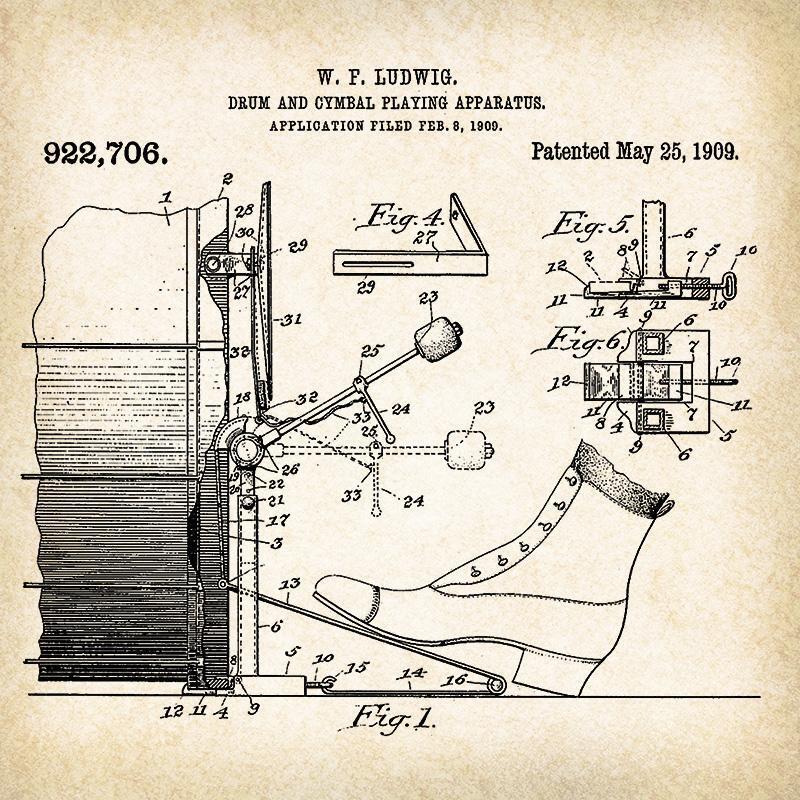 Back in the 1800s, drummers played mostly in a military-style drum corps or in an orchestra. One (or more) person played the snare drum(s), one person played the bass drum, one person played the cymbals, and so on. Then in the late 1800s, drummers started to change the setup a little and came up with double drumming (doubling up or playing more than one instrument at a time) in order to save space and to have fewer people in the orchestra pits. They would set up a bass drum and a snare drum beside each other and play both at the same time. But they didn’t play the bass drum with their foot like we do today; they played it with sticks — making it so one person could do the job of two. The next step in the progression was the invention of the kick drum pedal. In 1909, the William F. Ludwig Drum Co. patented a Drum and Cymbal Playing Apparatus, the first production-model kick drum pedal, and music changed forever that day. After that, drummers could play the kick drum with their foot and have their hands free for other things. It was great timing, because they were witnessing the birth of ragtime, jazz, and rock ‘n’ roll. Drummers took rhythm to extraordinary new heights, and the invention of the kick drum pedal helped pave the way.
2. Mylar Drumhead
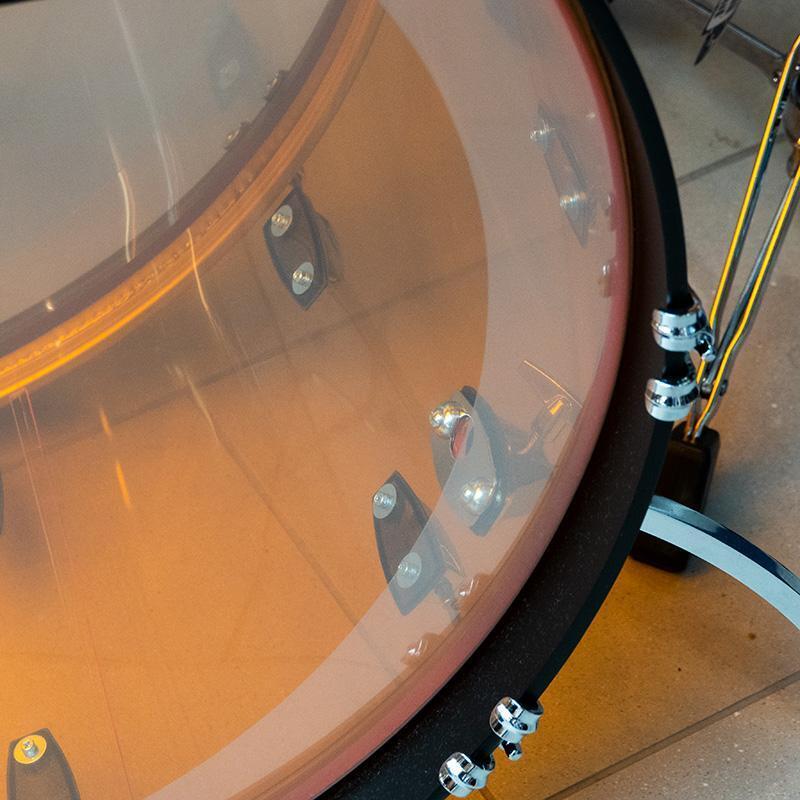 As stated in the opening paragraph, drums have been around for thousands of years, and up until 1957, all drums used animal skins for heads. In 1957, Remo Belli and his partner Sam Muchnick pioneered the first Mylar (plastic) drumhead, and from that the Remo Drumhead company was born. By 1957, music had changed a lot. Rock ‘n’ roll was in full swing, as well as big band orchestras. Drummers were hitting their instruments harder and there was a big need for a head that not only lasted longer but also made the drums sound good. Remo was the company that made that happen. Music and drumming were never the same. Drummers could play a lot longer on the same set of heads. Next came many different styles of drumheads (coated, clear, single-ply, double-ply, hydraulics, etc.) that made it possible to change up the sound and feel of the drum kit. Animal skins are still used for percussion instruments like congas and djembes. But for the drum kit, the invention of the Mylar drumhead changed the sound of music forever.
3. Electronic Drums
Electronic drums started making their way into the world in the late 1960s. With the invention of the Acetone rhythm box and then the Syndrum, there was a concerted effort to bring electronics and drums together. But it wasn’t until 1981, when the Simmons Company released the SDS-5 electronic drum kit, that the sound of drumming changed forever. The SDS-5, with its hexagon-shaped pads, had a very unique look, but more than that, it had a unique sound that became a huge part of music in the 1980s. Just put on the ’80s channel next time you sit down to listen to some music, and you will hear the sound of Simmons drums.
4. Linn Drum Machine
In 1980, an American engineer named Roger Linn released the LM-1 — the first ever commercially available drum machine that used digital drum samples. (Editor’s note: Yes, we know that Roger Nichols’ Wendel drum sampler/replacer was made in 1978, but it was not designed as a commercial product.) The Linn LM-1 was not the first drum machine produced, however. There were rhythm machines dating back to the 1950s. If you remember the days of walking through your local shopping mall and hearing that ubiquitous mambo rhythm coming from the organ shop (those really existed), then you know what those early rhythm machines sounded like — bursts of white noise edited down to sound like drums, sort of. Roger Linn figured out a way to take the next step in drum machines, and when he released the LM-1, the sound of music changed big time! If featured samples of real drums recorded onto removable sound chips. You were able to program all kinds of different rhythms that you could then chain together into a whole song. You could put accents onto only certain beats; there were swing and shuffle grooves; plus it had its own mixer, direct outputs, and a lot more. You could do more with the LM-1 than with any other machine that came before it. Along with all those options came a hefty price tag — about $5,000. That was a ton of money back then, so only the big stars got ahold of the LM-1, but the top 40 charts were never the same.
5. Roland 808/909 Drum Machines
 Following right behind the Linn LM-1 was the Roland TR-808. It was a programmable drum machine like the LM-1, but unlike the LM-1, it was completely analog. In 1983, Roland released their next version of the drum machine as the TR-909. At the time, both of these drum machines did not do very well in the marketplace, but music was changing in the 1980s. Rap and hip-hop were starting to emerge and make a big mark on the music industry, with house music right behind that. The sounds of the TR-808 and TR-909 are still a big part of those styles of music. To this day, every plug-in made that has drum sounds in it has something resembling the first 808 and 909 sounds.
6. Akai MPC60
The last on this list of drum technologies should certainly not be least. The Akai MPC60 (MPC stands for Music Production Center) changed the way hip-hop music was made and became a recording studio mainstay. Roger Linn’s original company went out of business in 1986, but Roger did not give up on his dreams or abilities to invent amazing gear. Linn collaborated with the Japanese company Akai, and together they made the MPC60. It was not just a drum machine but also a complete looping workstation. You could load your own samples into it and create all kinds of funky rhythms with the use of 16 velocity-sensitive pads. It was a very powerful machine for its time and turned dance music on its head, changing how the music was made.
People have been making music for centuries, and through all that time, certain people have been inspired to take an existing instrument and make it better or to design something from scratch that introduced a completely new tool — with the intention of making music better, easier to play, and more interesting. Thank goodness all those people have come along. Their inventions and drumming innovations changed the sound of music forever. I wonder what will come next?
If you have any questions about current drum technology, don’t hesitate to reach out to your Sweetwater Sales Engineer at (800) 222-4700.