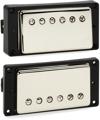
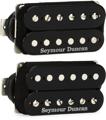
Two of the most confused concepts in the world of guitar mods are coil splitting and coil tapping. While both options are really killer upgrades to consider, they’re light-years apart in how they manipulate your pickups. While coil splitting is, by far, the more common mod, we want to shed a little light on what coil tapping is and why we feel it deserves to be recognized as one of the most unique but often overlooked pickup mods available.
Single-Coil and Humbucker Pickups
Before we go into the specifics of what it means to split or tap a coil, you’ll have to understand the basic anatomy of a humbucker pickup and a single-coil pickup. A single-coil pickup is one single magnet and one single coil of wire that generates a magnetic field that’s amplified by the vibration of your instrument’s strings. A single-coil pickup has an unmistakable sound that you would recognize from any Buddy Guy, Eric Clapton, or John Mayer record. The incomparable bite and clarity of single-coil pickups has forever defined and shaped the landscape of blues and country guitar solos. If you pick up and plug in just about any Stratocaster or Telecaster with single-coil pickups, then you’ll know exactly what we’re talking about.
The humbucker pickup was developed to solve the dreaded 60-cycle hum that is routinely picked up by a single-coil pickup. By taking two magnets and two wired coils of opposite polarity, the hum of the single-coil is canceled, or “bucked,” if you will. The result is a thicker, more bass-driven tone that sits well tonally in a group when playing rhythm. The humbucker also helped sculpt the signature sounds of jazz and rock with some help from a few of the greats like Wes Montgomery, Carlos Santana, and Slash.
While most guitarists would prefer to have a Les Paul and a Strat at their disposal, the inevitable question arose: What if I want both . . . in the same guitar?To answer that, we have coil splitting.
Coil Splitting Humbucker Pickups
Coil splitting is, by far, the more commonly requested mod, and it comes stock from the factory on lots of guitars. We have a huge arsenal of guitars prewired with coil-splitting capabilities in stock, waiting for you. The process of coil splitting is to take one of the coils of a humbucker pickup and “split” it off from the signal chain, essentially making it a single-coil pickup. You, then, have the bite of a Strat and the growl of a Les Paul ready and waiting.
In order to split a humbucker pickup, you’ll have to ensure it has four leads, which means two potential signal flows. With one path, the humbucker functions as designed, and both coils are active. With the second path, the connection between the two coils is grounded and only allows one coil to pass signal — in essence, only using half of the humbucker and creating a single-coil pickup. The ability to choose between these two signal paths is usually part of the functionality of a push-pull pot. To learn more about what a push-pull pot is capable of, take a look at our article, “7 Killer Mods with a Push-Pull Pot.”
Coil Tapping Single-Coil Pickups
Chances are, you’ve either never considered coil tapping a pickup, or you’ve been confusing tapping a pickup with splitting a pickup. By tapping a single-coil pickup, you’re potentially taking a high-output pickup and cutting its volume or power in half.
The output of a pickup is determined by how many winds are used when it’s initially wound. When coil tapping a pickup, you’re “tapping” into those winds, typically about halfway down the pickup. This allows you to switch from a high-output, heavily wound, modern pickup to a vintage-sounding, low-output pickup. A coil-tapped pickup can be activated the same way as a coil-split pickup: usually with a push-pull pot, as mentioned above. Coil tapping results in a lower-output, more mellow, vintage sound that’s right at your disposal, whenever you need it.
While coil tapping is not as common as coil splitting, Sweetwater’s Guitar Workshop is always up for a challenge. We have the ability to custom-wind pickups to any spec, and that’s a great time to modify the pickup for coil-tapping capabilities. Or, if you prefer to handle your own mods, this Telecaster pickup set comes with tapped pickups ready to install. Also included is a 5-way switch instead of the usual 3-way so that you can take advantage of all the different sonic capabilities.
Both Sound Cool – What Do You Have to Lose?
Now that we’ve cleared up the confusion on coil tapping vs. coil splitting, which one do you want? Sweetwater’s Guitar Workshop handles hundreds of mods just like these every week, so check us out here to upgrade your next guitar purchase before it even ships to you. Also, all of our inventory is painstakingly spec’d out just for you. Be sure to keep scrolling and check out all the pickup-switching options that come stock, right from the factory, listed on every guitar in our “Tech Specs” section. If you have any questions about what we’re capable of or how you can squeeze the maximum amount of tonal juice from your pickups, then contact your Sweetwater Sales Engineer or give us a call at (800) 222-4700.