



Climate Controlled Warehouse

55-Point Guitar Inspection

Unique Photos of Every Guitar

Packed & Shipped With Care
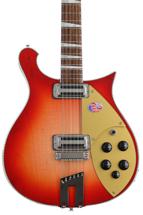
Rickenbacker Guitars

Get More at Sweetwater
Refine Your Search
Category
Availability
Price Range
Type of Deal
Color
Series
- Rickenbacker 300 (17)
- Rickenbacker 4000 (10)
- Rickenbacker 600 (9)
- Rickenbacker W Series (4)
- Rickenbacker C Series (3)
- Rickenbacker Vintage (3)
- Rickenbacker Cases (1)
Left-/Right-handed
Number of Strings
Body Shape


If you want to compare another product, please remove one of your earlier choices.
About Rickenbacker Guitars and Basses
Ever since the British Invasion stepped onto the world stage in the 1960s, Rickenbacker guitars and basses have come to represent a different breed of music maker.
John Lennon with his Hamburg 325. Chris Squire with his Rick-O-Sound 4001S. Susanna Hoffs with her modified 350 Jetglo. Noel Gallagher with his 330 Mapleglo. These artists and the throngs that followed helped introduce the world to the innovative sound and iconic looks of Adolph Rickenbacker and F.C. Hall’s all-American instruments.
Are you searching for that missing Rick to relive the sounds of your music heroes? Sweetwater proudly partners with Rickenbacker to bring you guitars and basses that are in stock and ready to rock. Enjoy our fast, free shipping and 55-point Inspection on your next purchase — perks you won't find anywhere else! Not sure where to start? Call our knowledgeable Sales Engineers at (800) 222-4700 for personalized Rick picks based on your needs.
History of Rickenbacker Guitars and Basses
Though understandably associated with the British rock revolution, Ricks have always stood for pure Americana. Much like muscle cars and craft beer, these high-performance guitars and basses are famously handcrafted in the USA by a dedicated team of skilled artisans.
Swiss-born tool and die tradesman Adolph Rickenbacker cofounded Santa Ana’s Electro String Instrument Corporation (then known as Ro-Pat-In Corporation) in 1931 and quickly took an interest in guitar technology. This passion led to the development of the electromagnetic Rickenbacker Electro A-22 “Frying Pan” — the first commercially viable electric guitar and companion amplifier ever released. Rickenbacker was awarded a patent for the guitar in 1937.
In 1953, guitar and amp distributor F.C. Hall purchased the Electro String Instrument Corporation and continued to release guitars under the Rickenbacker name. However, it was Hall's enlistment of Roger Rossmeisl in 1954 that truly helped steer the Rickenbacker design into the guitars and basses players know and love today.
By the late ’50s, Rickenbacker was off to the races and finding favor in the hands of the era’s most visible artists and guitarists — including a certain quartet of Liverpudlian longhairs on the verge of igniting the music industry.
Rickenbacker Guitars
Following the success of the “Frying Pan” guitar and the acquisition of the Rickenbacker/Electro name by Hall and Rossmeisl, the Rickenbacker guitar line began to evolve dramatically. Here are some milestones that occurred along the way:
- 1949: Rickenbacker rolls out a variety of art deco–inspired acoustic guitars, electric guitars, and lap steels to meet the demands of the burgeoning dance-hall and rock-radio music scenes.
- 1956: Rickenbacker guitars begin to take shape with the Combo series of “Tulip”-bodied guitars. These instruments gain increasingly more recognizable features, including the winged headstock and Toaster pickup design.
- 1958: The 3/4-scale Rickenbacker Capri line (Models 310, 315, 320, and 325) includes the first production guitars of the Hall-Rossmeisl era.
- 1960: The Rickenbacker 360 debuts. Its innovative “R” tailpiece and distinctive rounded body shape become hallmarks of the brand.
- 1964: The Beatles’ use of Rickenbacker guitars, particularly John Lennon’s 325 Capri and George Harrison’s 360/12, catapults the brand into international fame.
- 1966: The Rickenbacker 330 is introduced and soon becomes one of the most popular models due to its versatile sound and comfortable playability.
- 1970: Rickenbacker’s experimental designs include the slanted-fret 331, also known as the “Light Show” guitar, featuring built-in lights that respond to music.
- 1980: The company continues to innovate with the introduction of the 650 series, which includes modern features like humbucking pickups and a sleeker body design.
- 1990: Rickenbacker reissues several classic models from the 1960s to cater to the growing vintage guitar market and establish its legacy as a maker of iconic instruments.
- 1991: The 660/12 Tom Petty Signature is released, paying tribute to the legendary musician and his long affiliation with Rickenbacker guitars.
- 2010: Rickenbacker introduces the 1993Plus, a modern take on the classic 12-string model with updated hardware and improved playability.
- 2020: Celebrating its rich history, Rickenbacker continues to produce high-quality guitars that remain favorites among musicians worldwide.
Rickenbacker Basses
Rickenbacker’s renowned bass designs have had just as much impact on the music world as its guitars. Here’s the highlight reel:
- 1957: The Rickenbacker 4000 Series bass (released in Fireglo) becomes the first production bass to feature a neck-through construction. Rickenbacker’s curved, string-surrounding Horseshoe pickup epitomizes the Rickenbacker bass sound.
- 1961: The dual-pickup 4001 debuts with separate volume and tone controls for each pickup. The 4001 and its new Toaster neck pickup eventually form the basis for Chris Squire’s and Paul McCartney’s signature basses.
- 1963: Rickenbacker debuts its Jetglo (black) and Autumnglo (honey burst) finishes.
- 1965: The thinline 4005 semi-hollow bass with “Slash” soundhole launches, featuring a body based on the double-cutaway 360 and 375 guitars.
- 1969: A new high-gain pickup begins to push out the 4000 Series’ Toaster and Horseshoe pickups.
- 1970: John Entwistle can be seen playing a 4005LS “Light Show” bass onstage with the Who.
- 1970: The 3000 series basses quickly come and go. These are soon followed up by a 30-inch-scale 3001 model before eventually receiving a Rick-standard 33.25-inch-scale neck.
- 1970: A set-neck construction method can be seen replacing earlier neck-through designs.
- Early ’70s: Chris Squire’s Rick-O-Sound wiring becomes a standard option on Rickenbacker basses, allowing players to send independent signals from the neck pickup and bridge pickup.
- Mid-’70s: The Toaster pickup is finally dropped in favor of a traditional understring pickup.
- 1982: The Rickenbacker 4003 replaces the 4001, featuring a new truss rod design.
- 1984: The 4001 becomes officially discontinued (though it is later reissued).
- 1984: Rickenbacker rolls out the 2030 Hamburg and bound 2050 El Dorado basses. These two-pickup models feature extra-hot pickups (believed at the time to be active) to push bass preamps easily into overdrive.
- 1987: Rickenbacker introduces its first 5-string bass, the 4003S/5, along with the 8-string 4003S/8. Both models remain in production today.
- 1999: The 4004 bass series is introduced, known for its comparatively modern design and humbucking pickups that create a different tonal palette.
- 2002: The 4001c64 and 4001c64S models are introduced, paying tribute to Paul McCartney’s unmistakable 4001 and 4001S basses.
- 2014: Rickenbacker releases the 4003AC in collaboration with Al Cisneros of Sleep and Om.
- 2020: Rickenbacker continues to innovate and produce high-quality basses, maintaining its status as a favorite among musicians worldwide.
Rickenbacker Guitar and Bass FAQs
Where are Rickenbacker guitars made today?
Since 1931, all Rickenbacker instruments have been proudly made in the USA.
What special features distinguish a Rickenbacker guitar or bass?
Look, sound, and feel — every Rickenbacker instrument belongs to a league all its own. Here are some features that continue to set the brand apart:
- Neck-through design: Rickenbacker pioneered the neck-through design on its production guitars and basses, endowing them with palpable sustain and enduring stability.
- 33.25-inch scale length: many Rick aficionados consider the bass models’ 33.25-inch scale length to represent a Goldilocks zone between standard long- and short-scale basses.
- Breathtaking features: Rossmeisl’s angular silhouettes play a key part in the brand’s instant recognizability just as much today as they did in the ’60s.
- Triangle fret markers: Rickenbacker was the first guitar maker to use “shark’s-tooth” fingerboard inlays, adding to the guitars’ appeal.
- Toaster/radio knobs: classic Ricks are known for their Beaver radio and oven (or Toaster) knobs, which look like they were ripped straight from a ’50s appliance catalog.
- Vibrola tailpiece: love it or hate it, the Vibrola floating tailpiece played a key role in the tone and ’tude of Rickenbacker’s ’60s standards.
Which notable artists have used a Rickenbacker?
Here’s just a smattering of the satisfied artists who discovered their sounds in a Rickenbacker guitar or bass:
- Paul McCartney (the Beatles): Paul McCartney is best known for playing a left-handed 1964 4001S (“S” for “Special,” on account of its streamlined appointments) with an “upside-down” headstock. He could be seen playing this bass during the Beatles’ 1965 US tour and onward into such post-Beatles bands as Wings. Although McCartney’s 4001S began life as a Fireglo, it was repainted in psychedelic colors during the Magical Mystery Tour and later sanded down to bare maple when the Lads were convinced unfinished guitars delivered the best tone.
- John Lennon (the Beatles): Perhaps no Rick is more famous than the short-scale 1958 Rickenbacker 325 Capri (serial V81) John Lennon brought stateside for the group’s first televised performance on The Ed Sullivan Show in 1964. This Hamburg 325 was Lennon’s main axe from 1961 to 1965. It was modified with a Bigsby tailpiece and “bowtie” bridge and eventually painted black. Rickenbacker gifted Lennon a brand-new ’64 325 Jetglo in time for the Beatles’ second Ed Sullivan appearance. This '64 is sometimes referred to as John's “325 Miami.”
- George Harrison (the Beatles): McCartney and Lennon weren’t the only Rick rousers in the group! George Harrison was particularly fond of his 425 and could even be spotted rocking a 1964 Rickenbacker 360/12 12-string Fireglo hollowbody with a crescent soundhole in the music video for “A Hard Day’s Night.”
- Tom Petty: Tom Petty could be seen bearing a ’backer throughout his solo career and Heartbreakers era. Favorites included his Electro (Rickenbacker’s student line) ES-17 Fireglo and 660/12 Tom Petty Signature Fireglo.
- Chris Squire (Yes): Chris Squire hit the scene in the late ’60s playing a modified ’64 4001S in Cream Colorglo. Squire had his twin pickups wired in stereo with independent outputs — a configuration known as Rick-O-Sound (ROS). In this way, he could run his bridge pickup with fuzz and modulation while leaving his neck pickup dry to maintain its low-end integrity.
- Geddy Lee (Rush): Geddy Lee has admitted it was Squire’s bass wizardry with Yes that led him to purchase his very own Jetglo Rickenbacker 4001 in 1973. This was the bass Lee was most often seen playing onstage — it was customized with a Leo Quan bridge and a removed bridge pickup cover. Listen closely, and you’ll hear it throughout 1975’s Caress of Steel.
- Lemmy Kilmister (Motörhead): Lemmy Kilmister’s first 4001 was loaded with Thunderbird pickups to achieve his bulldozer-like tones. Kilmister was loyal to Rickenbacker throughout his career and eventually became known for repping a modified Mapleglo 4001 with star inlays and a “born to lose out to lunch” sticker. Toward the end of his career, he could be seen playing his signature 3-pickup 4004LK with hand-carved walnut wings.
- Cliff Burton (Metallica): The first-call bass belonging to Metallica’s most formative early bassist was a heavily modified Burgundyglo 4001 outfitted with aftermarket pickups — notably, a stacked single-coil electric guitar pickup wedged under the rubber saddle mutes.
- Michael Parks Jr. (All Them Witches): The neo-psych sultan’s prized picker is a 1972 4001 that’s had its upper bout and headstock hacked beyond recognition by its previous owner. It’s been the featured bass on every album and tour to date.
- Al Cisneros (Sleep, Om): Desert-rock delegate Al Cisneros has featured a flight of doomy Rickenbackers throughout his solo career and with Sleep and Om. Earlier years saw Cisneros favoriting a 4004 and 4003S5. Today, he can most often be seen rocking his now-discontinued signature 4003AC and custom-built 4420.
- Other notable Rickenbacker users: Michael Rutherford (Genesis), Roger Glover (Deep Purple), Phil Lynott (Thin Lizzy), and Paul Simonon (the Clash) have been included among the ranks of proud Rickenpickers.
What’s next for Rickenbacker — are new guitars on the way?
Rickenbacker owner/heir John Hall (F.C. Hall’s son) states the company has seen such a backlog of orders for its traditional models that it hasn’t felt the need to innovate new instrument models. Hey, if it ain’t broke! In the meantime, there are plenty of Ricks at Sweetwater to keep most of us guitar and bass players busy well into the next century.
Shopping for Your Next Rickenbacker Guitar or Bass? Start at Sweetwater
It’s no secret: Sweetwater is the first stop on many a Ricken-stricken’s instrument hunt. Our close partnership with Rickenbacker allows us to stock ready-to-rock guitars and basses you won’t find anywhere else.
Searching for a great deal on a rare Ricky? Check out used Rickenbackers for sale on Gear Exchange!
