
Delay Pedals
Get More at Sweetwater
Refine Your Search
Availability
Brand
- Electro-Harmonix (12)
- JHS (11)
- Keeley (11)
- Boss (10)
- Catalinbread (10)
- Strymon (10)
- TC Electronic (9)
- Walrus Audio (8)
- NUX (6)
- MXR (5)
- Source Audio (5)
- EarthQuaker Devices (4)
- Empress Effects (4)
- Fender (4)
- Red Panda (4)
- Analog Alien (3)
- Eventide (3)
- Maestro (3)
- T-Rex (3)
- Wampler (3)
- Behringer (2)
- DOD (2)
- Meris (2)
- Suhr (2)
- Universal Audio (2)
- Way Huge (2)
- Zoom (2)
- Baggs (1)
- Beetronics FX (1)
- Benson Amps (1)
- Danelectro (1)
- Dreadbox (1)
- Dunlop (1)
- Fishman (1)
- Gamechanger Audio (1)
- Ibanez (1)
- Laney (1)
- Line 6 (1)
- Nobels (1)
- Red Witch (1)
- Supro (1)
Price Range
- $25 to $50 (3)
- $50 to $100 (16)
- $100 to $200 (41)
- $200 to $300 (52)
- $300 to $500 (34)
- $500 to $750 (10)
Financing
What is this?Type of Deal
Series
- Catalinbread Delay and Reverb (10)
- Strymon Delay (10)
- NUX Effects (6)
- Source Audio One (5)
- TC Electronic Flashback (5)
- Empress Effects Big Box (4)
- JHS 3 Series (4)
- MXR Carbon Copy (4)
- Boss Stompboxes (2)
- Electro-Harmonix Nano Pedals (2)
- Electro-Harmonix Pico Pedals (2)
- Eventide dot9 (2)
- Fender Hammertone (2)
- Suhr Pedals (2)
- Universal Audio UAFX (2)
- Walrus Audio Fundamental Series (2)
- Walrus Audio Mako Series (2)
- Baggs Align (1)
- Boss 200 Series (1)
- Boss 500 Series (1)
- Boss Waza Craft (1)
- DOD Classic (1)
- Dunlop Electronics (1)
- Fender Bassman Pedals (1)
- Fishman AFX (1)
- Gamechanger Audio AUTO Series (1)
- Ibanez Mini (1)
- Laney Black Country Customs (1)
- Red Witch Apothecary (1)
- Way Huge Smalls (1)
Reverb/Delay
What is this?Analog/Digital
Max Delay Time
True Bypass
What is this?Inputs
What is this?Outputs
What is this?MIDI I/O
Related Searches


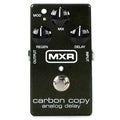






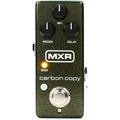




MXR M292 Carbon Copy Deluxe Analog Delay Pedal
Analog Delay Guitar Effects Pedal with Up to 1.2s of Delay, Tap Tempo Footswitch, Bright Switch, Tap Division Switch with Status Display, and Mod Switch with Top-mounted Speed and Width Controls


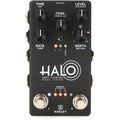
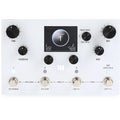
Keeley Halo Core Andy Timmons Echo Reverb/Delay Pedal - Voyage Edition, Sweetwater Exclusive
Stereo Delay Guitar Pedal, Signature, with Time, Level, Feedback, HPF, Saturate, Tone, and Tap/Hold Controls and True Bypass/Trails Modes - Voyager Edition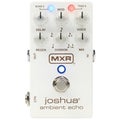




If you want to compare another product, please remove one of your earlier choices.
How the Delay Pedal Sparked an Effects Phenomenon
All it took was John Lennon leaning on a tape machine or Jimmy Page plugging into an Echorec to ignite an entire industry of delay pedal devotees.
You know the sound: the hypnotic pulse of modulated echoes, the warm blanket of gooey repeats. It’s an effect you’ve undoubtedly heard on hundreds of recordings. And yet, delay remains one of the most sought-after sounds for guitar and keyboard players of the 21st century.
As players who lived through an era when achieving Edge-level rhythmic repeats and Gilmour-ish atmospheric occlusion meant hauling racks of heavy studio gear, all we can say is: baby, delay has come a long way!
Are you searching for a tape delay with accurate analog grime and grit? Or a modulated delay that stays perfectly synced to your click track over MIDI? Whatever you’re asking of your next delay pedal, Sweetwater has you covered.
How Does Delay Differ from Reverb?
Unlike reverb, delay effects are built on discrete repeats. These repeats, or echoes, can be generated using analog circuits — such as bucket brigade device (BBD) capacitor arrays — or through digital sampling, made legendary by the PT2399 echo IC.
Modern delay pedals may even rely on advanced ARM or SHARC architecture to achieve their cavernous space and infinite repeats. Many of today’s digidelays even manage to capture the soul of tape delay and analog units by re-creating their imperfect mechanical artifacts — including saturation, filtered repeats, and even wow, flutter, and dropouts.
How Do Digital and Analog Delay Pedals Stack Up?
Analog delay pedals provide warm, natural repeats over shorter periods — usually a second or less. Analog’s charm lies in how the repeats naturally degrade, stack, and darken with each subsequent echo.
Digital delay pedals, on the other hand, are famous for delivering pristine repeats over longer spans of time. Thanks to their high-fidelity sampling, many digital delays can even be used to build loops or hold notes with otherworldly sustain. Plus, because many digital delays mimic the imperfections of analog delays, you’ll be able to craft an echo rhythm that successfully fits the piece you’re playing.
Our advice? If it’s convenience and maximum note length you’re chasing, digital is the way to go. But if your heart beats for the most accurate reproduction of vintage tape and echo effects — or if you’re running a board off 9V batteries — analog is sure to scratch that itch.
What Is Self-oscillation, and Which Delay Pedals Have It?
Self-oscillation occurs naturally in analog delay units, and it’s one of the effect’s most wildly chaotic tricks. You may have experienced self-oscillation yourself when you accidentally cranked the Intensity knob of your DM-2 too high and created a sputtery feedback loop onstage (probably to great applause). You may have even heard Ed O’Brien intentionally cause his RE-201 to self-oscillate and melt into sludge for the final 30 seconds of “Karma Police.”
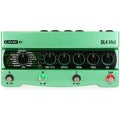
Self-oscillation has become so popular that even many of today’s digital delays by Strymon, MXR, and TC Electronic use complex DSP to replicate the effect. Other outstanding oscillators include the Ibanez Echo Shifter, Line 6 DL4, Way Huge Aqua Puss, and Keeley Caverns.
Once your delay begins to self-oscillate, it becomes an instrument unto itself. Twist the Rate knob to control pitched sweeps and dives. Just mind your amp volume when it starts to howl so you don’t damage your speakers!
Still Chasing the Perfect Delay? We’re Oscillating to Hear from You!
One thing’s certain: when it comes to digital and analog delays, you’ve got plenty of options. If you’d like help choosing your next pedal, your Sweetwater Sales Engineer would love to connect you to your new favorite effect. Give us a call, and we’ll answer any questions you may have.
