
Recording Consoles
Get More at Sweetwater
Refine Your Search
Availability
Brand
- Solid State Logic (24)
- Neve (13)
- API (9)
- Audient (8)
- Harrison Audio (8)
- Wolff Audio (8)
- Trident Audio Developments (7)
- Rupert Neve Designs (6)
- TASCAM (1)
Price Range
Financing
What is this?Type of Deal
Series
- Audient ASP (8)
- Neve Genesys Black (6)
- Neve 8424 (4)
- Rupert Neve Designs 5088 (4)
- Solid State Logic Duality Fuse (4)
- Solid State Logic Odyssey (4)
- Solid State Logic Origin (4)
- Trident Audio Developments 88 Console (3)
- API 2448 (2)
- Neve Genesys (2)
- Solid State Logic Oracle (2)
- Solid State Logic System T (2)
- Solid State Logic XL-Desk (2)
- Trident Audio Developments 68 (2)
- Trident Audio Developments 78 Console (2)
- Neve BCM10/2 (1)
- Solid State Logic AWS (1)
Channels
What is this?Automation
What is this?Related Searches

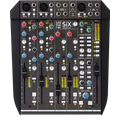
Solid State Logic BiG SiX 18-input Desktop Analog Mixer and Interface
18-input Analog Recording Console with 4 SuperAnalogue Preamp Channels with Per-channel Compressors, Per-channel 3-band EQ, 9 Long-throw Faders, 18 Summing Channels, G Bus Compressor, Talkback with LMC, 16-in/16-out USB-C Audio Interface, and SSL Production Pack






- 1
- 2
If you want to compare another product, please remove one of your earlier choices.
About Recording Consoles
Many of our favorite albums owe their distinctive sounds to the consoles they were tracked and mixed on — from the Beatles' Abbey Road (an EMI TG12345) to Foo Fighters' Wasting Light (an API 1608). The producers and artists on these records understood the benefits of bridging premium sonics with flexible routing in a central control station known as the recording console.
As recording studios have migrated homeward and mixing has become increasingly digital, however, the use of large-format recording consoles in modern production has become less common. Nonetheless, for industry titans like Bob Clearmountain and Chris Lord-Alge (both SSL users), the console remains the gold standard for producing music.
Are you looking to incorporate some of that old-school workflow into your recording setup? Mix on faders? Gain-stage on meter bridges? Twist knobs to effect real-time changes? You've come to the right place! For over four decades, Sweetwater has helped professionals like you get their hands on the consoles of their dreams. Whether you're after the stereo glue of a Trident Series 80 or the heritage tone of an Audient ASP, Sweetwater has the board for you.
Why Choose a Recording Console
Analog mojo under the hood
The first aspect of recording consoles you'll want to understand is the channel strip. One reason recording consoles are considerably more expensive than most sound-reinforcement mixers with the same number of channels is that recording consoles include studio-grade components. To put this into perspective, the preamps and the equalizer sections in many of these studio mixers would cost hundreds or even thousands of dollars in equivalent 500 Series modules. In effect, these channel strips replace a sizable gear rack and eliminate the need to deal with a sprawling patchbay.
Speaking of routing, the analog circuitry at work in these studio mixers is another aspect of what makes them so special. For starters, there's the analog signal path itself. Component to component, including the way each channel strip connects to each bus, recording consoles feature signal paths that are almost always entirely comprised of discrete analog circuitry. This includes top-shelf transformers, premium resistors, and specialty capacitors, a recipe that results in the sound you'd expect from premium studio channel gear.
Flexible routing for any need
In use, recording consoles offer major advantages for both recording and playback. Historically, one of the features that helped establish a console as a studio mixer was the direct outs, and that's still largely true, except in the case of some digital boards that perform functions such as acting as a control surface and/or audio interface. The traditional routing, however, is simple. Although it stems from a time when we recorded on 2-inch tape, it's still applicable to modern audio interface-DAW workflows.
Here's how it works, assuming you have an audio interface with at least as many inputs and outputs as your recording console. Connect your sources to the preamp inputs on your mixer, connect the channel outs to your audio interface, and finally, take the corresponding outputs from your audio interface and connect them to the line inputs on your mixer. This lets you record individual channels or play them back through your mixer, depending on if you select mic or line input. And with the flexible routing, such as multiple auxiliary buses and groups, this is just one example of how you can use a studio mixer to record.
Analog summing defrosts digital mixes
One additional reason Sweetwater engineers recommend recording consoles is their summing. In fact, summing is one of the key points of more popular and affordable studio mixers. Typically, you sum by mixing your tracks down to stems and then sending the stems to individual channels on your console. While they're available, you'll usually keep the preamp at unity gain and leave the EQ, inserts, and any additional in-line processing out of it. The big benefit is when your tracks come together in the final mix, where the high-end analog circuitry provides the kind of organic character so often missing from digital recordings.
Find Your Next Recording Console at Sweetwater
At Sweetwater, we understand a recording console is a big investment. That's why our Sales Engineers are trained to help you find the gear you won't regret. Call us at (800) 222-4700 for a personal console recommendation based on your needs, wants, and budget.
What are the most popular brands for Recording Consoles on Sweetwater.com?
What are the most popular Recording Consoles on Sweetwater.com?
-
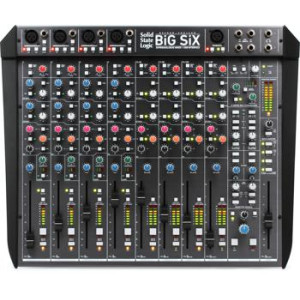
Solid State Logic BiG SiX 18-input Desktop Analog Mixer and Interface
4.5 out of 5 stars 25 reviews
$1,999.99 -

Trident Audio Developments Trident 68 24-channel Modular Analog Mixing Console
5 out of 5 stars 4 reviews
$17,500.00 -
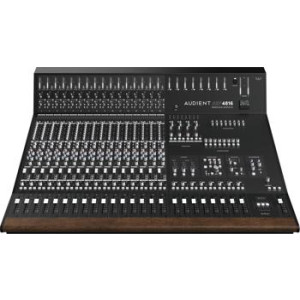
Audient ASP4816-HE 16-channel Recording Console - Heritage Edition
5 out of 5 stars 1 review
$16,499.99 -
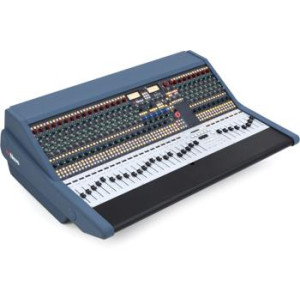
Neve 8424 24-channel Analog Mixing Console - Motorized Faders
5 out of 5 stars 1 review
$34,950.00 -
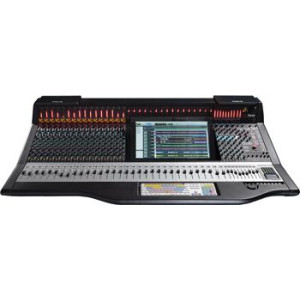
Neve Genesys Black G32 - 32 Faders, 16-channel Analog Mixing Console with DAW Control
5 out of 5 stars 2 reviews
$75,950.00
Why shop Recording Consoles at Sweetwater.com?
With a massive selection of Recording Consoles, free shipping, a free 2-year warranty, 24/7 access to award-winning support - and more - Sweetwater gives you more than any other retailer! If you have any questions about Recording Consoles, make sure to give your personal Sales Engineer a call at (800) 222-4700.
