



Keyboard Month: Expert Picks & Hot Deals

Sorry, all Certified Open Box models of this item have been sold.

Since Certified Open Box items are such a great deal, they often sell within hours of showing up on our web site. Order a new one below, or browse every currently available Certified Open Box item here.

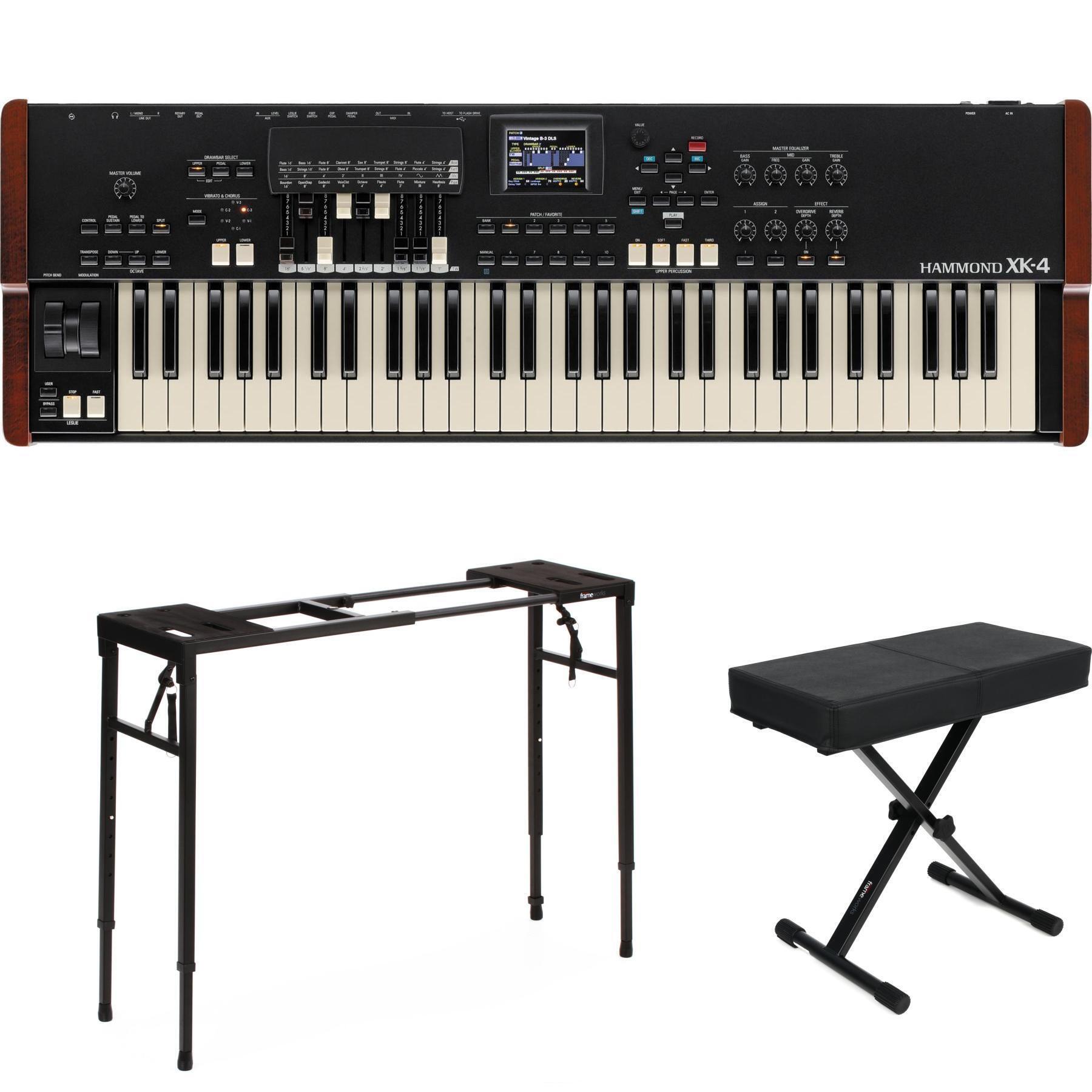
Hammond XK-4 Portable Organ

Portable Digital Organ with Virtual Tonewheel, Transistor, and Pipe Organs; Digital Leslie, and Onboard Effects
Share
Item ID: XK4
Hammond XK-4 Portable Organ
Price:$2,495 and 00 cents
Special Financing. $52/month with 48 month financing*

In Stock!

This item is not available for local pick-up. Place your order now and your gear will be on its way to you!

Only 2 left in stock! More on the way.
Add to Cart
Sales engineer photo
Ask An Expert

Our expertly trained Sales Engineers are ready to help!

What is a Sales Engineer?
Sweetwater Gear Exchange

Have one to sell?
Check out Sweetwater's Gear Exchange!
Learn More

Complete Your Order
Product Image - This Item - Hammond XK-4 Portable Organ
Hammond XK-4 Portable Organ
$2,495.00
+
+
=
Buy all:
OR
Hammond XK-4 Portable Organ
In Stock!
Price:$2,495 and 00 cents
Add to Cart
Add to list
Skip to Description
Most Popular Accessories & Related Items
Back to navigation

This article was Written By

Our Product Research Team

Get to know them!

The Modern Hammond for the Tonewheel Obsessed

At Sweetwater, the name Hammond commands respect. It’s synonymous with the classic tonewheel organs such as the B-3 that played an outsized role in the music revolution of the 1960s and ’70s. In the digital era, Hammond assumed a leadership role in developing cutting-edge “clonewheel” organs that deliver those legendary organ sounds. Now, the B-3 experience reaches a breathtaking new level of realism with the Hammond XK-4 Portable Organ.

Next-gen Modeled Tone Wheel 2 sound engine

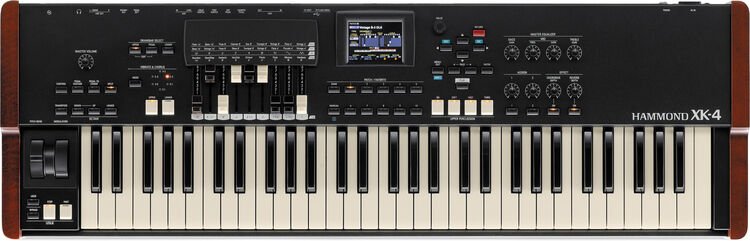
Equipped with Hammond’s powerful next-gen Modeled Tone Wheel 2 (MTW2) sound engine, the XK-4 brings sounds to life by meticulously reproducing the 91 tone wheels that drove all vintage Hammond organs. This advanced technology re-creates imperfections such as pitch and volume fluctuations that gave vintage Hammonds their distinctive sound. It also gives you unfettered freedom in customizing your tone. Hammond’s latest tube modeling system reproduces coveted vacuum tube warmth, while vintage Hammond “matching transformer” emulation fleshes out the sound with fullness and harmonic richness. Add in the tactile feedback of nine real drawbars, and you have the hands-on ability to tweak your tonewheel organ sounds to perfection in real time.

The tonewheel experience — and more

Hammond’s proprietary 9-level virtual multi-contact system delivers the distinctive feel of the mechanical multi-contact keyboard of a vintage Hammond organ. What’s more, if you connect any of the optional Hammond MIDI pedalboards, you’ll also get multi-contact feel on the pedal keyboard. Of course, the latest cutting-edge Digital Leslie algorithm is onboard, and it painstakingly models the airflow of Leslie rotors, faithfully reproducing their unique tone and 3-dimensional effect. Complete with the latest Digital Leslie and a selection of Italian, British, and Japanese transistor combos as well as classical and theater pipe organs, the Hammond XK-4 is a stunning achievement, and a worthy inheritor of the title, “King of Instruments.”

Hammond XK-4 Portable Organ Features:

  • 61 semi-weighted, velocity-sensing, waterfall-style keys; 9 drawbars
  • Pitch bend and Modulation wheels; Master EQ
  • Traditional drawbar organ tone reproduced in detail by the new MTW2 sound engine
  • 9-level virtual multi-contact system
  • Intuitive and logical interface gives you easy access to all functions
  • Color display for quick check of performance status and programming data
  • User-assignable knobs and switches can be used to control internal functions and external devices
  • Master EQ allows for instant tweaking in any performance environment
  • Onboard Digital Leslie with advanced algorithm models the airflow of Leslie rotors
  • Italian, British, and Japanese transistor combo organ sounds
  • Classical and theater pipe organs
  • Effects: Vibrato, Chorus, Multi-Effects 1, Overdrive, Multi-Effects 2, Matching Trance, Leslie, Equalizer, Reverb
  • Multi-contact feel on optional XPK-130G/XPK-200G/XPK-200GL MIDI pedalboards

Warranty Info

Sweetwater's FREE 2-Year Total Confidence Coverage Warranty

Extra peace of mind at no extra cost.

  • Save money with FREE parts and labor
  • Get back to making music with the industry's fastest turnaround time
  • Fix it the first time with our award-winning, factory-certified Service Department
Learn More about Total Confidence Coverage
Back to navigation

Tech Specs

  • Type: Portable Organ
  • Sound Engine: Modelled Tone Wheel 2 (MTW2)
  • Analog/Digital: Onboard Digital Leslie
  • Number of Keys: 61
  • Type of Keys: Semi-weighted, Waterfall-style
  • Velocity Sensitive: Yes
  • Other Controllers: Pitchbend, Mod wheel, Leslie (bypass, stop, fast)
  • Drawbars: 1 Set of 9 Rows
  • Polyphony: Simultaneous 61 notes (tone wheel organ)
  • Number of Presets: 100 x Factory, 100 x User
  • Effects: Vibrato, Chorus, Overdrive, Matching Trance, Leslie, Reverb, Equalizer
  • Storage: USB Flash
  • Audio Inputs: 1/8" TRS (AUX)
  • Audio Outputs: 2 x 1/4" (R, L/mono), 1 x 1/4" (rotary), 1 x 1/4" (organ pedal)
  • Headphones: 1 x 1/4" TRS
  • USB: 1 x Type B (to host), 1 x Type A (to flash)
  • MIDI I/O: In/Out
  • Pedal Inputs: 1 x 1/4" (expression), 1 x 1/4" (damper), 1 x1/4" (foot switch), 1 x 1/4" (leslie switch)
  • Other I/O: 11-pin Leslie Speaker Jack
  • Power Source: Standard IEC AC Cable
  • Height: 4.29"
  • Width: 39.52"
  • Depth: 12.67"
  • Weight: 20.72 lbs
  • Manufacturer Part Number: 002-XK4

What Makes Our Sales Engineers Great?

Sweetwater Sales Engineers are a world-class team of experts dedicated to you. Hand selected from across the globe, each brings a wealth of experience and expertise in the world of music gear to provide you with unparalleled service completely free of charge. Friendly relationships, real trust, and the right gear are only a call or a click away!

Back to navigation

Reviews

Excellent Hammond sound!!!
Bought my Hammond xk4 through SWEETWATER WEBSITE. I do own a Hammond A105 and needed a portable equipment for a live musical performance, when I started using the xk4 I wasn't to happy about the factory presets, but when I went through the menu I found all kinds of settings that allow me to create my own sounds . The keyboard looks good with a nice vintage keys color, it it's well designed . If there any improvements in the future, I will suggest other effects like more stereo projecting sounds.
A+ Authentic Hammond Organ - The Feel & The Sound!
I've been playing clonewheels for several years and this is the first one that nails the sound and feel. The multicontact keys allow for authentic ferocious percussive playing a la Jon Lord, Greg Rolie, and Brent Mydland. Or lightly tap the keys and you can get tiny harmonic effects. I owned a vintage 1950s Hammond M2 years ago and it's the only other keyboard I've played that could do this. Truly beautiful!

You can dial in every aspect of the sound. After testing all the onboard amplifier simulators, the A-100 is my favorite. It's a little smoother and less shrill at the top end. Perhaps the biggest standout is the Leakage control - this is where the warmth really shines! Vintage Hammonds were never perfectly clean and the leakage is what gives them their unique tone. A little goes a long way. I keep the Overdrive dimed and it adds so much character!

Great job, Hammond!
Music background: gigging musician
The Best So Far
I'm a long-time pro who lives near Boston. In May of 2025 I decided it was time to replace my vr09, a keyboard that I was never completely happy with, with another "clonewheel" organ. After researching and watching videos I became most interested in the Crumar Mojo and the XK-4. Unfortunately, I could not locate either keyboard near me, so I contacted Sweetwater and decided it was time for a road trip, (I know, crazy!). I played the Crumar first, and it sounds really great. While the rep at Sweetwater went to the warehouse to get the XK-4 I tried a few others, among them the SK Pro and the Nord. They sound fine but I liked the Crumar organ sound much better, (Sorry to all you Nord freaks, I just don't get it!). The rep came back with the XK-4, we plugged it in, and I knew immediately that this was the one. I played it a little longer and scrolled through some of the menus and listened to the effects. The only thing a B3 does that the XK-4 doesn't is give you a hernia. On a serious note, I have owned and/or played just about every clonewheel since the 80s quite extensively, and I have owned and played many real Bs and Cs, and the XK-4 is absolutely the best clonewheel made so far. Some cost a lot less, some cost a lot more, but none are more realistic. It's now late July and I have used it on many shows and programmed all of my own sounds. Two soundmen from different shows have asked me how I am getting "that amazing Hammond sound." I am still beyond thrilled with this keyboard.

Note: As soon as you plug it in, disable the auto shut-off feature or you will momentarily freak out when your brand-new expensive keyboard suddenly turns itself off if it's not used for 30 minutes.
An Unbelievably Configurable Keyboard
I bought the XK4 because I wanted a modern replacement for a Korg CX-3 I was playing for several
years. I wanted something physically lighter and smaller. Also, something that had other organ
tones in it, like transistor organs and pipe organs. I originally started by playing the Yamaha
and Roland tonewheel clones. These are "value priced" keyboards and they come with low
quality, non-organ keybeds. The XK4 appeared to have a good mix of features and an authentic
organ keybed. It was a stretch financially but the promise of owning an authentic hammond
was too good to pass up so I bit. I bought the CU1 leslie control as well.

Initially, I was impressed with the keybed, which has a real organ type key shape. The key
pressure is just right compared to a pipe organ I play and the other keyboards I own. No
"plasticy" synth keybed here. The black keys are wide too, which for a new keyboardist, make the
organ easier to play. The keys are balanced too, the white keys have a 15 nickels to depress
pressure (using my stack of nickels pressure test) and the black keys are the same. The XK4 emulates the electrical contact variation of the original Hammond organs with a random contact for the different drawbars too.

The more I dived into the operation of the XK4, the more I appreciated its options. There is a
screen on the XK4 (not touch sensitive - thank you), but the mix of menu items vs. the controls
on the face of the keyboard is really well thought out. The screen displays status live with
the changes to the controls. Dive into the menus and submenues and there are a lot of settings you can control. They really went all out customizing the minutia. BUT, you are not stuck deep in menus to just play the keyboard!

I discovered a shrillness to the sound of the tonewheel organ type that took me awhile to identify.
I normally play the XK4 through headphones of monitor speakers. I discovered that there is a fantom tone that shows up when you have the tonewheel type set to one of the organs other than "B3 Mellow". With only the 16' drawbar pulled (no effects enabled), there appears to be a phantom tone on some keys. It shows up in octave 5 and not all notes have this tone. I investigated this with a spectrum analyzer and discovered that there are harmonics above the key that is pressed for all keys. On the notes that have the shrillness, these overtones were very prominent. Of course there will be overtones, its a tonewheel and the XK4 is an authentic tonewheel. After speaking with Hammond about this I discovered that the B3 Mellow tonewheel type, that does not have this problem, was designed specifically to eliminate this issue.

When I got a Leslie speaker I discovered how this phantom tone actually enhances the sound. First,
the Leslie frequency response rolls off in a way that mostly masks the shrillness created by the
XK4. Also, the Leslie "tone" overall is shaped so the sound of the XK4, when played through the
Leslie sounds like an authentic B3/Leslie. It appears that the designers of the XK4 expected users to use a Leslie.

Another thing I discovered is that the "true" tonewheel emulation includes the foldback issue from the original Hammonds. This is selectable which is really nice. Another thing is that the pedal generator emulates the "complex tonewheels" of the original Hammonds. This makes the pedal notes muddy. There is a menu to customize the pedal tone generator but it does not appear to eliminate the complex tones of the pedal generator. With some custom tweaking you can make the lower keybord in a split sound a regular tone down to C1 - no muddy bass and no foldback. You can disable the "hammond foldback" in the menus

Sidebar: I have never played an actual A/B/C Hammond organ. The Korg CX-3, the Yamaha CK, Roland VR09 and Roland Fantom-0 do not have this shrillness. Is this a valid test? I consider the Roland
tonewheel sound the best non-hammond tonewheel emulation so far. To me, if I can emulate the sound of Benmont Tench, Boston and Santana, then I think I nailed it.

An odd thing which I am sure there is a reason for is the lower drawbar settings image is on the
right hand side of the screen.

I suggest you read the pdf of the users manual critically, and of course visit Sweetwater to try out the XK4! This is a really customizable and capable keyboard for the money.

PROs:
A superior organ keybed. When you press a key, the DBs come on at different times, emulating the old
multi-contact keybeds, and you can turn this off too.

On a lot of the external input control screens, there is visual feedback on the screen of the external
controls position, settings, etc. , like the expression pedal position.

Really programmable pipe organ operation, select which pipe is assigned to
each drawbar and create your own pipe stop sets (up to 4). Separate upper, lower and pedal settings.
Good sounding pipes too.

Really like the bank switching mechanism. Press and hold bank while pushing a number button
the keyboard waits then for the patch in bank to be selected. Easy to do 1 handed.

The XK4 has settings to accept lots of expression pedals, Im using a yamaha FC7. Dont bother buying
the hammond expression pedal, it cheap and not worth the money. Check p109 of the XK4 user manual...

A really nice thing that this keyboard does is it shows when the patch and system settings
are changed on the display. And really nice is that if you change a setting back to the
setting in the patch, it knows this and the modification symbol goes away.

Real 11-pin leslie connector!!!

Excellent users manual (the pdf version)

Can set the perc to work every time you hit a key - great for student Hammond players!

Ample room for a usable patch name: 16 chars

A real power switch, so you can control the XK4 power from a power controller

Great effects built in. The compressor is remarkably configurable. Parametric EQ per patch plus a master parametric EQ

Excellent phone support - talk to the pros directly!

CONs:

If you want a TW type with no leakage, you have to make it by yourself and the process is tedious.
Even when you change the leakage to 0 for all TWs, there is still leakage. Have to select B3Mellow to
get rid of the leakage completely.

The CU1 state is not read when changing patches so it might be out of sync with the current leslie
mode when you change patches.

Lack of a good bombarde pipe voice.

No headphone jack on the front.

No support responses from Hammond web site - you have to call them.

Leslie emulation is basically mono. When the leslie is set to slow, there is barely any stereo effect.
No matter what the miking settings in the custom leslie, you cant get the horn rotor sound to scan across
the stereo image. The Roland and Yamaha clones have better leslie stereo emulation. So did my 2001 Korg CX3.

The printed user manual that comes with the XK4 is half english, half japanese. The english content in the
printed manual ends at p61 of the pdf version then turns to japanese. All the intricate details of the XK4 settings and MIDI are missing from the printed manual. I use printed manuals to take notes so this is a big deal for me.

Backing up patches and settings is (still) done to a USB stick (?!?!?) you can save one patch or everything.

WISHLIST

True stereo leslie. Add the ability to separate the horn mics far enough so the horns output scans across the
stereo image.

Lighter CU1 switch detent stiffness.

A "Leslie filter" option in the effects chain to make the line out have a leslie frequency response

A true/pure octave 1 generator. Install a setting to bypass the complex tonewheels and resistor network that
is part of the emulation for C1-B1 octave. The pedal generator should be able to generate a single
32Hz tone when C1 is pressed like the pipe organ type, and non-hammond organs - throwing some love for the
Lowrey and Gulbransen organs sitting at the curb! I realize that this is a B3 emulation
but since you are writing code to do all of this stuff, why not make it work like a non-hammond organ too.
Hammond XK-4 the king
I've had this Hammond for about 3 weeks now, not one complaint. I had a Hammond SK1-73 for about 8years which I played through a Ventilator 2, which I thought sounded fantastic, but this XK-4 blows it away! No more Vent the new Leslie sim is just as good. The new sound engine Hammond came out with is so realistic and the virtual contacts are awesome. Thanks Sweetwater again.