







The Heart of Your Bidirectional Wireless System
The central hub of your Sennheiser Spectera wireless system, the Base Station is a dual-carrier, 32-in/32-out transceiver that tackles both microphone transmission and in-ear monitor reception with equal assurance. This bidirectional hardware unit is fueled by Sennheiser’s revolutionary WMAS technology, enabling you to manage both data and audio control using a single waveband carrier, along with straightforward frequency coordination, dropout-free performance, and near-zero latency. The Base Station flaunts redundancy from stem to stern, including Dante connections and power supplies, while four antenna ports ensure extended zone coverage and added spectrum capacity. Multiple Audio Link modes supply selectable control over audio quality, latency, channel counts, and operating range. You also get simplified planning and configuration via the intuitive LinkDesk software, while automated assistive behaviors make managing your entire Spectera-based wireless system fast and easy. The Sennheiser Spectera Base Station — and the entire Spectera ecosystem — offers an incredibly streamlined wireless solution, consolidating your entire setup into as few components as possible.
Note: The Sennheiser Spectera Base Station must be activated with a per-region license. For more information, call your Sweetwater Sales Engineer.
Related Videos: Spectera Base Station Wireless Transmitter/Receiver
Wireless is a two-way street
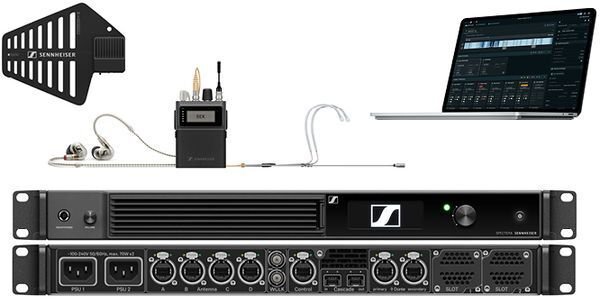
Most modern stage setups comprise both microphones and in-ear monitors, requiring you to run two independent wireless systems simultaneously. Boasting bidirectional operation, Sennheiser’s Spectera series provides a more streamlined option, enabling you to deploy mics and IEMs using as few components as possible. The Spectera ecosystem’s core components include the Base Station, SEK bodypack, DAD antenna, and LinkDesk software. The Base Station is a dual-carrier, 32-in/32-out transceiver that acts as the central hub of your setup. SEK bodypacks accommodate both mic/line transmission and in-ear monitor reception simultaneously from the same unit. The DAD is a bidirectional transceiver antenna that sends IEM signals, receives mic/line signals, and manages all bidirectional data concurrently. Finally, Sennheiser’s intuitive LinkDesk software puts comprehensive configuration and monitoring capabilities at your fingertips.
Revolutionary WMAS technology onboard
Besides the convenience offered by its streamlined system configuration, the other thing we noted early on while running Spectera through its paces here at Sweetwater was how stable it is. This rock-solid reliability is a byproduct of Sennheiser’s innovative WMAS wireless multichannel audio technology. By virtue of WMAS’s cutting-edge modulation and multiplexing capabilities, the entire Spectera ecosystem is highly resistant to dropouts and RF fading, especially when compared to typical narrowband systems. Redundant Dante connections and power supplies add to Spectera’s near-bulletproof operation, and thanks to four antenna ports, you’ll benefit from additional zone coverage and spectrum capacity. You can also optionally outfit your Spectera system with redundant MADI audio I/O connections.
Sennheiser Spectera Base Station Features:
- The central hub of Sennheiser’s Spectera wireless ecosystem
- Consolidates your entire wireless setup into as few components as possible
- 32-in/32-out bidirectional transceiver with 2 wideband RF carriers
- Enables simultaneous mic/line transmission and in-ear monitor reception
- WMAS technology manages both data and audio control using a single waveband carrier
- Straightforward frequency coordination, dropout-free performance, and near-zero latency
- Redundant Dante connections and power supplies ensure maximum reliability
- 4 antenna ports ensure extended zone coverage and added spectrum capacity
- 11 Audio Link modes supply selectable control over audio quality, latency, channel counts, and operating range
- Intuitive LinkDesk software provides simplified planning and configuration
- Assistive behaviors make managing Spectera-based wireless systems fast and easy