





The Essential 1980s Digital Reverb for 500-series
As a revved-up version of the AMS DMX15R — the world’s first microprocessor-controlled, full-bandwidth digital reverb — the original AMS RMX16 hit the streets in 1982 and proved to be an instant hit, embraced by groundbreaking artists such as Brian Eno, Joy Division, Peter Gabriel, and Tears for Fears. The AMS Neve RMX16 500 Series digital reverb converts the classic unit into a 500-series format module, presenting all of the original programs and a thoroughly satisfying tactile interface. From lush chorusing and snappy nonlinear verbs to dimensional ambience and echoes, the AMS Neve RMX16 is overflowing with recognizable effects that will blast you back in time. But producers and engineers at Sweetwater find that it offers enough sonic flexibility to bring excitement to contemporary styles, too. Fire up the AMS Neve RMX16 and prepare yourself for massive drums, sopping-wet synths, glistening electric guitars, and haunting vocals — it’s an addictive sound design tool that offers limitless creative potential!
Related Videos: RMX16 500-series Digital Reverb
Familiar look and feel in a compact format
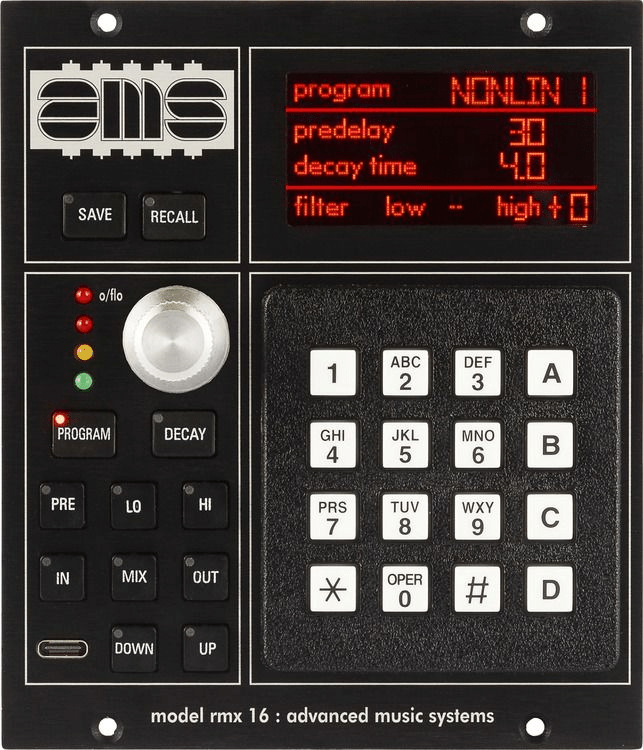
This sleek-looking unit sports the iconic alphanumeric pad, distinctive aluminum control knob, and monochromatic red display of the original unit, but these aren’t just for show! This simple and intuitive interface invites deep dives into the AMS Neve RMX16’s wealth of tweakable parameters. Pull up any of the classic presets and manipulate them to your taste by altering decay time, pre-delay, decay filter, wet/dry mix, and by using the unique nudge controls. Once you’ve conjured up a signature sound, save it to one of the 100 user memory slots for immediate recall!


18 classic program sounds
The AMS Neve RMX16 includes all nine original programs and the nine custom programs available to owners of the later-released remote control unit, including:
- Ambience
- Room
- Hall
- Plate
- Chorus
- Echo
- Nonlinear
- Reverse
- Freeze
- Delay
- Image
The legend continues
At Sweetwater, the name Neve commands reverence. Rupert Neve started designing audio equipment in the tube console era but made his mark with solid-state designs. Setting up shop in Little Shelford in the ’60s, Mr. Neve faced many obstacles establishing his brand amid a new technological landscape. Transistors were new, expensive, and difficult to obtain in quantity in the UK. Reliable faders didn’t exist yet — a far cry from today’s world, where parts are affordable and readily available from multiple suppliers, all competing to win bids. Nevertheless, Rupert persisted. And by the early 1970s, the Neve company was humming along, taking orders and building custom transformer-balanced consoles for recording and broadcast studios the world over.
Neve 80-series consoles had a huge, punchy, and authoritative sound that defined the sound of ’70s rock. From London to New York to Los Angeles and beyond, top studios were installing Neve desks as fast as they could. By 1978, with the introduction of the majestic 8078 — the pinnacle of handwired analog “production” consoles — and NECAM automation system, Neve boards were the main component of the success formula for any recording studio with world-class aspirations. In the decades since, AMS Neve has innovated with groundbreaking products such as the VR, VX, and 88R series consoles. And today, the company continues to advance the state of the art with cutting-edge pro audio gear that sounds incredible and intelligently addresses the challenges of the digital age.
AMS Neve RMX16 500 Series Digital Reverb Features:
- Iconic 1980s digital reverb unit in 500-series format module
- High-fidelity 32-bit DSP Processing with 24-bit/48kHz sampling
- Includes 9 original programs and 9 custom programs
- Tweakable parameters include decay time, pre-delay, decay filter, and wet/dry mix
- 100 user slots for storing your favorite custom programs
- Intuitive and attractive interface with alphanumeric keypad, aluminum rotary encoder, and crisp monochromatic red OLED display
- 3-slot-wide 500-series module