




Voltage Redux: Next-gen Analog Synthesis
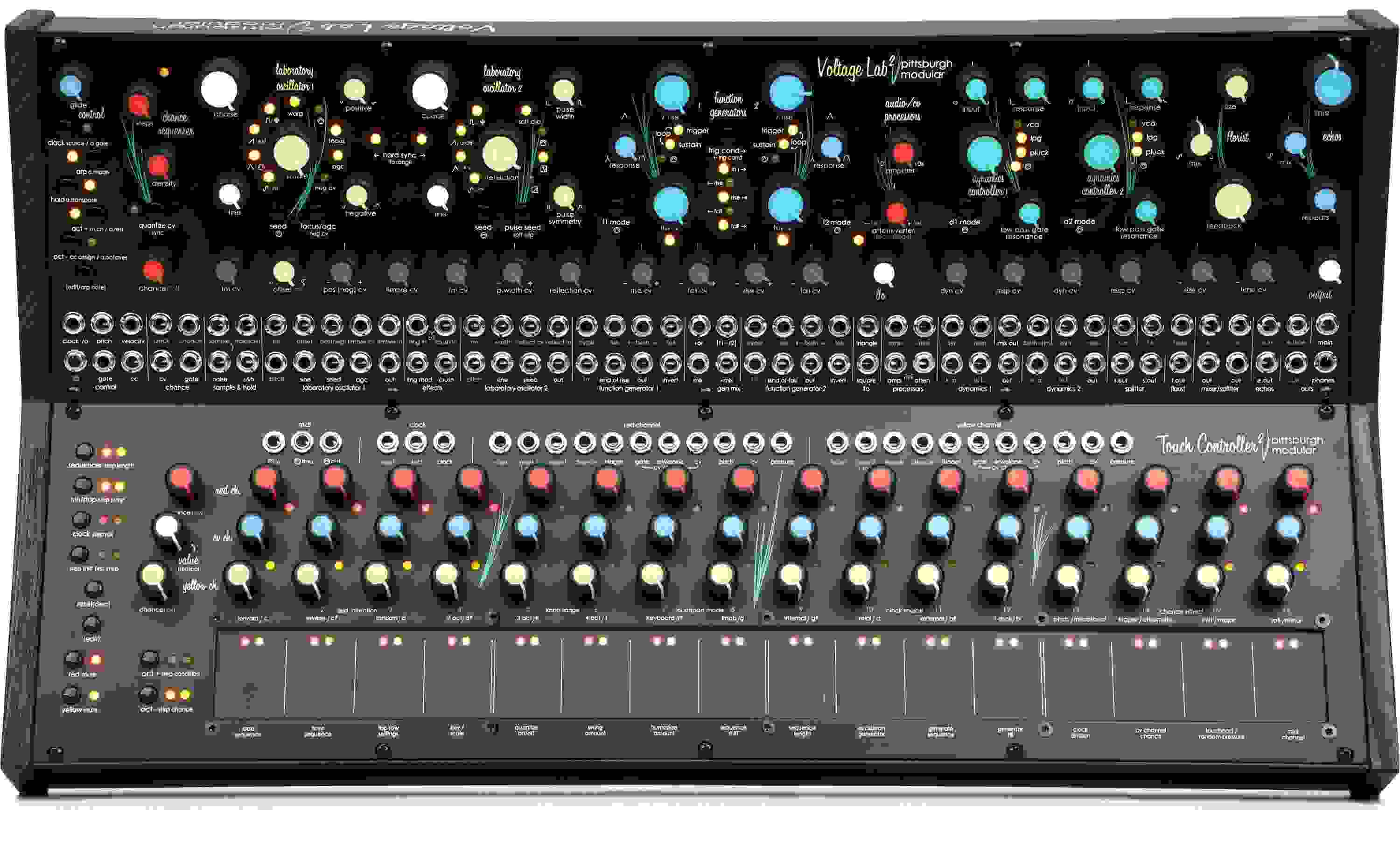
Like its predecessor, the Voltage Lab 2 is outfitted with an extensive armada of sonic-sculpting tools, paired with a 16-note touch surface that can be tuned to suit any setup. Synthesists at Sweetwater are delighted to see the Voltage Lab 2 incorporate tools developed for previous Pittsburgh Modular instruments make their way into the lab, including the Echos bucket brigade delay, Dynamics Controller, and no-dead-spots filter — each of which has been thoughtfully tooled to maximize their use within the Voltage Lab 2’s vast architecture. Versatile modulation possibilities abound, with over 100 onboard patch points to facilitate untold realms of powerful, inter-operative, and standalone sound design, from LFOs, ring modulation, and FM to per-channel probability values, function generators, complex waveshaping, and beyond. Furthermore, Voltage Lab 2 introduces state-of-the-art synthesis tools carefully developed by the Pittsburgh Modular team, including Pulse Symmetry, Reflection Wavefolding, and Center Clipping. With onboard MIDI compatibility, detailed patching possibilities, and versatile vectors of exploration, Voltage Lab 2 is precisely what synthesists clamor for: a cutting-edge sandbox of limitless sonic discovery.
Related Videos: Voltage Lab 2 Standalone Analog Synthesis Laboratory
Scions of synthesis: multidimensional wave crafting
With a reputation for innovation, it comes as no surprise that the Voltage Lab 2 is the site of multiple synthesis debuts, beginning with a duo of waveshapers: Pulse Symmetry and Reflection Wavefolding. Pulse Symmetry reimagines the principles of pulse-width modulation (PWM) to include a step between the peak and valley of a waveform, creating a second point of adjustment, in addition to standard PWM. Reflection Wavefolding mirrors the bottom half of a waveform and reproduces it up top, resulting in complex harmonic behavior and waveshape mangling that produces unusual sonic attributes, just waiting to be explored. Furthermore, the Center Clipping capabilities found with Oscillator 1 provide unprecedented control over your analog waveforms, processing them outward, from the center, instead of inward, from the peaks. This lets you mangle, modulate, and modify the harmonic and timbral attributes of your sound without affecting its pitch value.
Dynamic textures and exorbitant effects
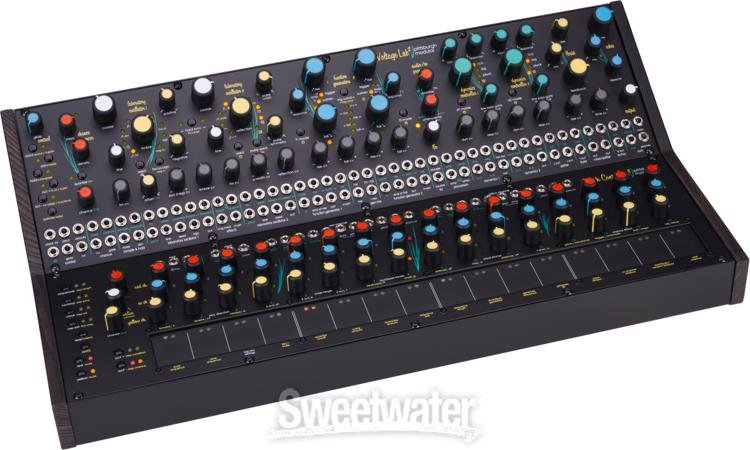
Voltage Lab 2 is outfitted with a dyad of time-based analog effects: Florist and Echos. Florist sits in the liminal space between flanger and chorus, simultaneously both and neither, optimized for short, shimmering shifts that deal exceptional ringing via deeply controllable feedback prior to entering self-oscillation. Echos, by contrast, supplies a bucket brigade delay rife with dark analog character, tooled for longer-scale repeats and malleable feedback. The onboard Dynamics Controller can be imagined as an evolved VCA, with one for each oscillator channel, managing and attenuating values of amplitude and harmonic content at the same time. The Dynamics Controller operates in multiple modes, including a conventional VCA, a shapable pluck, or a lowpass gate, augmenting your output with greater depth and dimension.
Hands-on interfacing and complex control
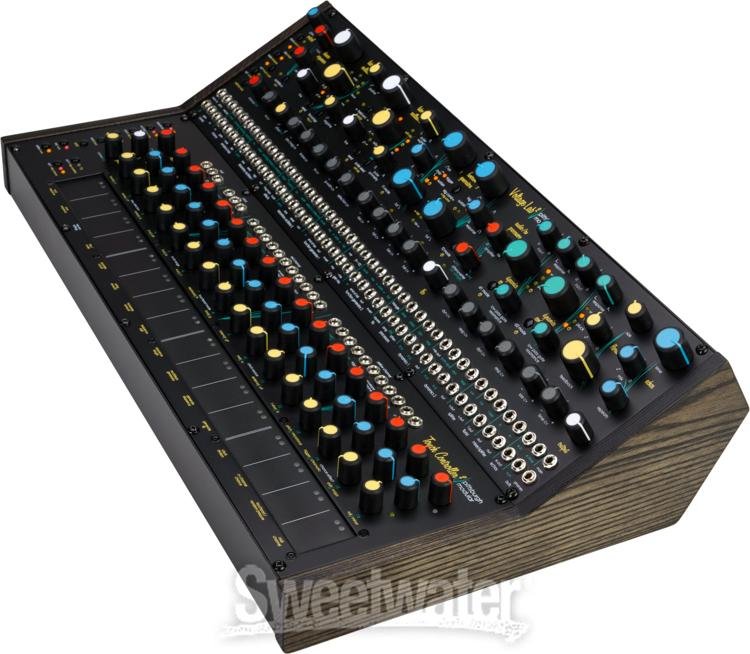
Though a different version was found with its predecessor, the Voltage Lab 2 boasts an upgraded interface: the Touch Controller 2. This 16-note touch-sensitive surface features dedicated controls for each panel, including tuning, key assignments, sequencing, and more, blurring the boundaries between pitched performances and aural experimentation, all with a heaping dose of expressive possibilities. All 16 notes include dedicated per-channel pitch knobs and CV channel knobs, expanding your opportunities for sonic R&D through Red- and Blue-channel arrangements. Moreover, the Voltage Lab 2 is fully capable of internal and external MIDI processing, including a MIDI to CV converter, assignable MIDI channels, external MIDI clocking, and complete control via MIDI controller.

Step into sequence, sound, and beyond
Sequencing and arpeggiation come in multiple voltaic shades on the Voltage Lab 2. Scale and key values can be assigned as chromatic, major, minor, and even microtonal arrangements, with upwards of 32 steps for each octave. What’s more, each step is deeply modifiable, boing beyond pitch to include multiple step shapes, sizes, destinations, and probabilities alongside jumps, rolls, gate lengths, and envelope lengths. At the global level, the robust sequencer introduces additional reality-bending vectors of aural excavation, including variable swing, quantization, humanizing elements, and touchpad use, alongside sequence, fill, and Euclidean generators.
Malleable modulation
Yes, there’s still more the Voltage Lab 2 can achieve. Across analog and digital synthesis tools, the Lab brims with modulation mechanisms that are more conventional than the wavefolding wizardry above. Ring modulation and FM are complemented by malleable bit-crushing and bidirectional Hard Sync capabilities. At the same time, its dyad of Function Generators can work independently or in concert to evoke complex voltage-controllable modulation via variable sustain, slew, LFO, gate delay, and further parameters. The Voltage Lab 2’s noise generator includes a patchable Sample & Hold circuit, and its analog tools offer an amplifier, attenuator, mixer/splitter, dual-range LFO, and signal-splitter controls to manage sound at every level.
Pittsburgh Modular Voltage Lab 2 Features:
- Groundbreaking Pulse Symmetry, Center Clipping, and Reflection Wavefolding inject never-before-seen sound design tools into an exceptional dyad of analog oscillators
- 16-note touch surface supports malleable pitched performances with individually tunable outputs and per-channel assignments
- Comprehensive MIDI and CV compatibility expands control options to ensure seamless interoperative use with nearly any setup
- Detailed sequencing and arpeggiation tools support near-endless combinations of rhythmic, pitched, and time-based performances, including Euclidean generators and probabilities
- Florist flanger/chorus effect supports short-term shimmering textures for bright, quick transcendence into self-oscillation
- Echos bucket brigade delay produces long, dark analog repeats for classic-inspired texturization
- Dynamics Controller offers multiple modes of processing, including a VCA, shapable pluck, and lowpass gate
- 100+ patch points ensure unrivaled modular integration and boundless CV possibilities
- Versatile modulation comprises ring modulation, FM, bit-crushing, and Hard Sync to provide dimensionality in your sound design
- Dual Function Generators can work independently or intertwined to conjure complex modulation across multiple realms of Voltage Lab sonics