



As Foretold, a Scion of Analog, Dual-layer Synthesis Is Reborn!
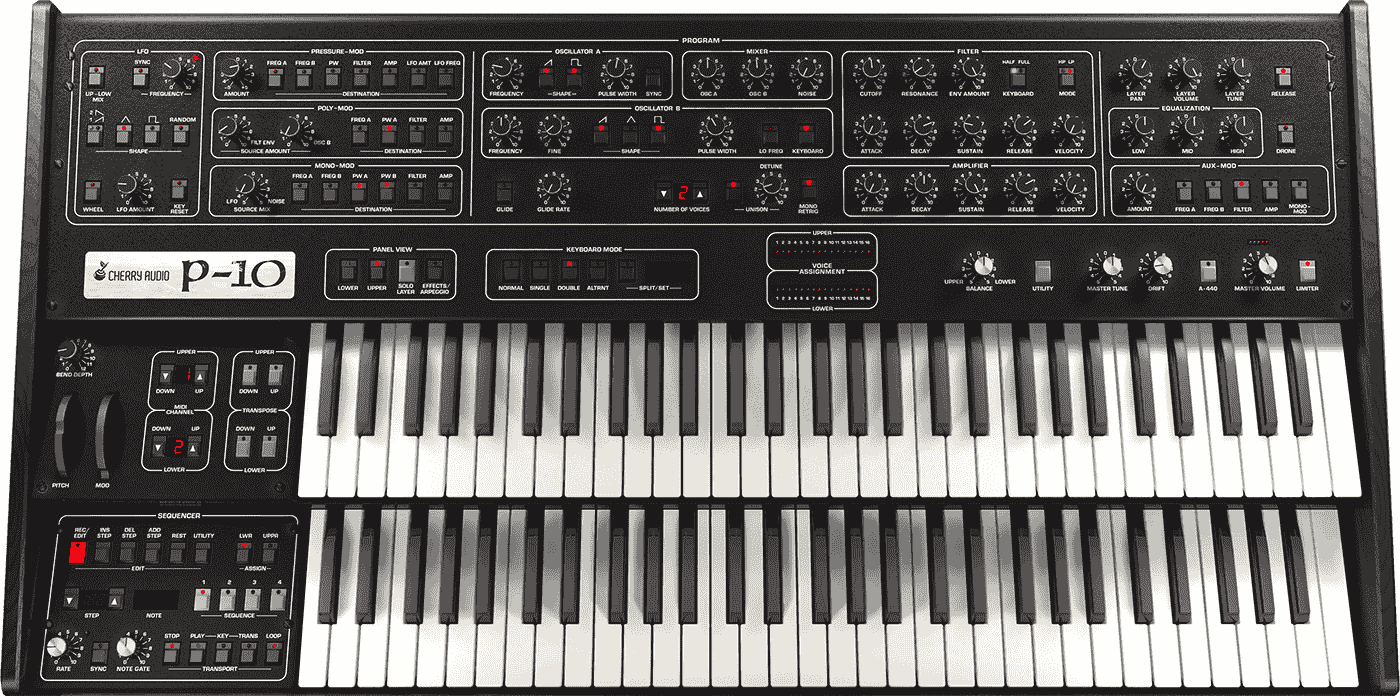
Back in 1980, an analog, polyphonic powerhouse of synthesizer sorcery emerged, boasting a dual-layer design that fused the pentacle of polyphony that its 5-voice predecessors produced into a powerful polysynth greater than the sum of its parts. Now, nearly a half-century later, Cherry Audio has endeavored to capture the magic of this mammoth music-making machine with some welcome expansions that have Sweetwater’s production pros and synth scholars alike enamored by its augmented architecture: the P-10 virtual polyphonic synthesizer. Through a combination of cutting-edge modeling technology and taking the utmost care in mapping and understanding each component of its spiritual predecessor, Cherry Audio’s P-10 features laser-precise emulations of both the Curtis 3340 oscillators and 3320 filters that were integral to the soft synth’s real-life counterpart. What’s more, the groundbreaking mono- and polyphonic sequencing, modulation, and aftertouch capabilities of the original not only return for the P-10 but have been expanded to include the now-sixteen voices of per-layer polyphony — a sonic tsunami of possibilities, upgrading from the original’s five per-layer voices. It all adds up to a staggering 32 total voices of virtual voltage, with extensive per-layer power meeting immense MIDI-mapping opportunities, with more than 500 presets that include all the patches from the five- and ten-voice variants of P-10’s hardware precursor. Classic and contemporary collide with P-10 for a cutting-edge virtual instrument that Cherry Audio and Sweetwater are eager to deliver to the world. Now, where will you start?
Related Videos: P-10 Virtual Polyphonic Synthesizer Instrument
Vintage voicing, virtual voltage, and voltaic versatility
The phrase, “If it ain’t broke, don’t fix it,” rings especially true for Cherry Audio’s P-10 soft synth. The company methodically threaded the needle between capturing the lush analog character of its predecessors and expanding its foundational capabilities to thrive in the modern music-making landscape. Like the original, the virtual VCOs offer ramp, triangle, and PWM (pulse-width modulation) waveform options that are all simultaneously available. Further honoring its forefathers, the P-10 offers multiple performance modes that derive from its dual-layer voicing architecture. You can redline its 32 voices as a single, gargantuan synth; treat each layer as independent instruments, with 16 voices for each; assign unique presents to each layer; and run the P-10 in such a way that the input of each keystroke alternates between the sounds assigned to each layer. What’s more, the P-10’s split- and stacked-layer modes can be used in conjunction with its slew of arpeggiation, modulation, effects, and dynamics controls, with each layer capable of being configured individually for every parameter.
Layers, layers, and layers: endless potential, tailored to suit
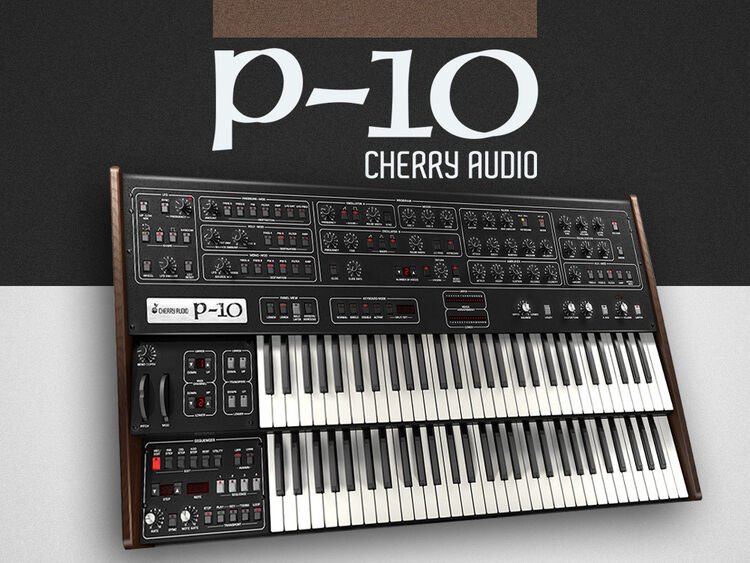
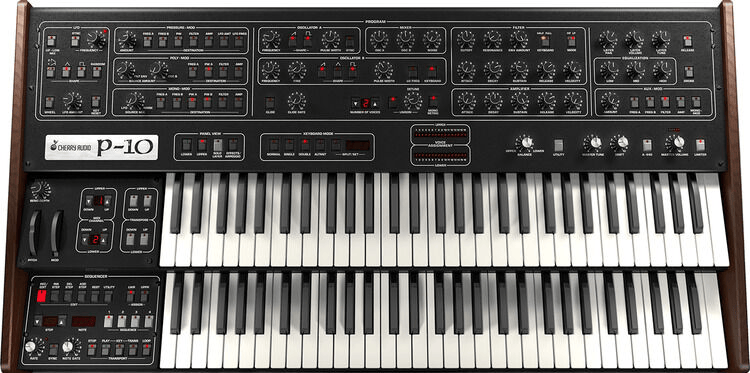
While the historic flagship polysynth was renowned for what its two-layer design creatively afforded, limitations on price and technology prevented it from going further. The P-10 takes up this mantle, giving this vaunted, vintage instrument an encore of multidimensional musicality and modularity. Each layer — regardless of how you choose to configure them — offers a laundry list of per-layer parameters for you to endlessly tweak, refine, automate, and customize. Dynamics controls comprising panning, volume, and tuning can be adjusted for each layer, with additional vintage-derived terrain to traverse, thanks to the per-layer drift parameters that imbue heaps of iconic warmth and delectable deviation that make classic analog synthesizers so distinguished from the digital ‘perfection’ that would follow. Effects, modulation, and step-sequencing tools are also available and assignable at the per-layer level, including effects-LFOs, pressure-induced modulation of effects via aftertouch, and modulation of key-based effects by an LFO or noise generator. Even the tempo-syncable arpeggiator can be deployed for one or both layers and independently attenuated!
Step into sequence: four layers of ferocious formation
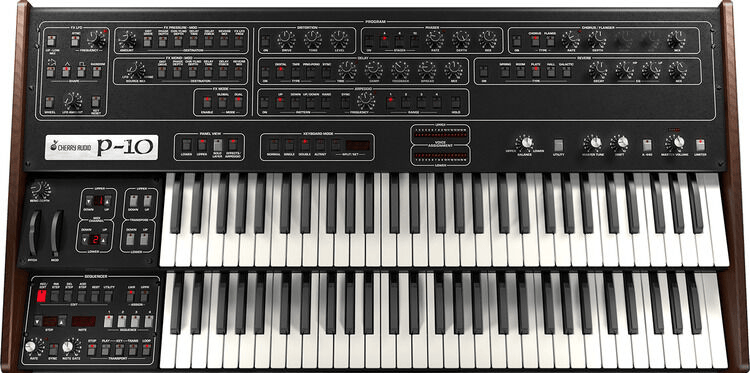
In addition to endowing P-10 with an expanded, 32-sum-voice polyphony, Cherry Audio took the utmost care to preserve the voice of its iconic originator while expanding its prowess through velocity sensitivity, polyphonic aftertouch, keyboard splitting, and a 4-track step-sequencer for starters. In the case of the last option, this amounts to four completely independent, 128-step monophonic sequences that can be freely assigned to your layer of choice, in addition to being saved as part of a preset. Moreover, the step-sequencer’s utility operations let you seamlessly copy, swap, or move sequencing data across tracks and presets.
Modulate wildly: mono, poly, pressure, and beyond
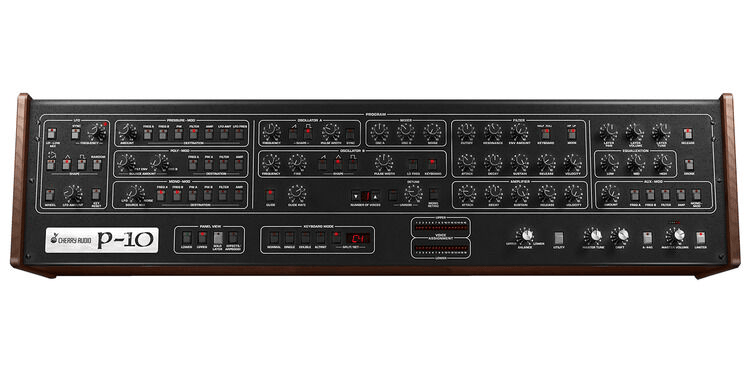
LFOs, with P-10, bring not only the original array of waveforms to its virtual fold, but adding both a Random waveform, as well as a tempo-sync option that includes key-based reset. Modulation abounds, and the madness comes in both monophonic and polyphonic varieties, with aftertouch of both flavors capable of modulating oscillator frequencies, pulse-width, filter cutoff, LFO frequency, LFO amount, and VCA amplitude through P-10’s Pressure Mod. The mosaic Poly Mod reimagines what polyphonic voicing can achieve, routing one or both of the Oscillator B behaviors and the filter envelopes of each voice to modulate the pitch, pulse-width, filter cutoff, and amplitude values of Oscillator A.
We’re not done yet, however, as P-10’s polyphonic possibilities aren’t the sole bearers of the limelight. The Mono Mod uses values from the noise generator, LFO, or both to modulate the VCA amplitude and filter-cutoff values, as well as the frequency and pulse-width parameters of both oscillators. Lastly, Cherry Audio took it upon itself to expand the galvanizing performance potential of the originals’ Pedal Mod, imbuing P-10 with Aux Mod. Rather than confining the modulation of oscillator frequencies, VCA, filter cutoff, or Mono-Mod amount to a pedal, Aux Mod lets you control these parameters with any form of MIDI-based hardware control, from classic controllers and external instruments to imaginative interfacing tools and beyond.
Sonic contouring abounds: classic filters and cutting-edge effects
Vintage synthesizers remain so lauded for their characteristic warmth, uneasiness, and a certain heft that comes through the sound as an inevitability of its physicality. However, a synth’s filter is the often-unsung hero of its distinctive output, and Cherry Audio understands as much. To this end, the company’s team knew they had to masterfully capture the CEM3320 filter of its heritage inspiration, outfitting P-10 with the same character, including the iconic 24dB/octave lowpass filter mode, alongside an augmented highpass filter mode.
Texturization tools don’t stop there, however, as the P-10 features a suite of flexible yet focused sound-shaping possibilities by way of dual, independent effects chains that can be configured for global or per-layer use. A multidimensional, multi-stage phaser offers 4-, 6-, and 12-stage modes, while malleable flanger-chorus effects open doors to prismatic stereo sculpting. Delays and reverbs emerge in three and five forms, respectively, with extensive tempo-sync capabilities supporting multitudes of dynamic spatialization. Rounding things out, onboard distortion becomes your gateway to tenacious timbral contouring, from subtle dirt and gravelly grit to searing sonics and scorched-earth solos.
Cherry Audio P-10 Features:
- A masterful emulation of a flagship analog polysynth with classic character and expanded creative tools, combining state-of-the-art modeling technology with unrivaled attention to detail
- 500+ diverse and professionally crafted presets include the SyxEx data of the patches found within both the 5- and 10-voice precursory instruments
- Expanded voicing architecture supplies up to 32 voices of total polyphony
- Malleable stacking and layering support the inventive use of the original’s dual-layer design, extending far beyond the capabilities of the historic hardware that inspired Cherry Audio
- Painstaking emulation of the original’s CEM3340 and CEM3320 VCO and VCF, respectively, guarantee time-tested character meets contemporary virtual versatility
- Multidimensional modulation includes monophonic and polyphonic modes alongside LFO, noise, mono/poly aftertouch, and auxiliary MIDI control
- Extensive per-layer controls of effects, dynamics, drift, arpeggiation, unison, drone, voice count, glide, noise, unison, and detune mean immense sound design
- Layer utility functions make easy work of duplicating, swapping, saving, and exchanging sequencing, arpeggiation, synth parameters, and effects between layers and presets
- 4-track step-sequencer delivers four simultaneous lanes of monophonic sequencing, up to 128 steps of user-definable length, with per-layer deployment
- Dual studio-tier effects chains offer distortion, multi-stage phaser, flanger, chorus, 3 delays, and 5 reverbs, with global and per-layer use
- Comprehensive MIDI control and DAW automation make for extensive interoperative integration with hardware and software instruments, effects, tools, and more