

Marshall Amplification at Sweetwater

The History of Marshall Amps
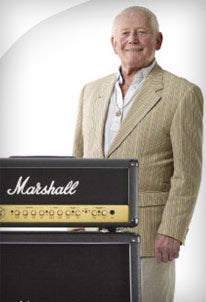 Behind every successful enterprise, there is always a very human aspect. In the case of Marshall, the company's success is closely tied to the history of Jim Marshall himself.
After a difficult childhood ruined by illness, Jim started work in 1936 at the age of 13, with no formal education. By the time he was 14, his interest in singing led to a part-time evening job in a band. After a succession of day jobs with little or no prospects, Jim began a career in engineering as a toolmaker, largely on the strength of his own learning from books. His semi professional music career had blossomed into regular work playing the drums, and by 1947 he began to study under Max Abrams — a highly respected drum teacher.
Jim was so busy playing and teaching his own pupils by the early '50s, that he had to consider turning professional. He quickly became very successful as a sought-after professional drummer and as a drum teacher, with up to 65 pupils a week attending his school. From the amount of retail business his drum school was generating, it became obvious that he should open his own shop. In 1960 the first Marshall shop was opened.
- «
- »


Drums to Amplifiers by Demand
Many of Jim's pupils became successful with their own bands and, consequently, began to bring their guitarists and bass players into the shop. Their demands for guitar products meant that Jim now had to stock guitars and amplification. Jim soon realized that he could produce his own cabinets to cope with the louder volume levels. He turned his garage into a workshop, building just two cabinets a week in 1961. By 1962 an amplifier was needed to provide something extra for the rapidly developing guitar players, and Jim enlisted the help of Ken Bran, an electrical technician and former customer. After months of trials they finally settled on the design — the Marshall sound was born.
Unique Tonal Quality
The first amplifiers were totally hand built on aluminum chassis with 5881 valves (similar to 6L6s). Serial numbers started at 1000, though the first three or four were taken by prototypes. When demonstrated in the shop, these early amps caused a sensation. The quality of the tone was something unique and previously unheard. Orders for 50 were taken from that first model.
The First Factory
The Marshall business became highly successful, and a second shop was opened. The original shop was now the amplifier manufacturing plant, and the back of the second shop was the cabinet workshop. Output was still too low, so in 1963 a small factory in Southall was set up to manufacture cabinets. Even this was not enough to cope with the demand created by the reputation of the Marshall sound and the growing list of endorsers.
New premises had to be found, and in 1964 a 5,000-sq.-ft. factory in Hayes, Middlesex, was set up. Output now reached 20 to 30 amplifiers a week plus 60 cabinets. As emerging bands such as The Who began to reshape the presentation of music, demand grew quickly, as other players wanted a piece of the "wild" Marshall sound. Pete Townshend was instrumental in the next major step. His wish to drive harder accelerated the development of the first 100-watt heads. He also asked for a special 8 x 12 cabinet. The impracticality of this cabinet led to a "stacked" version (i.e. , one 4 x 12 on top of another). The Marshall Stack was here!
Marshall Explosion
By the end of 1965 a production of 40 amplifiers and 100 cabinets per week was unable to reduce the growing back orders. Demand, fueled by the appointment of a distribution company, exploded. The world was crying out for more Marshall. The solution was another move. Marshall now moved to Bletchley, Buckinghamshire, into 7,000 sq.ft. Export sales grew as the success of British bands spread abroad. Throughout the 1960's Marshall sound powered the most influential and original guitar players, from Pete Townshend with The Who to Eric Clapton with his distinctive Bluesbreaker tone to Ritchie Blackmore with Deep Purple to the greatest ambassador of all, Jimi Hendrix. With his prodigious guitar talent, Hendrix used the power of Marshall as a creative tool and as an extension to the guitar itself. In 1968 the sales explosion created the need for greater capacity. A 14,000-sq-ft. purpose-built factory was opened, and at last the world market stood a chance of fulfillment. Investment in massive PA systems powered the tours of many early-'70s "super groups." Multicolored Marshalls appeared, and the product range expanded.
By 1975 the first transistor heads were introduced, followed by the first Master Volumes in 1976. Guitar styles soon adapted to squeeze the most from this extension of the Marshall sound. Here began the quest for gain, which continues to this day.
1981 saw the introduction of the JCM800 Series, and the long-awaited Split Channel amplifier came in 1982, and was an instant success.
Marshall TodayAs the company grew, Jim assembled a first-class team, which in the lead-up to the '90s, took Marshall to new heights. The factory has now extended to 7,0000-sq-ft., and the workforce has grown to over 200. The present generation of ever-more-demanding guitar players is enjoying even new innovations. The DSL and TSL Series amps offer Marshall sound times two and three, respectively, while the Vintage and Handwired Series offer everything you could love about the past!
One thing still holds true: Marshall sound is as unique as the man himself was. Though the world lost Jim Marshall on April 5, 2012, both his spirit and the sounds he helped create will remain with us all as long as guitar players play and fans want to be inspired.
