


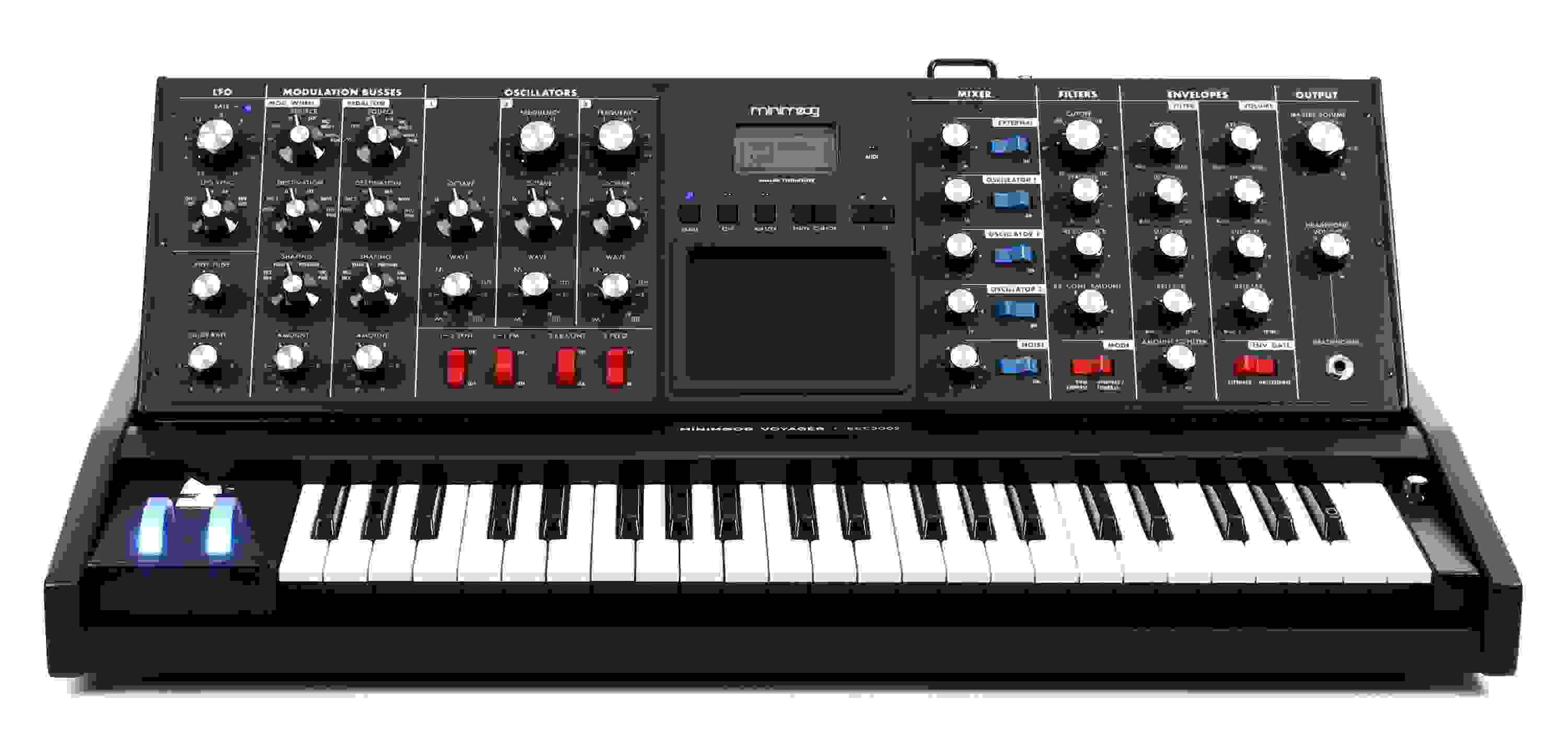

Legendary Moog Sound in an Electric Blue Case!
The Electric Blue Voyager is housed in a fractal blue solid ash cabinet. At first it looks black but as one draws near the fractal blue flecks pop out in an eye catching display. Combine this with the stunning look of the electric blue back lit panel, new blue LEDs, and some new killer patches and you have an instrument you will be proud to play for a lifetime.
Related Videos: Minimoog Voyager Electric Blue Edition
- The ultimate analog synth in a stunning new case!
- Classic Moog oscillators, filters, and amplifiers
- MIDI I/O plus control voltage connectors
- New features and seven banks of 128 presets (896) with version 3.0
The Moog Electric Blue Voyager is the newest incarnation of the ultimate monophonic analog performance synth. It incorporates virtually all of the sound resources and functions of the original Model D Minimoog, which was produced by Moog Music, Inc. from 1970 to 1982. The Electric Blue Voyager has many new additional features, including MIDI IN and MIDI OUT implementation, extensive patching facilities, and a large number of new panel features.
Classic Moog oscillators, filters, and amplifiersThe Electric Blue Voyager's signal path starts with a bank of three wide-range, high-stability voltage controlled oscillators, one noise source, and one audio preamplifier for externally-applied audio signals. The sound modifiers are two 'Moog-style' lowpass filters and one VCA (Voltage Controlled Amplifier). Modulation sources are two ADSR (Attack Decay Sustain Release) envelope generators and one multi-waveform LFO (Low Frequency Oscillator).
MIDI I/O plus control voltage connectorsThe Electric Blue Voyager's rear panel delivers all of the same input/output resources that are available on the Voyager via its MIDI IN, THRU, and OUT connectors, four audio input and output jacks, and two accessory port connectors. The output accessory port connects the RME's 21 control and gate outputs to the forthcoming VX-351 Voyager CV Output Expander, while the input accessory port connects the 18 control and gate inputs to the VX-352 Voyager CV Input Expander.
- Storage Mode - This sets the behavior after a preset is stored. The user is prompted: Go to stored Preset after Saving? If YES is chosen in this screen, then after a preset is stored to a new location the UI goes to the new location. If NO, then after a preset is stored the current location is maintained in the UI.
- Glide Modes - There are now 8 glide modes. 1 of 8 is stored in a preset.
- Mode 1: Normal Glide (glide is always on)
- Mode 2: Legato Glide (glide is only on when you play legato)
- Mode 3: Legato Glide to 2nd Only (glide is off when not legato, when the first note of a legato phrase is played, and when returning to the first held note of a legato phrase. Glide is on for the 2nd + notes of a legato phrase.)
- Mode 4: Legato Glide back to First only (glide is off when not legato, when the first note of a legato phrase is played, and when subsequent notes are legato, glide is on when returning to the first held note of a legato phrase)
- Mode 5: Legato 1st Note (Glide is on if not playing legato and is Off when playing legato)
- Mode 6: Mode 4+5 combined (this is Glide mode 4 and 5 combined)
- Mode 7: Legato back to first = glide off (Glide is On when not playing legato, and when playing legato but is turned off when returning to the first held note of a legato phrase)
- Mode 8: Legato Glide toggling (for legato playing, glide is on for two notes, then off for two notes)
- Quick Save - If a preset has been edited, pressing the Master switch twice saves the preset to the present location.
- Sound Category Browse - If Enter is pressed, the Preset advances to the next available sound in the bank or in the subsequent bank with the same sound category - this is useful for searching for all lead sounds, bass sounds, percussion sounds etc... pressing Enter AND Cursor goes backwards in the progression of the sounds in that category.
The External Mixer knob (just right of the display panel) has a dual function that allows you to rapidly change presets as opposed to continuously punching the cursor buttons.
MIDI Enhancements:
- Allows you to send either 7 or 14 bit resolution from the Mod Wheel.
- Optionally reduces the amount of MIDI data being sent from the Touch Surface.
These changes enable the Voyager to work better with older MIDI equipment.
Moog Electric Blue Voyager Features:- Legendary Moog sound in a stunning new case
- Blue backlit panel and blue LEDs
- Three wide-range, high stability VCOs with continuously-variable waveforms.
- Two "Moog-style" lowpass-resonant filters with choice of two-pole or four-pole response
- Five-input mixer for combining the audio sources prior to filtering
- Two wide-range ADSR (Attack Decay Sustain Release) envelopes
- Filter Envelope sweeps the filter and is available for modulation shaping
- Volume Envelope shapes the overall volume
- Low Frequency Oscillator generates triangular, square, Sample & Hold, and smoothed Sample & Hold waveforms for use as modulating signals
- Modulation Busses Module selects sources, destinations, and shaping signals for the MOD WHEEL bus and the EXT PEDAL bus
- GLIDE varies the speed at which the keyboard voltage changes, from instantaneous to several seconds
- Extensive MIDI implementation capabilities