
$6K PRS Line 6 Giveaway

Manley Massive Passive Mastering Version
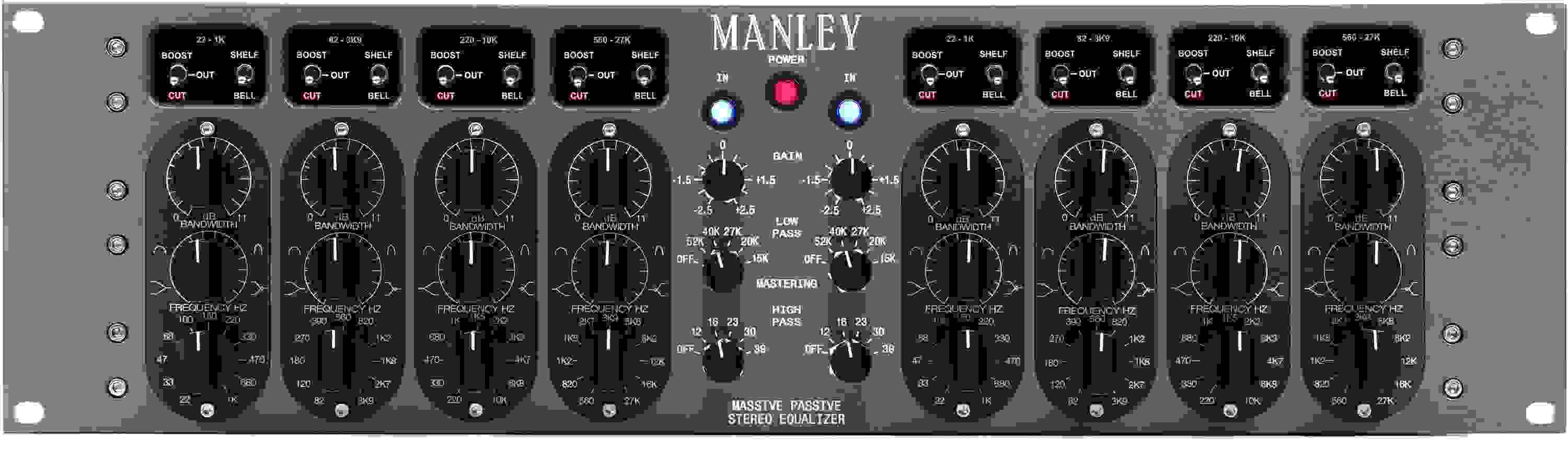
Item ID: MPMaster
Manley Massive Passive Mastering Version
Reviews for

Manley Massive Passive Mastering Version Reviews

Stereo Tube 4-band Mastering Equalizer

The Manley Massive Passive Mastering Version equalizer features a simple, passive design - not a standard parametric design - for more natural, organic shaping. It also offers mechanically detented knobs for both Gain and Bandwidth controls, so you can easily repeat your settings. On the Massive Passive Mastering Version, both the Gain and Bandwidth controls intentionally interact, and the bands interact, as well — this creates an incredible-sounding result without sounding "colored" or "processed." Also, both higher and lower than the normal version, the Manley Massive Passive Mastering Version's filters are tailored to mastering purposes.

More Details
Price:$8,399 and 00 cents
Special Financing - Ends Aug 2, 2026. $234/month with 36 month financing*
Add to Cart
We Can Get It Fast!

While this isn't an item we normally stock, we can still get it to you as fast as possible due to our great relationship with Manley. Go ahead and place your order and we'll follow up shortly to let you know when to expect it. Estimated May 2026.

Page 1 of 1
January 30, 2024

Stereo Pultec With Mid

By Amir B.

I want to share with you my personal experience of working with this device for several years.
You will find the great depth that MP adds to the sound in very few devices
Also, Tube material does not work well in simulations and plugins. I have the UAD2 version, but it is very different and has no depth. I have not seen any company that can simulate lamp devices well.
Basically, this passive equalizer is made with very high quality similar to the high quality vintage versions
Keep one point in mind that with a lot of conversion and a lot of back and forth, you reduce the very high quality of the device
Try to use external devices in the summing chain or insert and convert only one

April 10, 2020

Music comes to life

By Ted L. from Kalamazoo Michigan
Music Background: Engineer, musician, dad

Love this EQ. I opted for the mastering version even though I'm mostly using for final mix downs on my master buss. I don't use a DAW, rather run a couple hard disc recorders like a tape machine. This thing just makes everything sound better. Everything. Life is my best description. Songs come alive (life) when this thing is engaged. The frequencies are located well and can be bell or Shelf and are parallel. I mix through an analog SSL desk and this thing is just great on my master buss. It's pricey and built like all Manley gear, fantastic. It's a workhorse, with tone for miles, and I can't imagine working without it. I hear the regular version is better for special effects and tracking and had more dB available and slightly different eq frequency points, so if you were wanting to use it for tracking the regular version may be preferred. Mine has detents for recall, and slightly different points and slightly less boost cut dB. I won't hesitate to track with mine, at all. My master buss may not let me take it off, too cozy there. I would recommend either version, depending on your needs.

Read More
February 7, 2020

Built like a tank, beautiful craftsmanship and utility

By Happy O. from Maryland
Music Background: Mastering engineer, studio engineer, musician

Fantastic piece of technology that was obviously borne of TLC. Just a lovely and unique equalizer. The detented knobs are perfect, easy to "program" (manually set, then later re-set to the exact same positions if necessary). I have other mastering equalizers with detented knobs, and I prefer the nice, fat, clicky MPMST knobs/switches. They're easy to set, easy to re-set, and that's just the physical aspects of this unit. It is built like an absolute tank, which isn't surprising for Manley gear.

Sonically, it is easy to fall in love with. It can be absolutely transparent and subtle. It can also radically shape the sound, though it's never unmusical to my ears. I almost always start with the MPMST. If I can master a mix only using MPMST for curve bending, I consider it a good mix! If I need to add in other EQs, I "downgrade" the mix (in my mind; not out loud!). The MPMST is my personal "gold standard" for shaping.

I'm sure the Manley team agonized over the specific frequency selections, which seem well-chosen for most material. And there is a lot of overlap between the bands, which provides a great deal of flexibility, especially for more surgical fixes. From left-to-right, and clockwise per knob:

Band#1 -- 22, 33, 47, 68, 100, 150, 220, 330, 470, 680, 1K
Band#2 -- 82, 120, 180, 270, 390, 560, 820, 1K2, 1K8, 2K7, 3K9
Band#3 -- 220, 330, 470, 680, 1K, 1K5, 2K2, 3K3, 4K7, 6K8, 10K
Band#4 -- 560, 820, 1K2, 1K8, 2K7, 3K9, 5K6, 8K2, 12K, 16K, 27K

The Q knob goes from wide to notchy when in Bell mode. Even on the most narrow setting, it never sounds like a cold "filter" to me. It sort of finesses the bands in a sweeter, breathier way. When in Shelf mode (note that EVERY band can be used in Bell or Shelf mode!), the Q knob rolls off or boosts frequencies very nicely.

If you want one of these because have a pile of cash to burn, don't buy it! You will probably be underwhelmed and disappointed. The bands on the MPMST are not extreme Moog-type filters. You won't be able to save a **** mix with this. (Combined with other EQs, sure. But by itself, it's not even meant for that.) But if the material is even halfway decent OMG! You can take a so-so mix from "meh" to PERFECT. If that's what you're looking for, this is the mastering EQ for you. It requires patience and a willingness to get to know this unit. But once you've mastered a dozen or so mixes with this, you'll start to understand how powerful this EQ is. You'll also start to think of other applications (e.g., tracking, audio repair, etc.).

It is a mastering EQ intended for mastering. Sure you can use it for not-mastering, but why spend this much money if you don't intend to use it for mastering? If you're a mastering engineer, or even an aspiring mastering engineer, the MPMST will pay for itself in more ways than one. The only maintenance you might ever need to perform is changing the valves (if ever). It will easily outlast you! It is an incredible value and a solid investment. I think it is a marvel of audio engineering.

Kudos to my longtime Sweetwater sales engineer, Richard Whittington, whom I don't credit nearly enough! He's provided great service over the years and solid advice.

Read More
January 18, 2019

The Best Musical Tool I've ever have!

By Sweetwater Customer

I got this mastering version Massive Passive couple years ago! Not only use it for mastering, but also use it a lot for tracking. so musical, so smooth. It just like the best vanilla ice cream, sweet and smooth. when you turn the knob, all the hidden goodies underneath the ice cream all come out. When tracking, I like it on bass a lot, I can easily control the bass, bring out the picking attack or string sound I want without harshness. Anyway, the best EQ I've ever have by far

December 7, 2018

Game Changer

By Ryan from Orange County
Music Background: Audio Engineer

Once you run a mix through one of these, you will never settle for anything less!

October 11, 2018

Everything and more

By Josh W. from Los Angeles
Music Background: Music Producer

I honestly don"t know how I"ve worked without the Massive Passive. It is really a magical piece of gear. The depth of field is incredible. Built like a tank, as all Manley products are. Big shout-out go Brian Loney for getting it to me quickly!

December 22, 2015

Legendary EQ

By Johnny H. from NYC: Black Magic Studios
Music Background: Engineer, Production, and Sessions Musician

I first became aware of the Massive Passive about 20-something years ago when I was working with ADATs and a Soundtracs Topaz 8-buss board. At the time I could only dream about getting one. Now, my studio situation at the point that I was able to get one -- a dream come true. So, does the unit live up to my expectations? Short answer -- it exceeded them.

While the mastering version is obviously geared for mastering use, I found it highly usable for giving tone and weight to individual stereo tracks for mixing, such as drum busses, stereo guitar busses and two stereo piano recordings. The difference between the mastering version and the regular version is that the mastering versions knobs are all stepped, whereas the mix version's controls are continuous. Additionally, according to the user manual, the boast/cut controls offer greater gain/attenuation on the mix version than the mastering version. Still, I find a notch or two cut or gain change makes a big difference on the signals.

Attenuating frequencies on the MP is counter-intuitive at first because you first have to select the frequency that you wish to cut, engage the "cut" switch and then turn the gain control clockwise as if you were increasing the gain on another EQ. However, it quickly becomes second nature once you do a session with the unit.

The sound? Glorious and rich are the words that come to mind. Simply passing your signal through the MP, without any frequency gain or reduction changes instantly gives a subtle, though noticeable bigness and clarity to the sound. So far, I've used the MP on mastering an R&B album, a heavy metal track to be used in a movie trailer (as well as the trailer itself in post-production) and for an acoustic jazz EP. In all cases, the MP gave me everything I needed. I never felt the need to bring in a multi-band compressor or other specialty processor. My mastering chain now consists of the Slate VTM into the Shadow Hills Vandergraph followed by the MP and finally the UAD Precision Limiter.

In sum, in using the MP, I feel like I'm almost cheating in being able to get a rich, warm character on whatever signal I pass through it.

I also have the UAD version of the MP and I was able to make a side-by-side comparison between the UAD version and the real deal. My findings? While the UAD is close and it is a fine EQ in its own right, there is a discernable difference between the two. First off, the UAD is about a 0.5 dB to 1 dB hotter at unity gain than the real unit. Secondly, the real Manley is far more graceful when you push it. The plug-in tends to lose its warmth when pushed whereas the Manley still shines when pushed.

Most noticeable, however, is that the Manley simply has more organic vibe and girth that the software does not quite replicate. Perhaps it's the transformers? Perhaps it's the inherent noise (albeit low level) that analog introduces into the signal? Whatever it is, the real deal is simply more pleasing to listen to. Obviously, spending over $5k on 2-channels of EQ is not an impulse purchase. However, if you have the client base to justify the special magic that the hardware Manley MP gives, it is definitely worth every penny.

Read More
of

Have Questions About the Massive Passive Mastering Version?

Or call us at (800) 222-4700

Questions about the Manley Massive Passive Mastering Version?

Sweetwater's Sales Engineers are regarded as the most experienced and knowledgeable professionals in the music industry, with extensive music backgrounds and intense training on the latest products and technologies. They are available to offer you personalized product advice any time you need it.

Type your question below or call us at (800) 222-4700
Thank You!