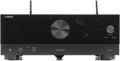
Whether you’re talking cinema-grade home theater systems or hi-fi stereo rigs, the all-powerful receiver is the beating heart of home audio; it’s the capstone that ties your television, speakers, turntable, game consoles, CD players, and more to a singular hub.
Because your receiver directly interfaces with every other element of your rig, choosing a model that perfectly fits your needs (both current and future) is of the utmost importance, and there are myriad factors to consider. We’re here to make the choice easy — join Sweetwater as we lay out the rules regarding home stereo receivers and A/V receivers!
What Is an A/V Receiver? What Is a Stereo Receiver?
In essence, a receiver is a multipurpose device that receives all the disparate audio and video signals in your home theater or stereo rig and routes them to your television and speakers. Receivers come in two main varieties: stereo receivers and A/V receivers. Both devices combine a preamplifier and a power amplifier into a single box, but their intended functions are quite distinct.
A stereo receiver is a two-channel, sound-focused device that’s designed to take the low-level audio signal of a turntable, CD player, radio, television, or other sound-generating device and raise its output to a level that can drive your speakers. An A/V (audio/video) receiver accomplishes all the same goals as a stereo receiver with the additional bonus that it can also interface with your televisions, game consoles, streaming devices, and more to route video sources.
What’s the Difference Between a Receiver and an Integrated Amplifier?
Integrated amplifiers are very similar to stereo receivers, only without a radio tuner. However, integrated amplifiers are generally geared toward hi-fi music listening rather than routing home-theater audio.
Why Not Just Stick with My TV Speakers or a Soundbar?
It’s all about the quality of the sound. A television has speakers and all the required amplification bits built right in, but these components are designed with strict cost and size limitations. Televisions get thinner and thinner every year, and you can only make a speaker so compact before you start seriously compromising on sonics. Big sounds require big speakers — that’s just physics!
Well, what about a soundbar? A soundbar is undoubtedly a significant step up compared to built-in TV speakers, and it’s also an excellent choice for those with limited space or little desire to invest in a full-featured setup. Still, the fixed speakers and compact size of a soundbar pale in comparison to the sound provided by a receiver and speakers. Here are but a few of the benefits of a receiver/speakers setup compared to fixed, single-point speakers.
Positioning Possibilities
A television’s internal speakers are fixed in place; if you don’t enjoy how they project sound throughout your room, then the only option is to move the TV itself. A soundbar offers slightly more flexibility of placement, but the speakers are equally locked into a predetermined position. In comparison, a receiver allows you to hook up external speakers whose positions can be fine-tuned to your heart’s content, allowing you to optimally adjust them for your room’s sonic sweet spot. Simply put, a receiver-centered setup offers superior sound staging, more accurate imaging, and a far more compelling listening experience.
Connect All Your Devices with a Single Unit
Stare down the rear panel of a premium A/V receiver, and the first thing you’ll notice is the sheer number of connections available. It’s a far cry from the handful of HDMI ports and scant secondary connections found on most modern televisions. Those looking to centralize their streaming hardware, game consoles, Blu-ray players, and other devices in a single place will find that receivers make a seriously compelling argument for connectivity convenience.
Enhanced Amplification
Speakers tend to get all the glory when it comes to hi-fi sound, but the truth is that preamplifiers and amplifiers are an equally important part of the sonic equation. The bulk of a receiver’s circuitry is dedicated to amplification, allowing for more power and a far lower noise floor compared to soundbars and TV speakers.
Stereo vs. Surround Sound vs. Immersive Audio
Now that we’ve covered the basic benefits of a receiver-based setup, the next step is to determine whether you’re after a stereo receiver or an A/V receiver that can handle surround sound and spatial audio formats.
Stereo
Stereo receivers and speaker configurations overwhelmingly dominate the music world. After all, most of the music we listen to is mixed for stereo, so it’s arguably the most authentic way to hear an artist’s sonic vision. Thus, many die-hard audiophiles still swear by a pair of floor-standing speakers for music listening.
However, stereo isn’t limited strictly to music. Even a modest pair of bookshelf speakers with a straightforward stereo receiver is a massive upgrade when compared to the stock speakers in your television. All in all, a stereo setup is a superb choice for home theater enthusiasts seeking an affordable rig or for those working with limited space.
Surround Sound
Conversely, a surround-sound rig fueled by a multichannel A/V receiver is the go-to standard for scores of home theater aficionados. Surround sound imparts movies and television shows with a spacious and enveloping feel through speakers that fire from the front, from the center, and from behind your viewing position. Dialogue rings with crisp clarity; sound effects strike from all sides — it’s tough to go back to TV speakers after experiencing a solid surround-sound speaker setup!
Immersive Audio
The newest format of the bunch, immersive audio upgrades the super-horizontal imaging of surround sound with height speakers. If you’re after the most three-dimensional listening experience possible, then an A/V receiver that can decode immersive formats, including Dolby Atmos, DTS:X, and IMAX Enhanced, will transform your living room into a world-class movie theater.
What’s more, immersive audio formats such as Dolby Atmos are becoming increasingly common within the music world — 128 channels is an alluring prospect for the adventurous mixers out there! Granted, you’ll need to track down music specifically mixed for immersive formats to get the full experience.
Last, many higher-end A/V receivers brandish cutting-edge technology that upscales stereo and surround-sound media to multichannel immersive formats, seriously improving spatiality and scale.
Where Is Your Audio Going?
Finally, we reach the ultimate purpose of a receiver: to send all your various sound signals to your speakers. The number and configuration of speakers in your setup are paramount when picking a receiver — especially if you’re investing in a massive surround-sound setup or an immersive-audio-equipped home theater.
If you spend any time researching speakers and receivers, then you’re bound to run into numerical designations such as 5.1, 7.1.4, and so on. These numbers simply refer to the number of sound channels, in which the first number represents the number of main speakers, the second number dictates the number of subwoofers, and the third number is reserved for immersive-audio setups to denote height speakers.
Since the height speakers are still driven by the receiver itself (unlike the subs, which are generally powered), the channel specs for a given receiver will total both the height speakers and the main speakers. For example, a 7.1.4 configuration requires an 11-channel receiver (7 + 4). Select receivers will also allow you to hook up an outboard amplifier to cover the extra channels required for spatial audio, which can often be cheaper than buying a massive multichannel A/V receiver.
Common Channel Configurations
2.0: A 2.0 configuration is simply a standard stereo setup with two main speakers.
3.0 (LCR) and 3.1: A 3.0 configuration consists of two main speakers and a center-channel speaker — the latter of which dramatically enhances the clarity of dialogue. Toss a subwoofer into the mix for a 3.1 setup, and you have a seriously impressive cinematic sound on your hands.
5.1: One of the most popular options for dedicated home-theater enthusiasts is the time-tested 5.1 surround-sound setup. This configuration generally consists of two main speakers, two rear speakers, a center-channel speaker, and a subwoofer to fill out the low end.
7.1: This surround-sound configuration is like a 5.1 rig, only with the addition of surround-left and surround-right speakers. This setup effectively envelops the listener on all sides; it’s just about as good as it gets for home-theater aficionados before you start diving into the world of immersive audio.
7.1.4: Perfect for home-theater fanatics and music listeners after the most immersive experience possible, this configuration adds four height speakers to a 7.1 rig.
Where Are Your Audio and Video Sources Coming From?
One of the first points to consider when shopping for a receiver is connectivity. After all, a receiver’s job is to collect the signals from your various audio and video devices, so it’s paramount that you pick a receiver that can accommodate all your needs.
Television Connections
Modern televisions connect to your receiver via HDMI, but not all HMDI connections are created equal. Look out for ARC (Audio Return Channel) and eARC (Enhanced Audio Return Channel) connections on your television and receiver; these protocols simplify your setup by allowing you to send and receive both video and audio using a single HDMI cable.
Turntable Connections
Turntables require a phono input stage and a ground connection to properly connect to your receiver. These are built-in features on many receivers aimed toward music listening.
Movie Players
Most modern Blu-ray and other movie players will connect to your receiver via HDMI.
Cassette Decks
The standard analog RCA inputs on most stereo and A/V receivers will cover any listeners using an old-school cassette deck.
Modern Gaming Consoles
Modern gaming consoles easily connect to A/V receivers via HDMI. Furthermore, many receivers also feature innovative technology such as VRR (Variable Refresh Rate), ALLM (Auto Low Latency Mode), and QFT (Quick Frame Transport) to supply lag-free gameplay and to minimize screen tearing.
Vintage Gaming Consoles
Mostold-school gaming consoles require an A/V receiver with analog video and audio inputs along with the technology to convert the analog source of the console to a digital signal that can be sent over HDMI.
Hardware Streaming Devices
External streaming devices (Apple TV, Chromecast, Roku, Fire TV, etc.) can be connected to your receiver via HDMI.
CD Players
CD players are easily accommodated on most receivers using digital or optical inputs.
XLR Connections
Many hi-fi-focused receivers and integrated amplifiers sport balanced XLR connections.
Bluetooth and Wi-Fi
If you’d rather cut out the cable entirely, then many modern receivers come equipped with onboard Bluetooth and Wi-Fi functionality to stream music and media. Plus, Sweetwater carries a variety of models that have streaming services built right in.
Network Connections
For those who have a custom collection of hi-res digital audio files, a receiver equipped with a network connection allows you to effortlessly send your music over.
How Much Power Should My Receiver Have?
The receiver power you require is integrally tied to the amount of speaker power you need, and thus heavily dependent on the size of your room. When in doubt, get more power than you think you need — it’s better to turn down the level on a high-power system than to overwork an underpowered receiver!
How to Effectively Match Your Receiver to Your Speakers
Matching your speakers to your receiver is a relatively straightforward process, as you generally want your speaker’s power rating to be as close as possible to the power output of the receiver’s amplifier. There’s certainly a bit of wiggle room involved, but extreme mismatches can result in suboptimal sonics, distortion, or even blown speakers. For a more in-depth speaker guide, check out our article “How to Choose Home Speakers.”
How Many Subwoofer Outputs Do I Need?
While a receiver with a single subwoofer output is more than adequate for most home-listening situations, dual-sub setups supply a more nuanced bass experience. Plus, two subwoofers will grant more power and depth with less volume required, negating the need to drive a single subwoofer hard (this can often lead to a muddy, undefined bass response). Furthermore, certain A/V receivers can even create impressive low-frequency effects when using a quartet of subwoofers.
Future-proofing Your System
Once you’ve chosen your type of receiver, selected your speaker configuration, and precisely dialed in all the extra bells and whistles you require, we have but one final tip: Future-proof your decision by picking up a receiver with all the connections, channels, and cutting-edge features you may require down the line. Purchasing a receiver with a few extra outputs and inputs now is far preferable to deciding you can’t live without surround sound or a phono preamp for your turntable later. The same goes for features such as 8K compatibility, audiovisual upscaling, built-in streaming, wireless compatibility, and so on. The receiver is the foundation of your entire home audio setup, so it’s imperative to start off strong right out of the gate with a model that accommodates both your current and future needs.
Ready to Choose Your Receiver?
While receivers can come across as complicated, the truth is that they exist to simplify your home theater or stereo setup. Rigging up a receiver to your television, speakers, consoles, streaming devices, and other music sources is a highly rewarding experience — both in terms of sound and convenience! And no matter what questions you may have, our Sweetwater Sales Engineers are on standby at (800) 222-4700 to guide you every step of the way from selecting the right speakers to building a cinema-grade system from the ground up.