
|
AKG MICS: A USER'S PERSPECTIVE |
When the editor announced that there would be an article in this issue of Sweet Notes on AKG microphones, I immediately volunteered to write it. Why? Because I've been using AKG mics for quite a while now, day in, day out, year after year. Yes, you can learn a lot about a product by reading the specs and looking at frequency response graphs or polar pattern graphics, but when it comes right down to it, tiny variations in specs often amount to big differences in sound quality. And in my experience, getting first-hand information has always proven valuable. So I'll share mine with you.
Let me start at the beginning. Back in the 1970s, when I was composing music onto my four track Teac 3340, I had two mics, a Shure SM58 (left over from my days in my old band) and a Sony electret condenser mic that the dealer threw in along with the Teac recorder. Back then I seemed to have a lot of time and I darn near wore those mics out recording day after day, mostly with fairly acceptable results (I eventually did wear the Teac out and it was retired in the early 1980s).
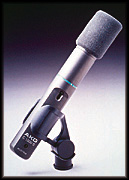
When I began my career as a sound designer at about the same time, I traded another musician my Sony condenser for an AKG D1200, simply for the reason that I knew AKG was a "premium" mic. That and the SM58 did most of my early work with 12-bit samplers, but when I was ready to move up to 16-bit machines, I knew I needed a higher quality mic, and considering the ruggedness and performance of the D1200, I decided on another AKG product, in this case a set of AKG C1000Ss. If you go and listen to samples in the Stratus Sounds library (released by Sweetwater, among others), you'll be hearing these particular AKG mics in the majority of the recordings.
I still have a number of beautiful recordings in my DAT library waiting to be digitized that were made using only the C1000s. I also did some live location recordings for musicians back in California, and the C1000s always produced a finished product that pleased the performers. At a list price of just $524, this is one great performer. It features both cardioid and hypercardioid operation and an effective 50Hz-20kHz frequency range. There's a compartment inside the mic that holds a nine-volt battery, so you can take this mic out into the field and not worry about having access to phantom power via a console. I can't even begin to tell you how much punishment these mics took over the years, yet they never once failed to deliver flawless performance.
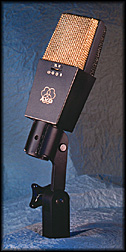
Fast forward a few years. A customer (who shall remain nameless, but he knows who he is) called to say how impressed he was with my samples and asked that I do some "custom" work for him. Offhandedly, he asked which mics I was using, and when I told him C1000s, he was amazed and asked how much better my samples might be if I were using, say, an AKG 414. My answer was something like, "probably better." The next day a FedEx delivery arrived at my door with a brand new AKG 414B-ULS inside ($1249 list in case you're wondering). Naturally, I was floored. Even more importantly, I was ecstatic when I began using it. The frequency response is near ruler flat from 20Hz-20kHz, it has four polar patterns, a two-position bass rolloff switch and built-in -10 and -20dB pads.
This meant I had to buy a second 414 - hey, everyone should have this problem - from Sweetwater, of course and they were thorough enough to look through their entire stock and find the one 414 that most closely matched mine so that I'd effectively have a matched pair.
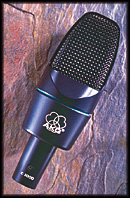
About a year later, my studio load increased and I had to buy an additional mic. Unable to afford yet another 414, my Sweetwater sales engineer suggested an AKG C3000, a model which had just been released. At $749 (retail, of course) it was reasonably priced and had features and performance that came quite close to that of the 414. In fact, I never once made a recording with this mic where I wished I'd had one more 414 - yes, the mic is that good, plus its internal elastic suspension pretty much eliminates the need for an external shock mount.
Not too long ago, I got an assignment from an audio magazine to review some new mics. One was the AKG 414B/TLII ($1675 list). This mic was specifically designed to faithfully capture the legendary sound of the original AKG C12 (which, if you can find one, will set you back more than a few bucks). Frankly, being an AKG fan already, I had nothing but praise for this mic. It's transformerless, so you get super powerful distortion-free low end reproduction, plus that much sought-after vintage sound. To my ears it may not be quite as accurate as the 414B-ULS (there's an acoustically-induced frequency response rise between 3kHz and about 5kHz), but it sure has a beautiful open sound that I immediately found to be pleasing to my ears.

One day I hope to own an AKG C12VR Tube microphone (don't we all?), though admittedly, givem its $4540 list price, I'll have to sell a lot of samples first. But I've heard this mic on some recordings done in the Sweetwater studios and all I can say is..."spectacular!"
Most recently, some friends of mine that I'd helped with an album project needed some dependable mics for club work. I immediately suggested the new AKG Emotion series (prices start at $120 list for the model D770), and I'm happy to report that they're absolutely thrilled at the sound they get from these mics (they purchased the model D880s). More importantly, they don't have to treat them with kid gloves. They've taken a fair beating the last few months or so and keep coming back for more.
So before you choose any mic, take a close look at AKG's full line. Call your Sweetwater sales engineer and together the two of you can decide if one of these fine microphones will meet your specific needs.
- Jim Miller
MASTER INDEX | SWEET NOTES INDEX | HOME | BACK | NEXT