

To hear some manufacturers talk, you'd think that tape-based digital recording is going the way of the dinosaur. Of course, they said that about analog synths, too, and look what happened. While hard disk (or non-linear) multitrack recorders are certainly gaining in popularity, tape-based recorders are going to be around for quite a while. One indicator of the format's longevity is the fact that a major manufacturer like TASCAM is actually introducing brand new tape-based recorders.
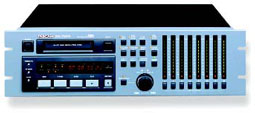 Case in point: The new 24-bit DA-78HR ($3199 list). TASCAM's new ASIC IC (Application Specified Integrated Circuit), which provides vastly improved modulation and error correction code algorithms, enables this outstanding recorder to write 24-bit data to standard DTRS format tapes without increasing either the tape or drum speed. The DA-78HR's proprietary ASIC IC utilizes a revolutionary data modulation system whereby 24-bit word lengths are accommodated without sacrificing error code correction as employed in TASCAM's tried and true ATF (Auto Track Finding) system. ATF is the means by which tapes can be transported between machines with full assurance of playback and record compatibility. Additionally, the size of the tape's subcode area has been expanded, ensuring even greater compatibility between machines.
The new ASIC IC incorporates the data modulation algorithms for both 24- and (to assure backward compatibility) 16-bit DTRS recording and playback. While TASCAM's 24-bit algorithm is the first of its kind integrated into a tape-based recorder; the 16-bit modulation algorithm has also undergone important revisions. Regardless of whether the digital audio on tape constitutes 16- or 24-bit word lengths, the DA-78HR assures you the finest audio possible.
The DA-78HR provides full record and playback compatibility with all DA-98/88/38 16-bit digital audio tapes – at either the 44.1kHz or 48kHz sampling frequencies. In High-Resolution mode, the unit will record and play back all eight tracks with full 24-bit resolution at either the 44.1kHz or 48kHz sampling rates. As 24-bit digital audio becomes the new standard for music, audio post, and multimedia production, TASCAM's DA-78HR provides the artist or audio professional the opportunity to capture performances with pristine sound quality and ensures the best sonic results at mixdown. Up to 16 units can be stacked with sample-accurate lock.
To facilitate the ultimate in creative flexibility, the DA-78HR features an integrated 8x2 MIDI-compatible mixer that provides volume and pan control over all eight tracks – enabling DA-78HR owners to create a reference mix with surprising ease. With its "read before write" capability, mixes can be routed to two tracks on the existing tape (see below for more on this) or via S/PDIF to any external digital recorder such as DAT. For added convenience, the recorder's MIDI interface allows the unit to be controlled remotely – enabling the home, project, or commercial facility to access the DA-78HR's numerous features via a MIDI sequencer or other MIDI-compatible controller. The DA-78HR includes 24-bit A/D and D/A converters capable of delivering a dynamic range of >104dB and a frequency response of 20Hz - 20kHz ± 0.5dB. You can record 1 hour and 48 minutes on a single 120 tape. An onboard SMPTE synchronizer allows you to chase or generate Time Code, and there's also onboard support for MIDI Machine Control. Word Sync In/Out/Thru is standard.
Owners of existing 16-bit TASCAM recorders will like the fact that you can totally interchange any TASCAM DTRS machine in the system, and they will all lock together. In fact, you could run a DA-78HR, DA-98, DA-88, and a DA-38 all in the same system simultaneously without a hitch. So, if you've got a couple of 16-bit DTRS machines, you can expand your system with 24-bit machines like the DA-78HR and the forthcoming DA-98HR, which can read and write 16-bit DTRS as well as 24-bit. This means any tapes recorded on the 16-bit machines will work on 24-bit DTRS machines. If you record a session in 16-bit format on a 24-bit machine, that will work on a 16-bit DTRS machine. However, 24-bit DTRS tapes can only be recorded and played on 24-bit DTRS machines.
If you were paying attention earlier, you will recall that we stated that the DA-78HR can digitally bounce all 8 tracks down to two in stereo within the recorder itself. It would seem that would require 10 tracks, plus a digital mixer, right? Well, here's the explanation: First of all, the DA-78HR has a built in digital mixer. Each track output has a volume and pan control. The 8 channels are mixed down to stereo in the digital mixer. Now that you've got the mix, you need to get it down to tape. But wait all our tracks are full! Multitrack recorders always have to read information, then write. There is a slight delay between the two that is compensated for with a buffer. This is part of the normal process in recording so that the tracks you overdub will be in time with the tracks you are listening to. Since it reads and then writes, what if you have two tracks do both? We can read what was there previously, then overwrite the tracks with the new mixdown material.
When you do this, it is important to realize that you cannot go back you have overwritten what was there before. But, for static mixes it's a piece of cake. This is especially useful for the one machine studio. You can track bass, guitar, and 6 tracks of drums all together, then mixdown the drums to stereo afterwards. This is a great advantage over recording the submix, since it is tough to set up that mix when the drummer is playing right in front of you. So there you have it: 8 tracks bounced digitally in stereo to 2 tracks no extra gear required.
Want to know more about the 24-bit DA-78HR from TASCAM? Want one for your studio? Then call your Sweetwater Sales Engineer for all the information you need and (naturally) your special low Sweetwater price on a DA-78HR.