

Thinking about a digital mixer? I'm pretty sure you are if you don't already have one in your rig. Whether you're building a home studio from scratch, considering the replacement of an old analog mixer in your professional studio to allow for more efficiency, deciding on a mixer for a permanent install or needing something more powerful and portable for your live show, you already know the reasons to choose digital over analog. (You do, don't you?)
Your friends and colleagues have been mixing away on their digital boards, letting their creativity flow freely through every mix each one different, and created without fear of losing those perfect settings. They're no longer restricted by fixed signal paths, long and tangled cable runs or even more importantly, their own trepidation over being able to recreate a specific mix, let alone re-perform a dynamic mix in real time! These new tools of the trade are keeping alive the passion of each and every engineer and musician that use them, providing a comfort zone to work "outside of the box." Way out where the fun is.
All that freedom should be yours. This is a certainty. Now its time to decide on which digital mixer will best integrate into your music making environment. Some of your choices may only allow for recording to one MDM, or they might be limited to a reduced number of mic preamps
with inserts. Something is always missing from that mixer in your price range, am I right? Sure, it has the onboard effects, built-in dynamics and EQ, but there are never enough holes on the back to connect all the cool gear you've got (or will get) from Sweetwater. Each of your digital mixer choices will typically support the Alesis ADAT, Tascam TDIF, and AES/EBU digital formats, as well as a few extra analog I/Os, but it is my opinion that the Roland 7000-Series V-Mixing System addresses these real-world issues most elegantly and completely.
In typical Roland fashion, the company took into consideration all of the ways a digital mixer can be used and then developed a unique modular approach to providing you with exactly the features and expansion capabilities you need. Because the mixing control surfaces and I/O processors are separate devices, you can purchase just the parts of the mixer that fit your application. Let's take a look at the entire product lineup in the Roland 7000-Series V-Mixing System.
We'll start with the most familiar part of the system: The V-Mixing Consoles. There are two consoles to choose from. The VM-C7200 ($3695) is the larger control surface with 25 motorized 100mm faders, while the more narrow, 13 motorized 60mm flying fader equipped VM-C7100 ($2995), squeezes into a rack by using the optional RO-C7100 rack mount kit. The larger VM-C7200 can be made quite handsome for desktop use with the help from the VM-SP72 optional side panel kit.
Both consoles have a large, backlit LCD window displaying all the functionality and flexibility that the V-Mixing system offers, and I found the layout of control panel to be quick and very friendly to navigate. A meter bridge option, the MB-24, connects either to the V-Consoles or the V-Processors using MIDI.
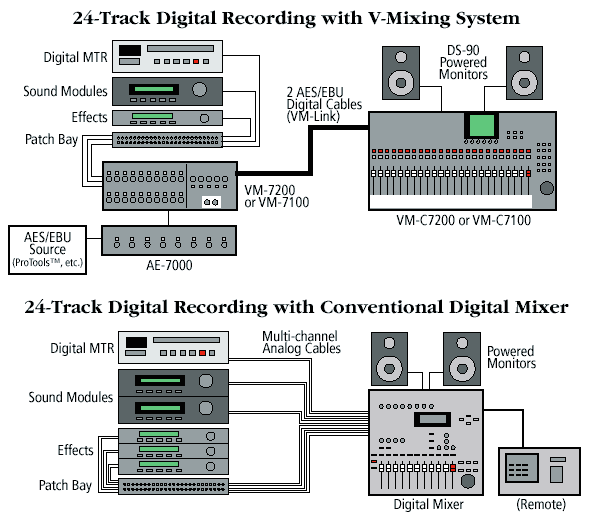
 Keep in mind that the V-Console's main function is to communicate control data with the V-Processors, the VM-7200 ($2795) and/or the VM-7100 ($1995). You might be interested to note that it is within these processors that the actual mixing takes place the VM-C7200 and VM-C7100 are the controllers for these powerful processors. In any event, this is where you'll find all the ins and outs and there's no shortage of ways to tie into the system with either unit. The beauty of this scheme is that only two standard AES/EBU digital cables are needed between the processor and the console. No more heavy, noisy and expensive analog snakes. The only audio that runs through the V-consoles are two channels for monitoring a stereo mix through two headphone jacks, a pair of RCA analog outs, and two coaxial digital outputs. Two 1/4 TRS inputs (on channels 23 and 24) can also be found on the console, as well as a Talkback/Slate mic XLR input with phantom power that uses channel 24 when activated.
Buried deep within the heart of each V-Processor are two onboard stereo multi-effects processors and one stereo master effects processor. The multi-effects are the sonic equivalent of the highly acclaimed Effects Expansion Board for the best-selling Roland VS-1680 Workstation, incorporating such unrivaled effects as high-end reverbs, delays, dynamics processing, COSM Guitar Amp modeling and sensational Mic Simulations for some totally awesome direct recording capabilities. Up to three optional VSF-2 Effects Expansion Boards can be user installed into the VM-7100/7200, yielding up to 16 stereo or 32 mono channels of awesome effects.
 As if that weren't enough, one of the standout VM-7000 Series effects is undoubtedly the new COSM-based Speaker Modeling. By carefully analyzing the response characteristics of a variety of high end reference monitors, Roland's engineers have graced the VM-7000 Series with the ability to convincingly "model" the sounds of these speakers when used in conjunction with the new Roland DS-90 Powered Monitors. This eliminates the hassle (and ridiculous expense) of switching between multiple pairs of monitors during mixdown to make sure that all your elements work perfectly no booming bass, no lost vocals, etc.
Of course, no matter how versatile a mixer may be, it's the sound that really matters most. Roland has always had a reputation for building fine-sounding equipment, and they may very well have outdone themselves in that department with the V-Mixing System. It's clean, quiet and dead-on accurate. In fact, the audio is so good that it's like you're hearing the original signal no more, no less. No subtle coloration or unusual peaks and dips across the full frequency range. This is the kind of superb sound that used to cost more than your average family car!
Now back to all of those ins and outs housed in the processors. The VM-7200 has 20 mic/line inputs with phantom power, 12 of them have inserts, while the VM-7100 sports 10 mic/line inputs, 6 of them with inserts. Each processor has 8 assignable outs, 1/4" phone balanced/unbalanced that output the same sounds as those output from MULTI OUT 17-24 The entire system employs superb 24-bit A/D and D/A converters and can be expanded with the addition of a VM24-E ($395 list) which is actually three of Roland's Digital multi in/out R-Bus (RMDB2) connectors.
At this point, let's put together a 700 Series V-Mixing system in four simple steps:
- Step One: Choose the control surface or console you wish to use, either the VM-C7200 Console with 25 motorized faders or the VM-7100 Console with 13 motorized faders. You can add an MB-24 meter bridge to either, and the C7100 can be outfitted with a rack mount kit.
- Step Two: How many XLR or analog inputs do you need. The VM-7100 offers 10 inputs, while the VM-7200 offers 20. If you wish to stack multiple processors, you can add a VM-7100 to a VM-7200 for 30 inputs, or combine two 7200s for 40 inputs. In either case, you'll need the VM-24C Cascade kit. If you want to rackmount the processors, you'll need one RO-7000 Rack Adapter for each processor. Simple so far, right?
- Step Three: Here you need to decide how many additional stereo effects you want, keeping in mind that each processor can hold up to three VS8F-2 boards. These effects would be over and above what ships with each unit.
- Step Four: How do you want your V-Mixing System to interface with other devices? You can start with a VM-24E I/O Expansion Board for each processor, each of which provides three R-BUS connections. From there, each R-BUS port can be connected to any of the R-BUS options in any combination. These include the hot new VSR-880 Digital Multitrack (now rackmount your VS Recorder!), the DIF-AT Interface for Alesis ADATs and TASCAM multitracks, the ADA-7000 8-channel bi-directional A/D and D/A converter and the AE-7000 with 8 channels of AES/EBU conversion.
 |
 |
| 24-Track V-Mixing System Chart | PA V-Mixing Sytem Chart |
Confused? Don't be. It may seem a bit overwhelming at first glance, but the entire system is so versatile and so totally user-configurable that it sometimes seems a bit much in black and white. Aha! Here's where your Sweetwater Sales Engineer comes in to explain everything! See how nicely it all ties together now? What's more, he or she will be happy to give you your special Sweetwater pricing on the V-Mixing System that's perfect for your applications. So give us a call now!
Robert Dorion