

 When it comes to guitar amps, a lot of guitarists I’ve met over the years are a lot like me and my car — I (allegedly) know how to drive it, fuel it, and keep the tire pressure right (when I remember), and that’s about it. Similarly, like a lot of my fellow 6-stringers, for many years I knew how to set up my backline, switch it on, dial it in, and that was it. Sure, I knew it had tubes in it, but I didn’t know where they were in the circuit, why they were there, or what they actually did. I just knew that they got really hot but helped make the amp sound really cool. Ditto the controls, to a large degree — sure, I knew what they did, but not how they did it, or where they sat in the signal path.
If you’re in the same boat I was, this series of articles will hopefully right that wrong. And don’t fret (horrible, 100% intentional pun). I’m not going to get even close to technical — because I can’t! The plan here is merely to help you generally understand how guitar amps work from a layman’s point of view — “guitarist-friendly,” if you will. It won’t make you the next Dave Friedman or Alexander “Howard” Dumble, that’s for sure.
We’ll begin this adventure with —
The Basic Anatomy of a Guitar Amp
 In a nutshell, there are three basic types of guitar amp setups (a.k.a. backline):
- A stack or half stack — or a wall of them!
- A combo — or three
- A rack system — compact and simple, or something the size of a refrigerator that looks like it belongs on Star Trek!
Regardless of which of the trio is being used, there are three basic but essential components to each, and those are:
- Preamp
- Power amp
- Speaker(s) or cabinet(s)
What Does What?
Preamp
The preamp is responsible for taking the relatively puny signal from an electric guitar, adding muscle to it, and determining both how clean, crunchy, or highly overdriven it is and its basic tonality — read: Bass, Middle, and Treble. In effect, it can be likened to a basic body-shaping gym that zones in on certain areas and adds muscle and/or bulk — but nowhere near enough strength for the signal to be able to move a speaker or set of speakers.
Here’s a pictorial synopsis:

Make sense? The body above on the right is shaped and bulked compared to the wimp on the left! It’s impressive, but as already mentioned, not strong enough to drive speakers — yet!
Power Amp
The power amp can be likened to an Arnold Schwarzenegger–approved, steroid-injecting gym!! It takes the post preamp signal and beefs the heck out of it so it can move one, two, four, or even eight speakers.
Here’s another pair of pictures to illustrate this point:
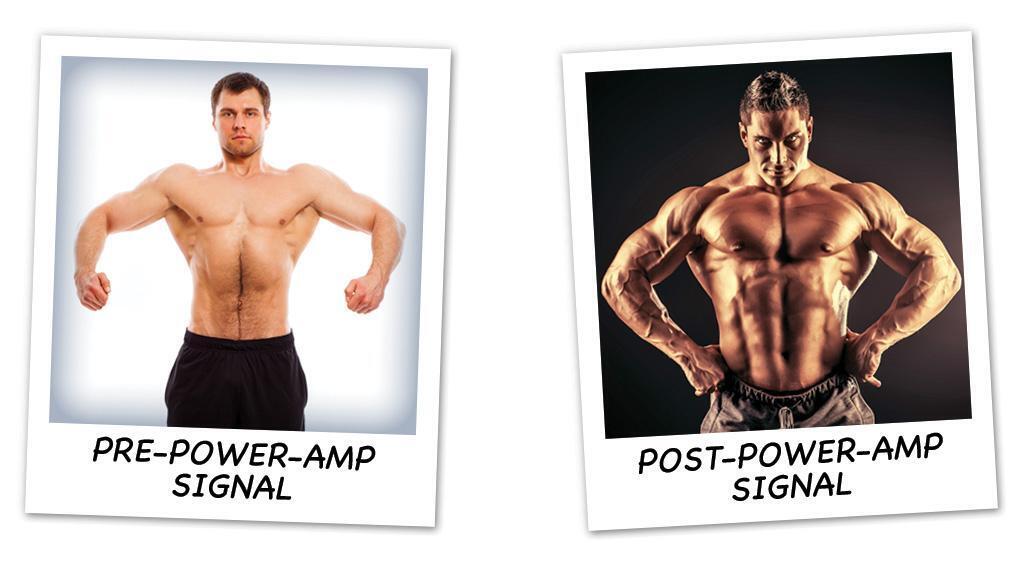
Make sense? Definitely enough brute force to move speakers — as hard as you like!!
Cabinet/Speaker
The Cabinet(s) and Speaker(s) are there to move air and make the guitarist’s tone dreams an audible, and often loud, sonic reality.
So the three basic blocks, in signal-chain order, are:
Preamp -> Power Amp -> Speaker(s) or Cabinet(s)
A stack or half stack consists of an amplifier head and cabinets or cabinet, respectively. The head contains the preamp and power amp blocks; the cabinets hold the speakers.
A combo is exactly what its name implies — a combination of all three — preamp + power amp + speaker(s).
Lastly, a rack system is comprised of separate components for all three blocks — namely a preamp, a power amp, and cabinet(s).
 To close, I’d just like to leave you with this thought. In a good guitar amplification system, although the preamp does the initial shaping, both the power amp and the speakers and cabinet also add (oft-times considerably) to the all-important resulting tone.
I’m sure you’ve heard of hi-fi (a much-used abbreviation for high-fidelity). Well, in a nutshell, good (and bad!) guitar amps and cabinets are the audiophile’s worst nightmare, as they don’t merely magnify a signal — they shape the sucker and often add musically desirable distortion and compression. Plus, when distortion is summoned, they add a bunch of noise and hiss too. Yep, guitar amps are lo-fi, my friend — and gloriously so.
What’s Coming Next?
How do guitar amps do what they do? Here’s an idea of the topics we’ll be covering in upcoming installments:
- Guitar amplification anatomy
- Preamps
- Gain and master volume
- Tubes (valves)
- FX loops (series and parallel)
- Phase inverters
- Rectifiers
- Power amps
- Class A vs. Class AB
- Pentode vs. triode
- Transformers (not the ones sold at toy stores)
- Negative feedback. Presence and deep/resonance controls
- Speakers
- Cabinet size
- Cabinet construction
- The relationship between a good guitar power amp and the speakers it drives
- The mojo of handwired
- Solid-state amps
- Hybrid amps
- Digital amps
So stay tuned.
– Nick Bowcott
For more tips on electric guitar amps, check out the other articles in this series from Nick Bowcott.